
Players in the art market – behind the scenes of the artistic scene
Julia Niżnik
Certainly, for many novice investors, the art market is primarily associated with a contemplative artist creating innovative works in the seclusion of their studio and the fervor of creative inspiration. However, the visual arts scene is not merely the monologue of an individual artist; it also encompasses other institutions serving as experts. These include art galleries, auction houses, museums, art dealers, curators, art fairs, and even corporations and banks assembling their collections.
In literature, they are referred to as gatekeepers or intermediaries and are seen as mediators in the art market between the artist and other entities. With specialized knowledge, they contribute to reducing information asymmetry and provide multifaceted services in the sector. Moreover, they add social, cultural, and financial value to the entire artistic scene, especially the contemporary one. The quantity and quality of these institutions also have an impact on the size of the demand and supply of artworks. This aligns with the concept of the economics of singularity, which, unlike neoclassical theory, creates value with the support of institutional backing such as auction houses, galleries, art critics, and reviewers. It's also worth mentioning that the art market can be divided into the primary market (new objects for sale) and the secondary market (resale).
Polish art scene in numbers
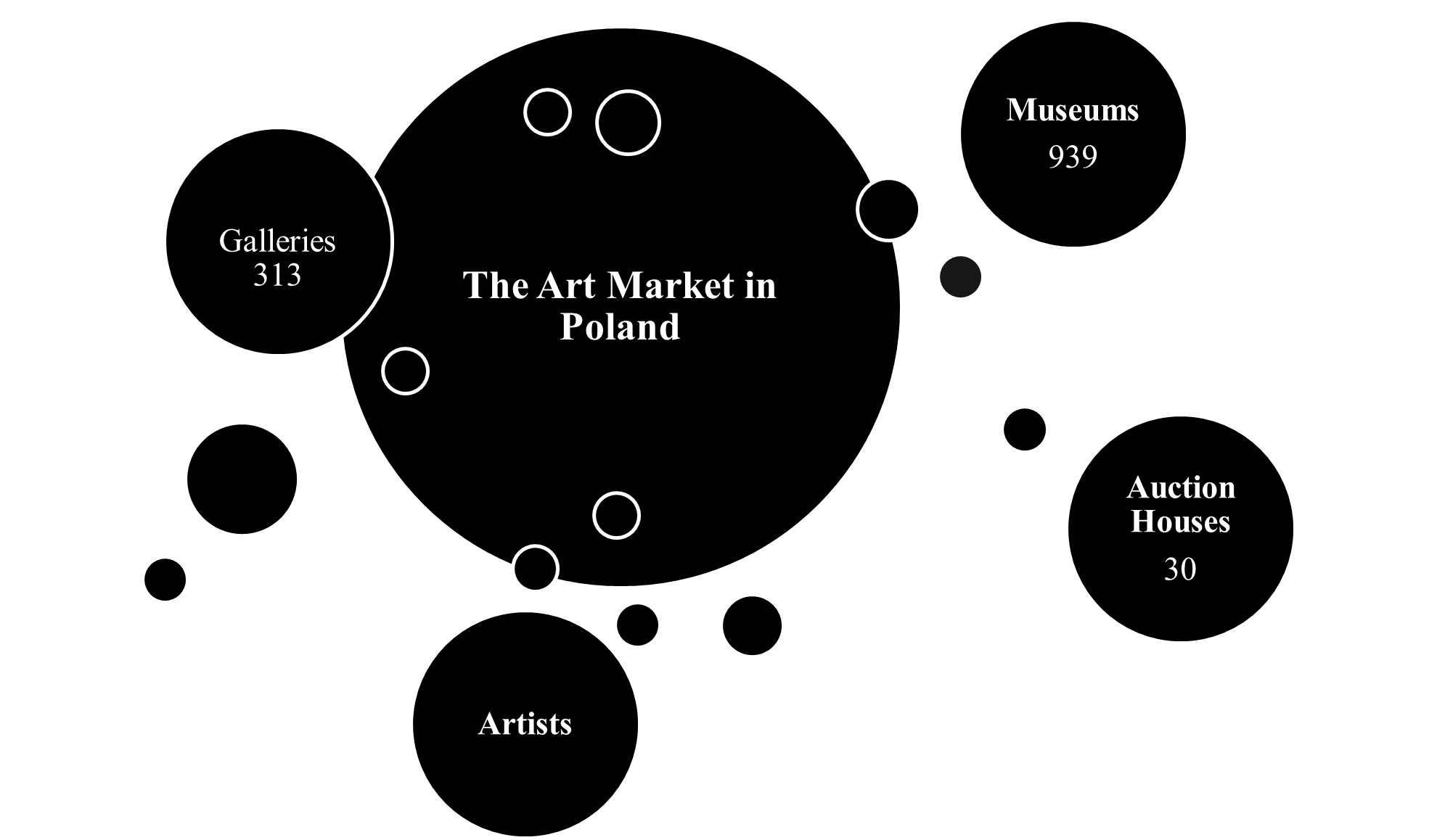
The Polish art market has developed with incredible dynamism over the last three decades in terms of the quality and quantity of institutions, offered services, and transactions. According to 2022 data from the Central Statistical Office (GUS), there are a total of 313 art galleries in Poland, with 63% belonging to the public sector, and 939 museums (including their branches), with over 70% in state hands . Additionally, art fairs are organized annually in Warsaw, with biennials occurring every few years . Since 2011, the capital has hosted the largest showcase of new art in Central and Eastern Europe-Warsaw Gallery Weekend. Over the last 30 years, there has been significant growth in the number of auctions and revenues generated, as well as exhibition activities. In 1990, fewer than 50 auctions were conducted, while in 2021, there were almost 600. Furthermore, from 2017 to 2022, the growth dynamics of sales in the auction market exceeded 17% annually. This has resulted in Desa Unicum – a leader in the Polish market for several years – ranking among the top ten best auction houses in Europe.
Why engage in transactions at an auction house?
Auction houses are cultural institutions equipped with a broad range of experts. Thanks to their knowledge, experience, and institutional connections, they are considered certified specialists in the field. For potential investors, this is essential for evaluating the authenticity and quality of acquired artworks. Established auction houses often have access to high-quality artworks and a diverse range of selection, ensuring the highest transaction security and transparency . Auction results are public and available to a wide audience, unlike transactions in the gallery market. Moreover, the development of new technologies has enabled them to introduce new activities that promote cultural events through various platforms and offer new services for consumers, such as online auctions. Information provided in auction catalogs is standardized, reporting the auction date, the name of the artist, the estimated price, and essential characteristics of the artwork. This makes the market more transparent, providing investors with more information. Selling artwork through an auction house is also profitable from an investor's perspective. Selling your work with an auction house, especially one with an established market position, not only enhances prestige and transaction security but also increases access to a larger pool of potential buyers. The proverbial "icing on the cake" is the provision of professional advisory services regarding art investments. As market experts, they offer assistance not only in the buying and selling process but also in other legal, logistical, and conservation-related formalities. Additionally, some auction houses have started to broaden their educational and social missions. Desa Unicum, the largest private cultural institution in Poland, invites visitors to over 100 free and open-to-the-public exhibitions in 2023 alone. Pre-auction exhibitions are often accompanied by other initiatives related to art exhibitions, such as guided tours, meetings, panel discussions, or special projects. These activities enable visitors not only to admire collector's gems, often held in private collections until now but also to receive valuable information about emerging trends in the art market.
References:
Artinfo.pl (2021). Raport Artinfo.pl 2021
Central Statistical Office GUS (2022). Kultura i dziedzictwo narodowe w 2021, Warszawa/Kraków
Lucińska, A. (2021). Obrazy na rynku finansowym. Analiza efektywności inwestowania. Difin.
The content of this publication is for informational and educational purposes only. Before each investment, one should individually assess the benefits and risks associated with the planned transaction. Before making any decisions, consider (for example, with the assistance of a financial advisor) whether the transactions are suitable in light of the interested party's specific needs and financial situation, the adequacy of investing in any assets, or the application of any investment strategies.
The information presented is based on the authors' current knowledge at the time of publication and may become outdated. It also does not constitute a guarantee that the art market will maintain its previous trends in the future. Trading in works of art is always associated with a series of risks that should be individually considered before making a transaction. No information contained in the publication constitutes investment advice or any opinion regarding the suitability of any securities, and the opinions expressed on this page should not be treated as advice regarding the purchase, sale, or possession of any securities. DESA Unicum and the author of the publication are not responsible for the decisions made by recipients of the published content, which always remain the individual choice of the parties involved in potential transactions.
Investing always carries the risk of loss, and those interested in art market transactions should seek professional financial or legal advice.