
Characteristics of artworks in the investment market
Julia Niżnik
How to eat a cookie and have a cookie?
Works of art are economic goods, both luxurious and investment-worthy. This combination is rarely found in any other industry or sector. As Clare McAndrew from Trinity College in Dublin states, from an economic perspective, works of art have a specific dual nature.
On one hand, they are consumable goods, which are "consumed" when the human eye comes into contact with the work and throughout the period of ownership. If consumed properly, that is, stored in safe conditions, they are also capital goods that can generate profits from investment as their value increases over the years. This duality provides an advantage over other investments because an investor's eyes can "consume," and the value of the owned artwork, in most cases, does not decrease but rather increases. Since artworks are tangible investments, it's also worth mentioning the costs of their acquisition and maintenance. Considering that the average time between auctioning the work is several decades, the effect of transaction costs, including the seller's and buyer's bonuses, if amortized over this period, amounts to less than 1% per year. In comparison, the annual cost of managing investment funds is 1.5% (Mei & Moses, 2005). Furthermore, it should be noted that during ownership, artwork can be lent to various institutions, both for a fee and free of charge, which usually enhances their prestige, influences their valuation, and can generate additional cash flows and profits.
3D Market
In the characteristics of alternative assets, especially artworks, there is often talk of so-called low liquidity, which determines how quickly a particular asset can be converted into cash. However, this may seem erroneous on one hand because the main measure of this liquidity is the number of paintings by a given artist (or an entire art movement or segment) sold in a calendar year. As Lucińska (2021) points out, owners of paintings are reluctant to part with them, continually expanding their collections. Moreover, in the art market, there are investors who do not aim to maximize profit, as they are art enthusiasts or museums that buy artworks due to their cultural significance. As a result, artworks are trapped in collections, and one of the circumstances for purchasing a painting is one of the 3D events (death, debt, divorce).
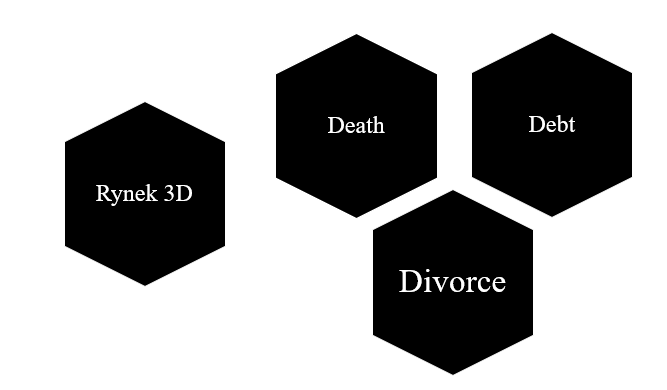
In the case of death, after the collector's demise, their heirs sell the estate along with the entire collection. It also happens that collectors go bankrupt and are forced to sell their collections to settle their debts - debt. The third situation is divorce, where the sale of the collection is the result of the need to divide the assets.
Art investments are long-term, so they do not guarantee immediate returns. However, as studies in the contemporary painting segment have shown, artworks have the lowest correlation with external socio-economic factors, which results in the continuous growth of the value of these assets over time, even when there are disruptions in the financial market.
References:
Findlay, M. (2012). The value of art. E-Books der Verlagsgruppe Random House GmbH.
Lucińska, A. (2021). Obrazy na rynku finansowym. Analiza efektywności inwestowania. Difin.
Mei, J., & Moses, M. (2005). Beautiful asset: Art as investment. Journal of Investment Consulting, 7(2), 45-51.
The content of this publication is for informational and educational purposes only. Before each investment, one should individually assess the benefits and risks associated with the planned transaction. Before making any decisions, consider (for example, with the assistance of a financial advisor) whether the transactions are suitable in light of the interested party's specific needs and financial situation, the adequacy of investing in any assets, or the application of any investment strategies.
The information presented is based on the authors' current knowledge at the time of publication and may become outdated. It also does not constitute a guarantee that the art market will maintain its previous trends in the future. Trading in works of art is always associated with a series of risks that should be individually considered before making a transaction. No information contained in the publication constitutes investment advice or any opinion regarding the suitability of any securities, and the opinions expressed on this page should not be treated as advice regarding the purchase, sale, or possession of any securities. DESA Unicum and the author of the publication are not responsible for the decisions made by recipients of the published content, which always remain the individual choice of the parties involved in potential transactions.
Investing always carries the risk of loss, and those interested in art market transactions should seek professional financial or legal advice.