
The return of an iconic work in the form of A non-fungible token
The artist is an icon of the 1980s. He belongs to the first generation of artists who openly rebelled against totalitarianism. He was the founder of the legendary Gruppa collective, considered the most important artistic formation in the communist period. His paintings, created before the democratic transition, are a testimony to the Polish pursuit of freedom. Although these expressive works did not avoid irony, they also constitute a record of Poles' traumatic experiences that resulted from the regime's repressions. Now, his work, irreversibly damaged in its physical dimension, returns in the form of the indestructible and non-replicable NFT (non-fungible token). The art of Paweł Kowalewski, as he is the artist in question, once again breaks boundaries.
It was an unfortunate incident that destroyed the painting "'Why There is Something Rather than Nothing". His workshop was flooded in 1997. Together with the aforementioned work, other paintings were destroyed, such as "I am Up, You are Down", "Between Hell and Heaven", "Maneuvers of the Red Army 1918" and "A Furious Red Dog Guarding against a Green Background". Fortunately, they were preserved in a digital form, although they do not exist physically. As a result, today we can bring back one of these paintings and, more importantly, secure its place in Polish culture.
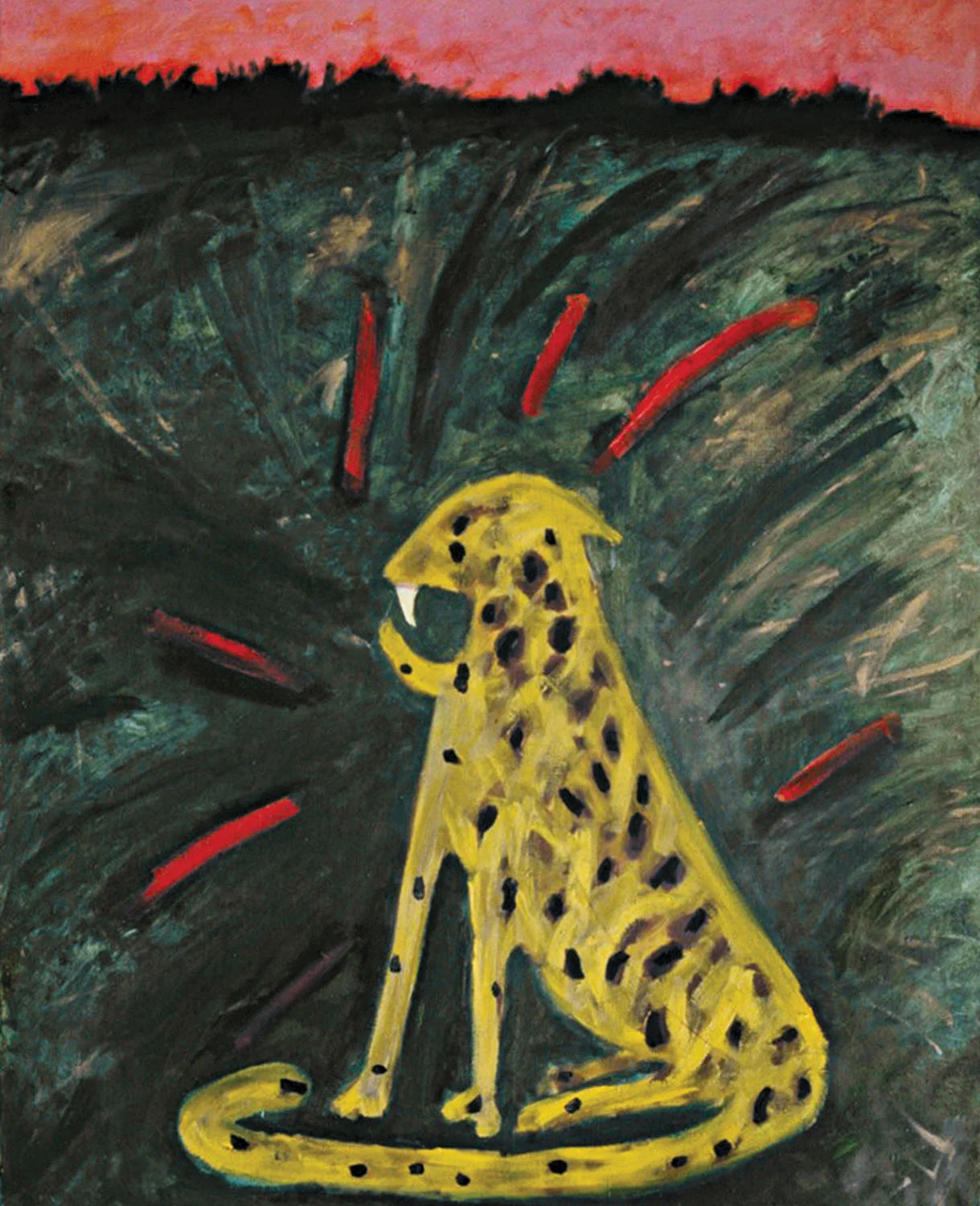
Paweł Kowalewski graduated from the Academy of Fine Arts in Warsaw. He obtained his diploma in the studio of a famous painter, Stefan Gierowski. A year earlier, in 1982, the Gruppa collective was founded. An eminent critic, Ada Rottenberg, wrote in 1984,
“They are not burdened by the past. They are not concerned with disputes over the language of art or disputes over the avant-garde - this is a concern of the older generation. They do not have to contradict themselves or prove themselves, they do not continue anything, and they don't break with anything. They are unfamiliar with the tragedy of self-embezzlement which we experienced too many times after December 13th. They are strangers to bare repentance. They appear like children, baptized by History, which saved them from the purgatory just before the Judgement Day. Therefore, they have a certain privilege unattainable for others. They can be true to themselves, they can keep up with their own life force, and even turn it into a program."
What seduced the audience was this life force and breaking with the past. The uncompromising language of rebellion was accompanied by suggestive figuration. It was a rebellion not only against the academicism and post-avant-garde movements in Polish art of that time but also against the censorship and repressions imposed by the martial law, the reality of communist Poland, which young Kowalewski perceived as absurd and grotesque.

Paweł Kowalewski made use of literary references, as well as patriotic and historical themes. He often referred to existential issues and threads related to everyday life. It constituted the "personal art, that is private" concept. As part of this assumption, Kowalewski looks for inspiration in his own life and at the same time puts the viewer in a universal context. Consequently, the painter oscillates between the experience of individuality and commonness.