
Happiness Full of Shine
Władysław Hasior's work "Happiness Full of Shine" from 1985 was undoubtedly a real gem in Maria and Ryszard Radwiłowicz's monothematic collection, which dates back to 1973. The professors collected works mainly from the field of Naïve art depicting Adam and Eve. The Radwiłowicz family believed that this theme is an archetype of first parents, the source, and the pre-beginning of life. Hasior also sought originality and universal values in art, as testified by his works, which frequently made use of four elements and pristine materials such as wood or stone, with their symbolism being close to all people and civilizations. Referred to as an artist-mediator between high and low art, Hasior was eager to draw inspiration from folk art, which he perceived as authentic, true, and having pure intentions.
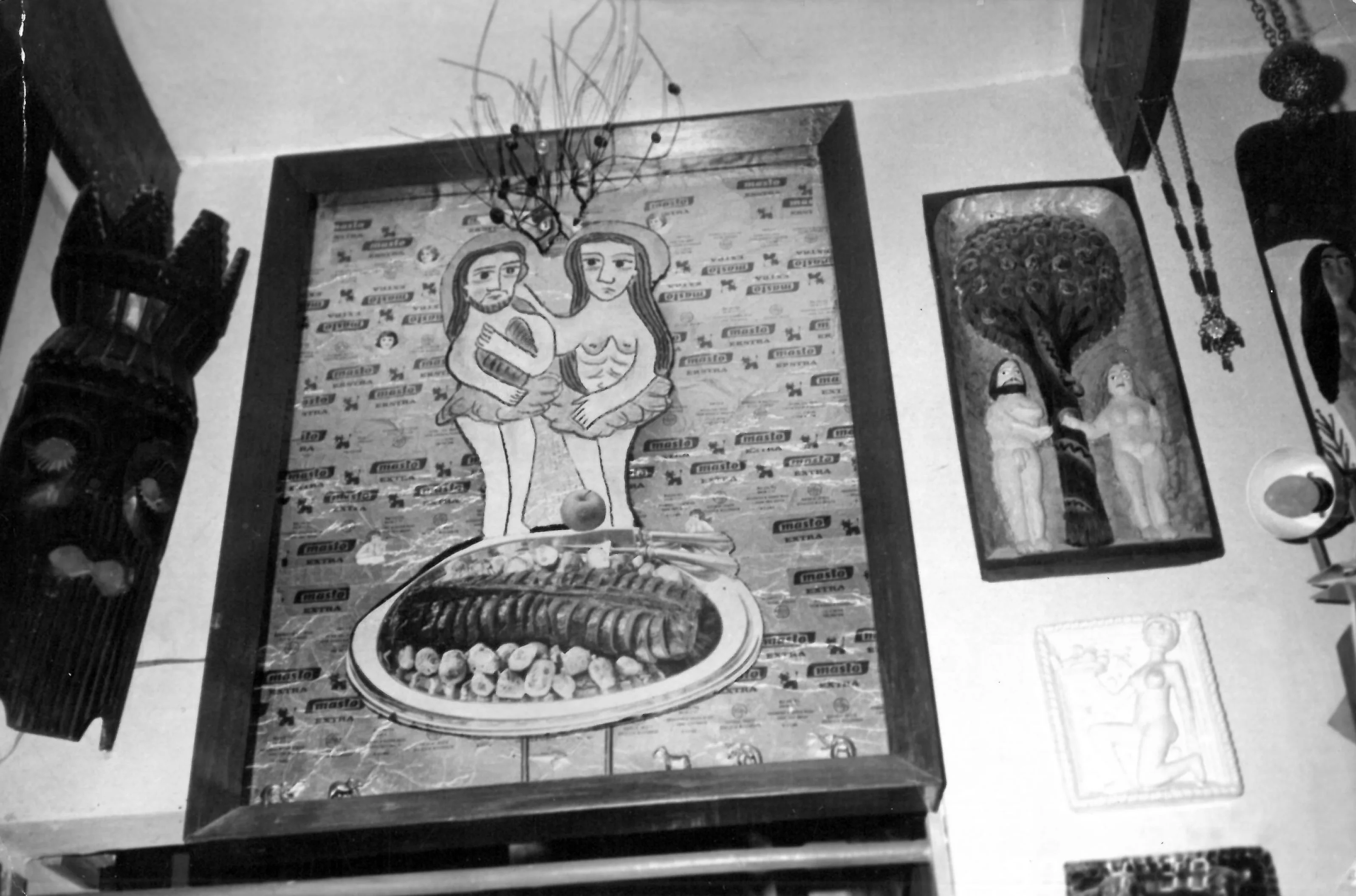
No wonder that the owners of this peculiar collection wanted to order an assemblage from the widely recognized Władysław Hasior, who at that time had already had numerous solo exhibitions in Poland and abroad. In the same year as finishing "Happiness Full of Shine'', the Tatra Museum inaugurated the Władysław Hasior Gallery and Art Exhibitions Office in Gorzów Wielkopolski opened a permanent exhibition of his works. The Radwiłowicz family was probably inspired by his work "Paradise III'' from 1982 (currently in the collection of the Municipal Art Center in Gorzów Wielkopolski), which they saw at the exhibition "Hasior and Kuskowski in the Old Synagogue in Nowy Sącz'' in 1983. The work presented figures of the first parents drawn with crayons and maintained in flat, muted colors, framed in thick contours. "Happiness Full of Shine" displays the very same representation just with one slight modification. In both drawings, Adam and Eve's lower parts of the body are covered by clouds, Adam presses two loaves of bread to his breast, and Eve stretches out her right hand with an apple towards him. The characters from the Radwiłowicz collection are closer to each other, they almost overlap. which makes the forbidden fruit invisible. The symbol of original sin is at Eve's feet, just above the plate with roast and Brussels sprouts. The green apple, however, was not painted with a crayon like Adam and Eve, it looked like it was cut out of the newspaper and glued to the composition, similar to the exquisite dish below. Is it thereby a symbol of disobedience of the first people to God, or just an element of the dish? Or maybe the artist wanted to point out how inconspicuous sin can be?
It is also worth paying attention to the techniques used in the assemblage. The cut-out silhouettes of Adam and Eve and the lavish dish were attached to the surface covered with used butter packaging and stickers presenting the heads of Raphael's angels. Wires imitating tree branches pop out from behind the figures. The trees are decorated with colorful buttons and wooden painted birds. The whole, quite motley composition consists of various everyday waste. In his work, Hasior uses the language of kitsch, which reveals the hardships and poverty of communist Poland. Instead of a gilded background, he uses crumpled silver butter packaging, instead of real food – only a photo of a dish. The wire, bare tree branches are decorated with buttons and birds. It is one of his works, which "manifests tenderness for poor people's helpless longing to see beauty" (H. Kirchner, "O Hasiorze – po latach" [In:] "Władysław Hasior: Europejski Rauschenberg?", [ed.] J. Chrobak, Muzeum Sztuki Współczesnej w Krakowie, 2014, p. 26). Nevertheless, the composition is full of colors and emanates childlike joy in contrast to many other grim and gruesome assemblages made by Hasior. The artist featured wooden, painted birds taken from folk art in many of his other works. They usually symbolize the joy and innocence of life.
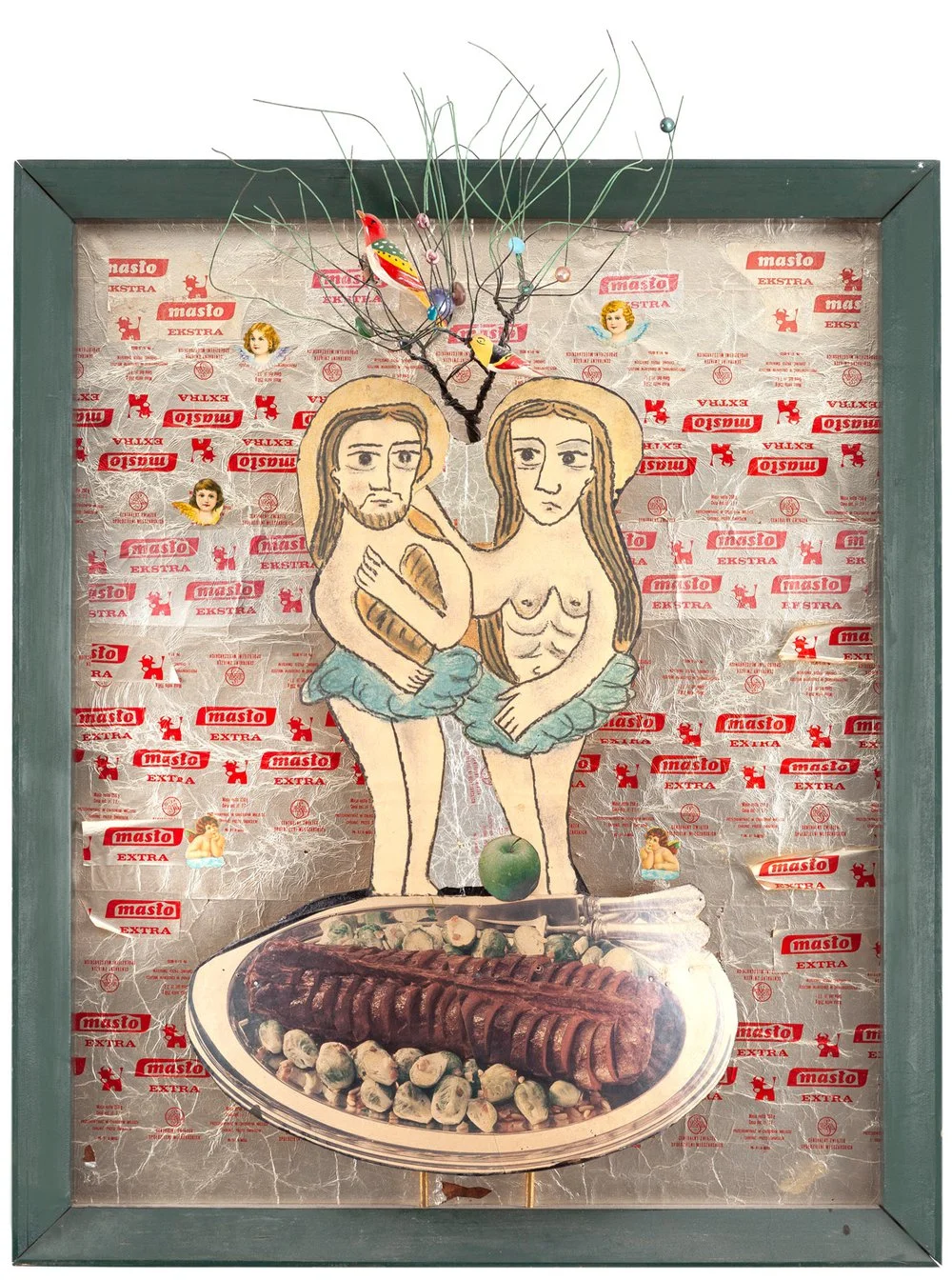
In the above-mentioned publication, Hanna Kirchner described Hasior's inspiration with folk art as follows, "Hasior's works are a reflection of countryside, culture, folk and plebeian aesthetics, tawdriness, as well as folk religious devotion and its symbols. He draws inspiration from these motifs for many reasons. Firstly, it stems from his biography, it is his cultural circle, the spiritual origins of the people who "entered the cities", inhabited and populated them. In this context, he can see eye to eye with the recipient. Secondly, he perceives folk art as an inexhaustible source of imagination. When he created the multi-colored spatial composition for Szczecin – the fantastic birds on bicycles, full of paradoxes, the idea of flight brought to earth, he referred to folk sculptors who generously color their wooden birds, compensating us for the lack of such creatures in the north." The work "Happiness Full of Shine'' seems to counterbalance the everyday dullness and hardship of communist Poland in the 1980s.
See more
See more