
Wojciech Kossak conquers America
"Successes of Wojciech Kossak in America [...], who returned to New York from San Francisco, where he achieved artistic triumphs. Tremendous success in California. A series of commissions awaits him in Los Angeles and Francisco."
"Świat," 1927, no. 15, cited in: Kazimierz Olszański, Wojciech Kossak, Wrocław 1990, pp. 36-7
Wojciech Kossak first traveled to the United States in September 1920. He went there as a diplomatic courier for the Polish government, but at the same time, he was looking for lucrative new commissions for his paintings. "I'm going, Maniusia, with a sincere intention to quickly make a fortune and come back healthy," he wrote to his wife from the train to France, from where the ship "Philadelphia" was departing for the New World (Wojciech Kossak, Listy do żony i przyjaciół [1883-1942], vol. I, edited by Kazimierz Olszański, Kraków 1985, p. 225). He arrived in New York after nine days, on September 27, where he was greeted by Secretary Modrakowski. The painter quickly arranged for a studio, as "how can one not only paint in a small hotel room, but also entertain billionaires and set up small paintings on chairs?" (Wojciech Kossak, op. cit., p. 237). Fully aware of his reputation not only in Poland but also in Polish-American circles, Kossak immediately set about accepting commissions from wealthy clientele. He firmly decided that he would set high prices; otherwise, his trip would not be profitable.
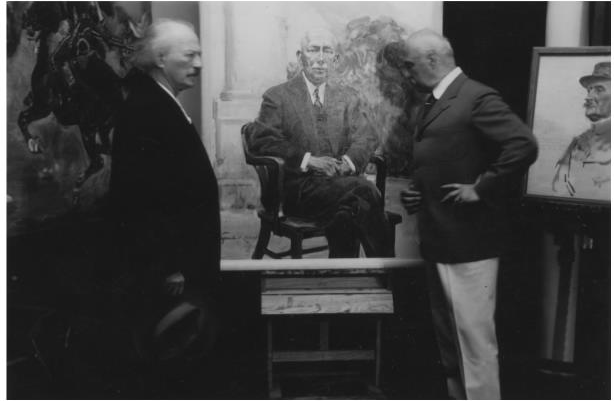
With the help of the painter Wojciech Benda, nephew of Helena Modrzejewska, he soon found a studio worthy of his name: splendidly furnished, with service, heating, light, a bathroom, a bedroom, and a gas stove. This studio was located at the Hotel des Artistes at 1 West 67th Street. He soon moved in, giving up his hotel room. He came to the United States with a stack of letters of recommendation to prominent Americans, but before inviting them to his studio, he wanted to fill it with his paintings. He began with commissions from his compatriots, whose enthusiasm was aroused by his arrival. "Polonia greets me like the Messiah," he wrote to his wife on October 2 (Wojciech Kossak, op. cit. p. 237). The Polish American community then established the "Kossak Art Society" foundation, whose purpose was to buy and sell his paintings, and the funds raised were to be used to help Polish artists in America. Among the admirers of Wojciech Kossak's work was Ignacy Paderewski himself. The artist received numerous invitations to dinners and receptions from his compatriots, which he sometimes had to decline to have time to paint. During his first visit to North America, he visited New York, Washington, Detroit, Chicago, Buffalo, and Pittsburgh and created about twenty paintings depicting Polish heroes in the struggles for the independence of the United States: Tadeusz Kościuszko, Kazimierz Pułaski, as well as equestrian portraits of famous Americans, including General John Pershing, presented by the artist to the Military Academy founded by Tadeusz Kościuszko, and a portrait of George Palmer Putnam, currently offered at "The Kossak Family" auction at DESA Unicum.
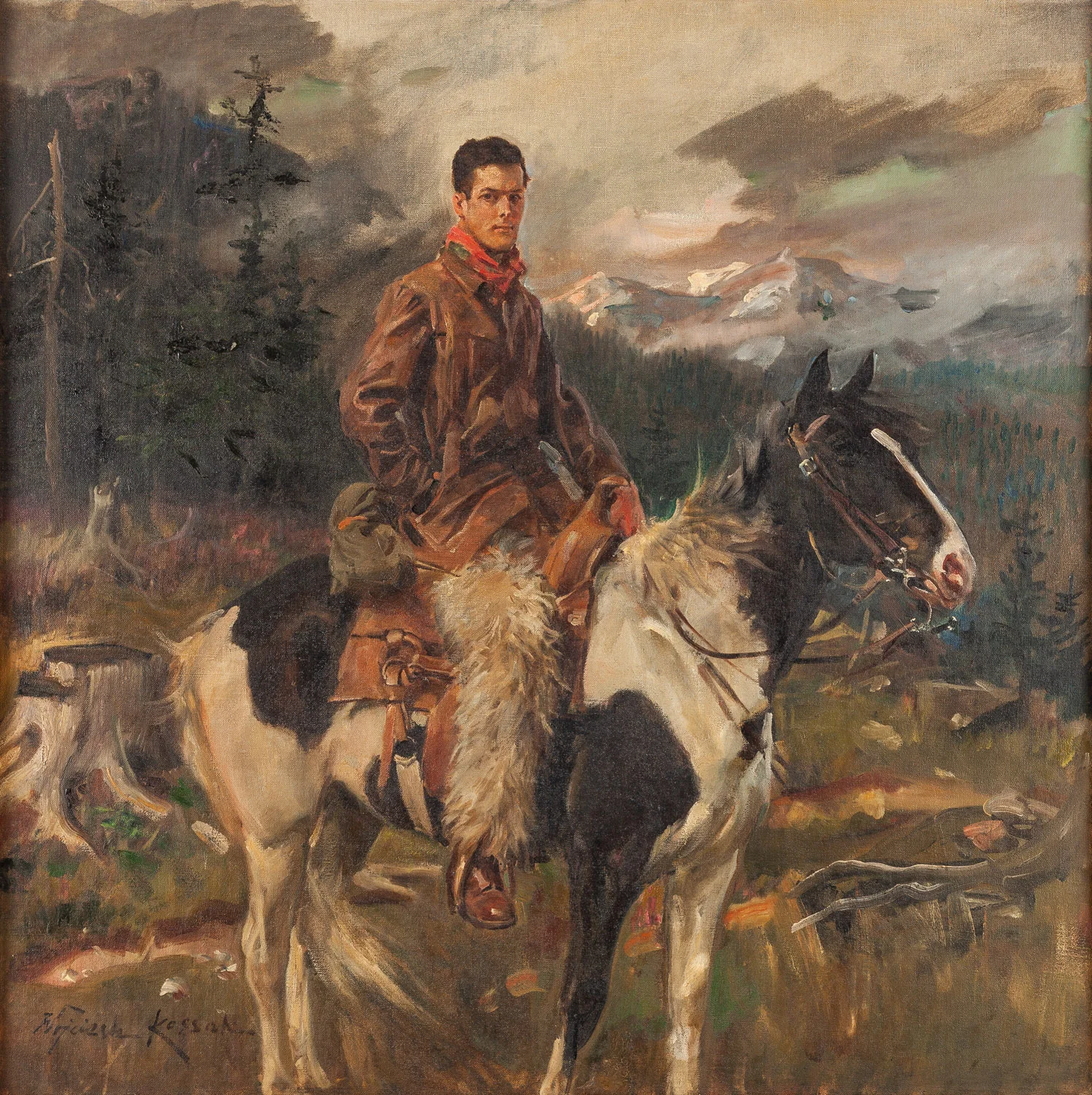
George Palmer Putnam was an American publisher, writer, and explorer. His parents named him after his grandfather, the founder of the G. P. Putnam's Sons publishing house in New York, established in 1838 and still operating today as an imprint of Penguin Group. Before joining the family business, he worked as a publisher and editor for the local newspaper "The Bend Bulletin" and as a private secretary to James Withycombe, Governor of Oregon. During World War I, he served in the United States Army. In 1926, the American Museum of Natural History awarded him a scholarship for an Arctic expedition, and the following year he received another mission from the American Geographical Society to Baffin Island to collect wildlife specimens. Thanks to George P. Putnam, the family publishing house published two bestselling autobiographies: "WE" (1927) by Charles Lindbergh, the first pilot to fly solo across the Atlantic Ocean, and "20 Hrs. 40 Min." (1928) by Amelia Earhart, who became the first woman to make a transatlantic flight. The publisher and the aviator became close, and after Putnam's divorce from his first wife, they married in 1931. After the successful flight, Putnam promoted Earhart in various ways. In addition to publishing her memoirs and two other books on aviation, he secured her advertising contracts and organized public meetings and lectures throughout the United States. After the premature death of the aviator under mysterious circumstances, he wrote and published her biography.
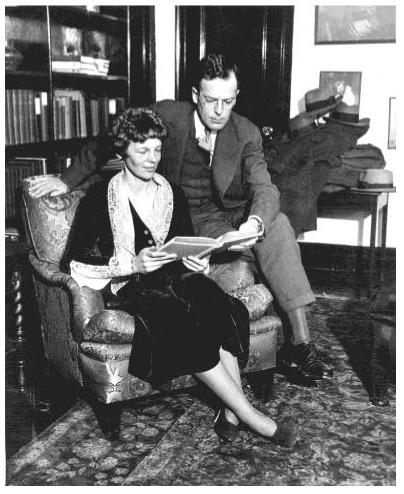
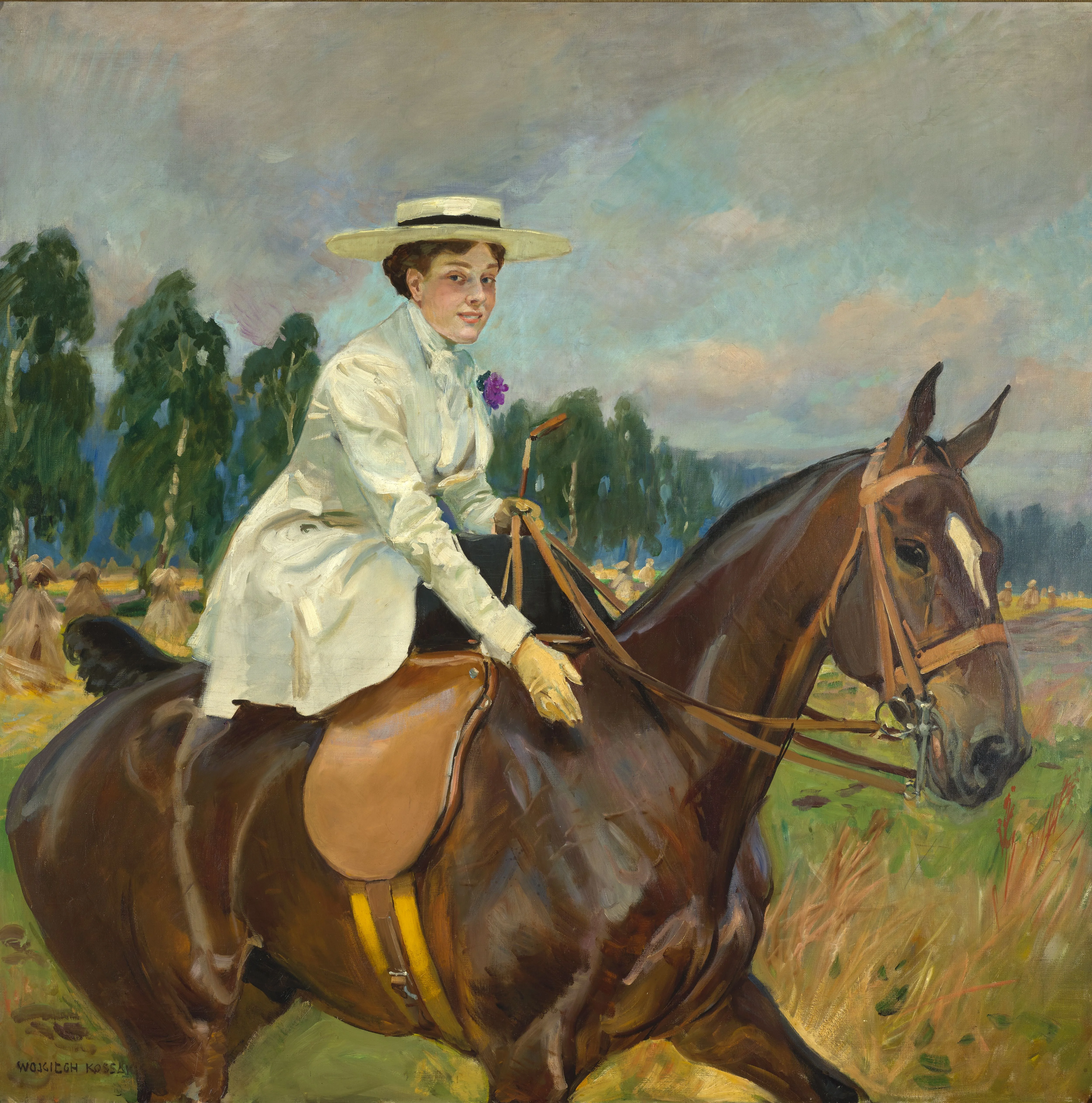
During the painting of his portrait by Wojciech Kossak, Putnam had not yet met Earhart but was already a promising businessman born into a wealthy family, educated at prestigious institutions like Harvard and the University of California, with military experience. He met the Polish artist on October 26, when he came with two other editors to visit his studio. The Americans advised him to promote himself in their country as a painter with a specific specialization, which would allow him to earn three times as much. This was not a problem for Kossak, as he had already established a reputation in his homeland as not only a painter of battle scenes but also an excellent portraitist. His portraits were highly regarded, especially among "horsemen" who wanted to be depicted in their stables, on rides, mounted on horses, or standing next to their favorite stallions and mares. Few portraitists could capture both the model and the animal so well. Wojciech Kossak, however, mastered the art of depicting horses. "Who could so seat a rider on a horse, even one who had never been in a saddle, and at the same time portray the horse? Therefore, his equestrian portraits, which had a well-established reputation, were the most popular" (Kazimierz Olszański, op. cit. p. 40). He portrayed the Potocki, Lubomirski, Mycielski, Tarnowski, and Tyszkiewicz families, as well as many other aristocrats, not to mention state dignitaries, including Marshal Józef Piłsudski and President Ignacy Mościcki. Now it was time for American billionaires.
Wojciech Kossak quickly became friends with George P. Putnam, as he described him in a letter to his wife on December 31 as his dear friend: "The second equestrian portrait, even more interesting, I finished yesterday: my dear friend George Palmer Putnam on a mustang as a cowboy. One of my best works overall, as soon as there are photos, I will send them to you immediately. This portrait is truly a masterpiece, although this one of Miss Crawford is also excellent" (Wojciech Kossak, op. cit., p. 259). Indeed, in this painting, the artist demonstrated great ease and proficiency in faithfully depicting both the model, his cowboy outfit, and the horse against the backdrop of the wild North American landscape. The broadly applied patches of color and the bold and sweeping lines reveal the artist's temperament. Kossak's bold and confident brushstrokes, combined with his excellent technique, won the hearts of Americans. The measure of the painter's success was the exhibition of his equestrian portraits organized by Gainsborough Galleries in New York between May and June 1927. Among the works was the "Portrait of George Palmer Putnam." The exhibition was met with an extremely enthusiastic public reception, resulting in even more commissions: "The success is mad, my exhibition is a sensation, the newspapers are full of reports [...] Orders are pouring in, but I am no longer accepting them, or only those I can complete at home with the help of studies and photographs and bring back " (Wojciech Kossak, op. cit., p. 403).
After his first trip to the United States, Wojciech Kossak returned four more times in the years 1927, 1928/29, 1930, and 1932. He was primarily motivated by the desire for easy profit. As he wrote in February 1927: "I have already done two portraits, and these two weeks have given me as much with light work as I could have earned in a year of hard work at home. Orders are pouring in. As long as they keep coming, I will stay here" (Kazimierz Olszański, op. cit., p. 36). He continued painting portraits of businessmen, military figures, and film stars as Amazons and cowboys riding wild horses, ranch owners, and their families across the ocean. For the American Polonia, he created new versions of "Racławice" and "Olszynka," portraits of Polish national heroes, particularly of Kościuszko and Pułaski, as well as genre scenes featuring lancers and girls against the backdrop of the beloved Polish landscape, evoking memories and nostalgia for their distant homeland. Wojciech Kossak's American paintings are not widely known; they remain in private collections overseas and very rarely appear on the art market. The auction of the "Portrait of George Palmer Putnam" at "The Kossak Family" auction will undoubtedly be a sensation.