
What I can't express in words, I depict in art
Ewa Kuryluk's work is an exceptional phenomenon in the Polish art scene. Making her debut in the late 1960s and early 1970s, the artist has developed a completely unique and, interestingly, interdisciplinary creative method that has no analogies on the Polish ground. She is primarily regarded as a pioneer of installation and drawing on fabric. Her focus on the body, illness, and transience, particularly in the context of femininity, may connote the mood and works of Alina Szapocznikow or Teresa Tyszkiewicz, but Kuryluk's works explore these themes on a different, less literal level.
For years, the figure of the artist living in Paris, remained somewhat outside the official canon of the Polish art scene. Today, thanks to numerous exhibitions that showcase her oeuvre, particularly the exhibition "I, White Kangaroo" ("Ja, Biały Kangór") at the 2022 Venice Biennale, as well as shows organized in Poland (National Museum in Wrocław, 2021; the Ego Gallery in Poznań, 2022), her art is being rediscovered and appreciated anew.
Ewa Kuryluk's creativity is deeply personal, rooted in her biography, and reflects the artist's private, inner world. Not without reason, self-portrait is the main motif of Kuryluk's work, manifested in numerous drawings and paintings as well as captured on film or fabrics. This artistic gesture not only emphasizes the openness and personal nature of her art, but when approached appropriately, it becomes a map facilitating navigation through this incredibly intimate body of work. The problem of representing one's own image, without unnecessary embellishments and masks, arose in the artist's imagination during her studies at a Vienna middle school and has remained the main source of her artistic exploration. Recalling that time, Kuryluk herself said:
"Spring in Vienna. Drawing class. A girl watches a sparrow outside the window. She unpacks a box of watercolors and pours water into a jar, but she doesn't intend to do anything. She doesn't feel like drawing, and she doesn't understand German, so she doesn't know the assigned topic. She yawns to infect the teacher, who approaches with an open powder box. Upon seeing her own reflection, she understands what it's about. And she transfers her features from the mirror onto the paper as if in a trance. That girl is me. The self-portrait, from which everything began, has remained to be my passion."
- Ewa Kuryluk, Obrysować cień. Malarstwo 1968-1978, BWA, Wrocław, 2011, p. 53.
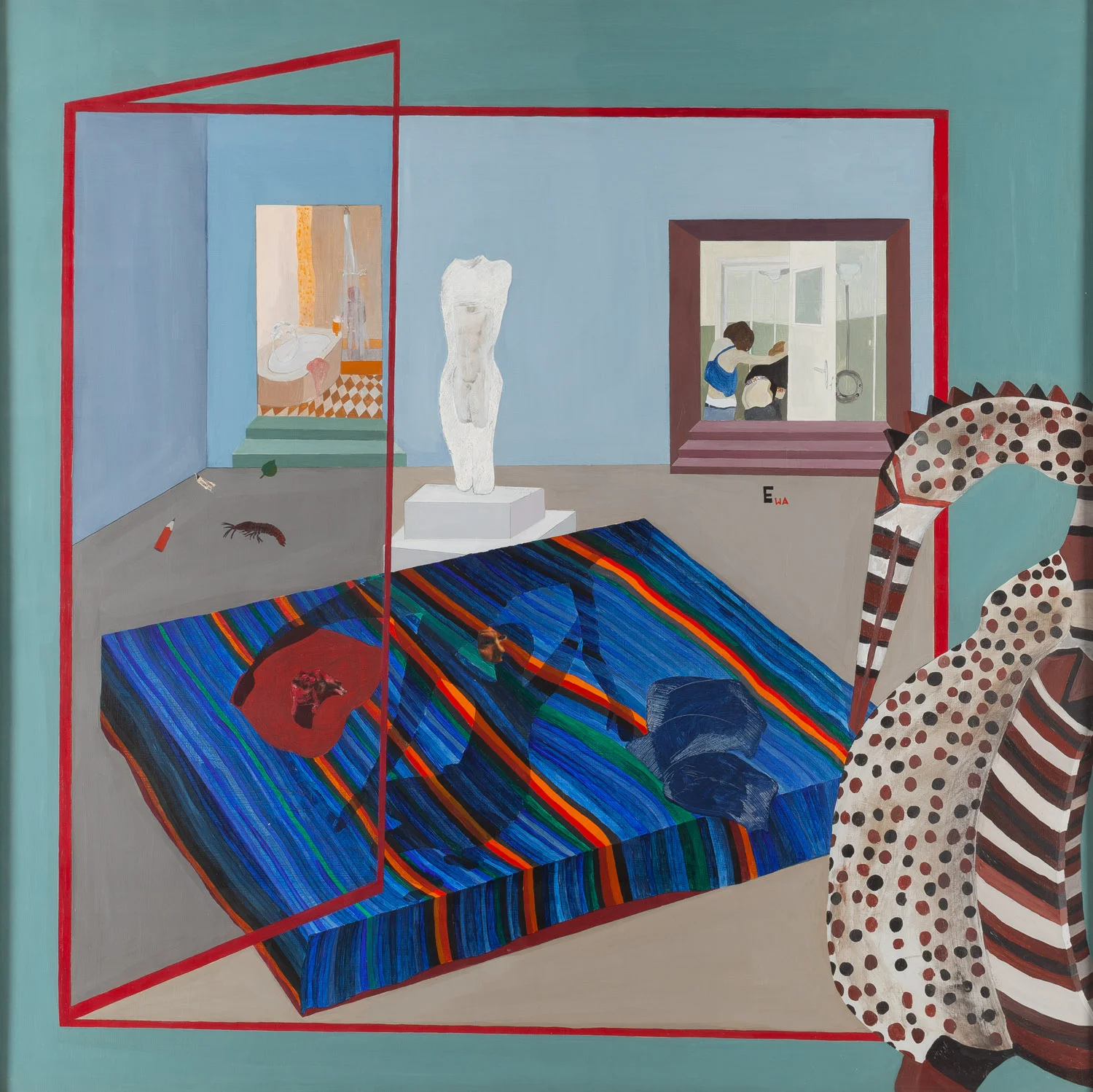
In her works, Kuryluk returns to the past, often depicting scenes from everyday life. An example of such realization is the painting "Pelican" from 1974, presented as part of an auction. It is a special work situated between two important series in the artist's career, "Human Landscapes" and "Screens". It still contains multicolored elements and grotesque figures (or rather their shadows) flowing in the central part of the composition, characteristic of the first series, as well as the transitional views and perspectives typical of the second series, which are manifested here in the form of windows revealing subsequent images to the viewer (thus referring to famous representations in the history of art). "Pelican" is an image within an image: the gradually constructed composition initially depicts the titular animal in the form of an African sculpture, then, as if through a slightly ajar window, invites us inside, where new spaces unfold. Painted with flat patches of color while maintaining the principles of perspective, they can simultaneously appear as posters or images displayed on a screen. The first view is an interior of a bathroom with a bathing figure, and the second reveals a significant scene in a toilet involving two individuals. The artist demonstrates incredible erudition in constructing space and, in a way, winks to the viewer: the interior of the toilet opens up to another space, while the view of the centrally placed ancient sculpture consists of two collage elements, once again presenting an image within an image.