
The headless crowd of Magdalena Abakanowicz
Magdalena Abakanowicz created figures without heads, sometimes also hands, in various media. The human figure directly appeared in her art in the early 1970s. As the artist explained, this change came after experiments with abakans, and it was caused by the fact that the form of sculptures in fabric did not allow for easy multiplication. Additionally, the author decided to change the sizes of her pieces.
During the first attempts with the new theme, the viewer is struck by the scale of the change in Abakanowicz's art. The artist, who was known for her dazzling variety of fabrics, turned her attention to human figures similar to one another. As Hermansdorfer described, the new sculptures were "the result of vivisection, an attempt to get to the truth about human nature as far as possible and as close as possible" (Mariusz Hermansdorfer, Magdalena Abakanowicz, "Konteksty" 2006, No. 3-4, p. 14-15, [quoted in:] "Orońsko. Kwartalnik Rzeźby" 2013, No. 2, p. 6).
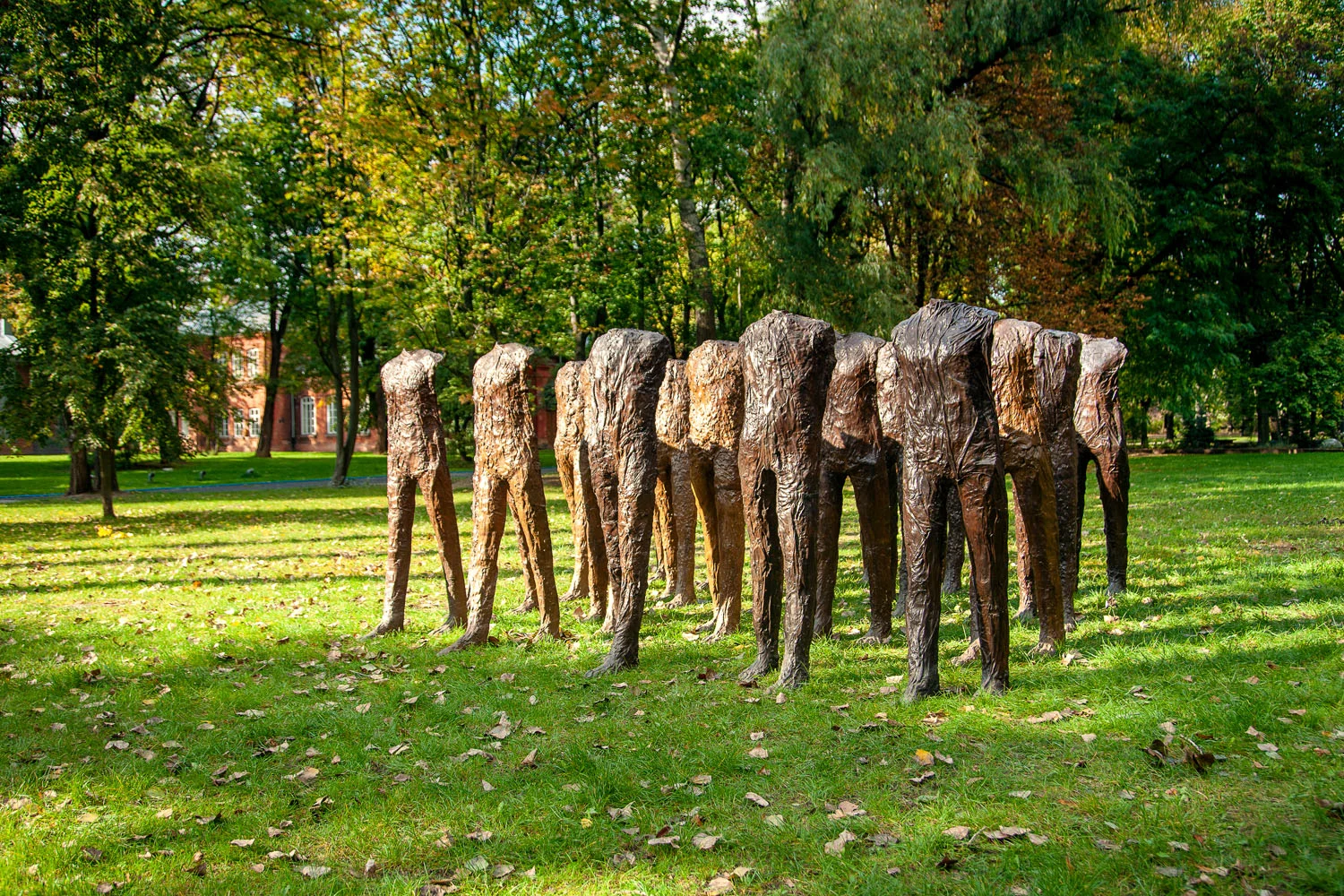
This time gave rise to the very characteristic human figures made of sackcloth or torsos without heads, which were made in jute fabric, bronze, or concrete. Regardless of whether they were made of jute, bronze, or concrete, they share a palpable sense of incompleteness, manifested in the headless torsos or in the way the fabric is shaped, with visible lines, creases, and material folds. Following Hermansdorfer's interpretive path, this change in the artist's work can be seen as an inevitable transformation resulting from the earlier stage of dividing humans into tissues, muscles, and fibers, which critics find in organic abakans. In the case of human figures, there was a kind of consolidation; this time they were made from tightly formulated material. Nevertheless, even in the description of the new sculptures, terms suggesting dismemberment, hollowness, or fragmentation quickly come to mind.
As the artist explained:
"In a human being, there is an incomplete awareness of one's own defects-so incomplete that it allows us to constantly gain something and seek new fulfillments. Some of them prove the presence of self-destructive instincts in us. This also results from the observation of collective action or, at least, from the fact that our rich imagination does not encompass the consequences of our inventions."
- Magdalena Abakanowicz, [in:] Zbigniew Taranienko, Podroż do źródeł energii, "Exit" 1993, No. 2, p. 560, [quoted in:] "Orońsko. Kwartalnik Rzeźby" 2013, No. 2, p. 7.
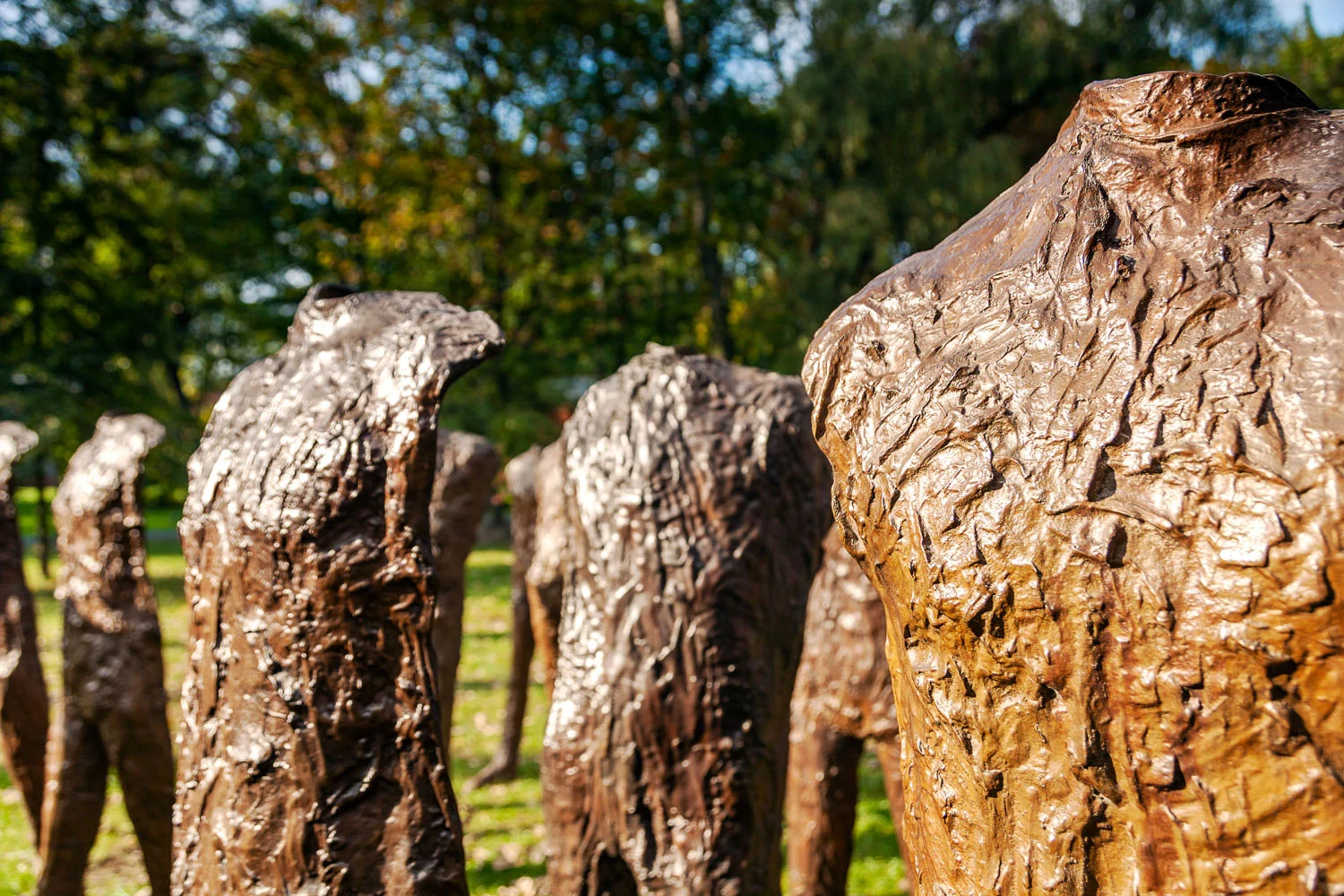
Anna Szary-Cioczek, an art critic, explains that Abakanowicz's art stems from reflections on human nature, but it also references current events in both the political and social realities. As the researcher notes, existential themes intertwine with the artist's wartime memories. In this context, the artist's memories from the end of the war and leaving her family home are significant: "1944. It was getting scarier. The front was advancing. Revolution. One day, my father had us harness the horses. We left Warsaw. As we moved away from home and the neighborhood, I felt as if I were being emptied. It was as if something had been taken out of me, and the inner layer, unsupported by anything, shrank and lost its expression" (Magdalena Abakanowicz, [in:] Eleonora Jedlińska, Sztuka po Holokauście, Łódź 2001, p. 151, [quoted in:] "Orońsko. Kwartalnik Rzeźby," 2013, No. 2, p. 7). The turn towards the human form led to several cycles in the 1970s, including "Głowy/Heads" (1973-75), "Postacie siedzące/Seated Figures" (1974-79), "Plecy/Backs" (1976-82), and "Embrologia/Embryology" (1978-80). However, the focus of the artist's interest remained on the human being, and a sense of inadequacy in the face of one's own biological structure accompanied subsequent series.