
"The American Dream" by Rafał Olbiński
"I called the 'Time' magazine's editorial office to show my portfolio. The receptionist said something, and I understood that the editor-in-chief wanted to meet me for lunch. Today, I think I was a total idiot to draw such a conclusion. (laughs) But I was really concerned about it, rolled up my posters, and rushed out of the house so as not to be late for the meeting. It was pouring rain at the time, so I got completely soaked. When I arrived, it turned out that there was no lunch, and I could leave my work hoping that the art director would look at them someday. I looked awful - like a cross between Rasputin and Chopin. Moreover, I was holding soaked posters under my arm. I suspect the receptionist felt sorry for me and called the art director. As I was laying out my work, Richard Hess, one of the greatest American illustrators, passed by. He looked at my posters and said they were 'energetic.' I replied something, but he quickly realized I didn't speak English. He asked which country I was from. I answered, 'Poland.' He said he was preparing a cover for the next issue of 'Time Magazine,' which would be dedicated to new immigrants. He took a polaroid photo of me, and a week later, my face appeared on the cover of that magazine."
- Rafał Olbiński.
This story sounds like a fragment from a Hollywood movie, and yet it happened for real. Rafał Olbiński's entire career is a ready-made script for a movie. The artist was born in Kielce, in a large family, at the end of the war. He then studied architecture in Warsaw.
Initially, Olbiński didn't dream of New York, but of Paris. As a student, he went on vacation to the city. The architecture of the French capital dazzled him, while life taught him humility. The artist lived in a tiny attic apartment with a roommate, worked the night shift at a hotel, and thanks to that, he could sustain himself. After the holidays, he returned to the gray, communist Poland. His aesthetic soul suffered because of it. And here begins a truly cinematic thread. Olbiński went to New York. He didn't plan to stay there, but the state of war broke out in Poland, and Olbiński faced a dilemma: either return to his homeland and forget about the international life, or try to embody the "American Dream" and indeed his determination, a handful of incredible coincidences (like the one with the "Time Magazine" cover) made him start a spectacular career in New York. He prepared covers for "Time Magazine" and "Newsweek," but also posters for operas. Over time, the author started painting, which was another milestone in his career.
He spent over 30 years in New York, and although he didn't plan it initially, it was certainly a good decision. As he admitted in an interview with "Lavie" magazine (issue 2, 2019), the moment when he unexpectedly landed on the cover of "Time Magazine" gave him a boost and was a good sign for the future. "And at that moment, I realized that there is no place for failure in my life. If you start your career in a new country with a cover in 'Time Magazine,' then everything has to work out!"
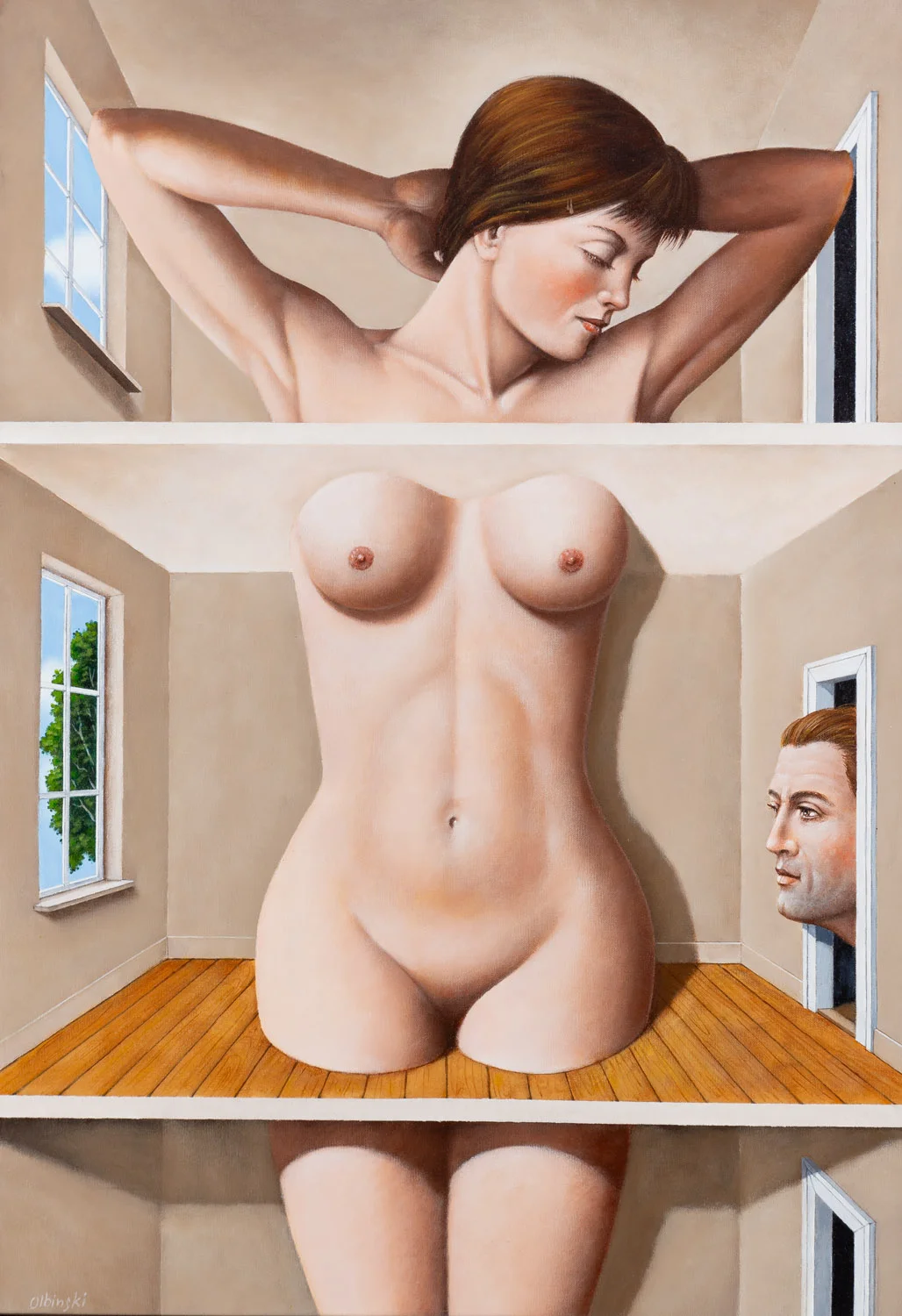
This journey, his stay in the USA, and continuous development allowed him to create such paintings as this oil one, full of subtexts and unexpected associations. Some pictures in the artist's nude album are paired with quotations by famous people, to whom Olbiński asked the question of what the viewer means when looking at the selected painting. The painting is connected with a statement by Agnieszka Holland. This outstanding Polish director, who like Olbiński, achieved enormous professional success in the United States, interpreted the painting as follows:
"A person - a woman - exists on many levels of knowledge. It's really hard to grasp the whole, it requires real effort, curiosity, humility, and distance. We close ourselves off, especially men close themselves off in cognitive cages. They see only a part, a fragment, reducing the object to one function. Looking at the painting, I wonder if he will even try to go to the next level? Maybe he doesn't even know it exists? Or maybe he knows, but he stopped at the middle one and it's completely enough for him? And what came first? The house or the woman? The levels or the whole? That's the question! And what does she feel, fragmented, dismembered, immobilized?"
- Agnieszka Holland (Olbiński. Akty, [ed.] Wioletta Połeć, Bosz Szymanik i wspólnicy, Olszanica 2020, pp. 32-33.
The presented work is very surrealistic in its meaning, reminiscent of Freud's psychoanalysis, who was considered a guru by the surrealists. Here, a curious man puts his head through the window and sees only the woman's chest and reproductive organs. His face seems mesmerized by this sight. We don't know if the woman is aware that her naked body is being spied on by the intruder, but the positioning of her hands and her gaze down towards the man suggests that not only is she aware that he admires her charming shapes, but also she looks at him with a hint of pity, as he focuses only on a fragment of her body, not seeing everything. The painting was created in 2016 but is still incredibly relevant today.