
Stanisław Fijałkowski. The Alchemist of imagery
Stanisław Fijałkowski systematically maintained a painter's journal. He made films using a Super-8 camera. He translated into Polish and published books by Wassily Kandinsky: “Point and Line to Plane," “Concerning the Spiritual in Art," and Kazimir Malevich's “The Non-Objective World." He was a scholar in search of wisdom. Stanisław Fijałkowski, whose works are in the collections of the world's greatest museums and galleries, approached the “Unknown" in all his endeavors.
He hoped to attain illumination by fully devoting himself to painting. On the surface of the canvas, he placed hue next to hue and used one color in such a way that the painting discreetly emanated its energy in absolute silence. When asked about the inner light achieved in his works, Fijałkowski responded:
“It is a perfect symbol of wholeness, that is, the world, a revelation, an epiphany of the mystery of all being. The inner radiance of the painting is the result of thoroughly sacred actions that enable the transformation of the material structure into a living spiritual form. A painting shining with such light reveals its true life and captivating beauty"
- Stanisław Fijałkowski, excerpt from the speech on the occasion of receiving an honorary PhD at the Władysław Strzemiński Academy of Fine Arts in Łódź, 2002.
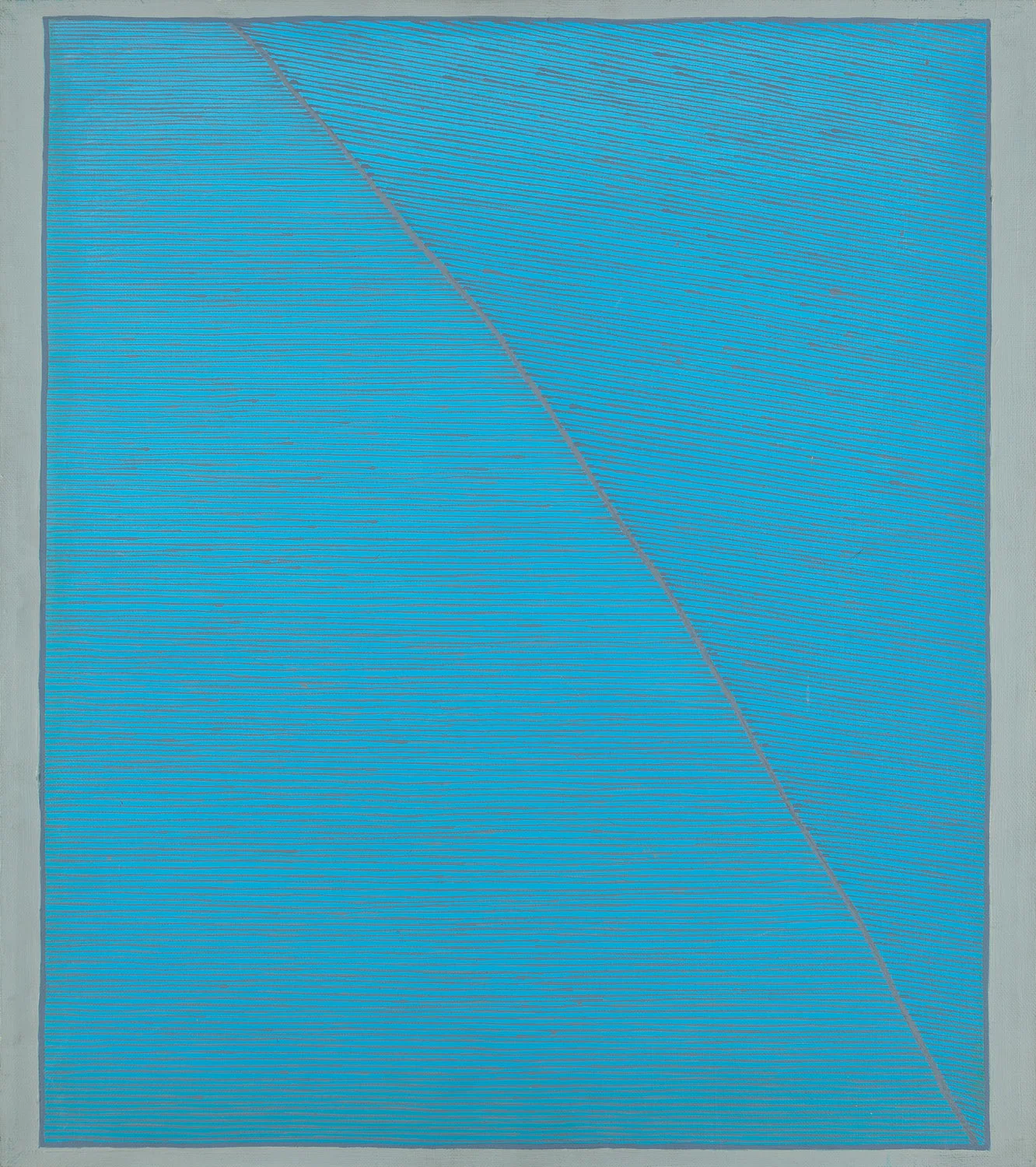
In 1968, in response to an anti-Semitic campaign, Fijałkowski created the graphic-painting series “Talmudic Studies." Through numerological references and camouflaged interpretations of the Holy Book, he found the source of his Christian faith in Judaism. With the government's expulsion of Jewish patriots, the artist felt a particular need to speak about the foundations of faith. In the equally significant series “Highways," the upward brushstroke, reminiscent of the Old Testament story of Jacob's Ladder, sufficed for Fijałkowski to create a form that was the beginning of the viewer's creation of the work in various forms. At the same time, through planes intersected by a diagonal line, sometimes interrupted in the middle of the composition, one should see only dynamics or tension, as emphasized by the artist himself:
“Proper painting almost always begins with drawing a frame around the plane of the painting. Its width, not necessarily the same on all sides, more or less clearly encloses the area of future activity. Closing the painting causes the undefined plane to individualize, because what is inside the frame distinctly and differently each time contrasts with the frame itself. The tensions of the plane, so separated from the surroundings, become more visible, particularly the significance of the top, bottom, left, and right sides. Slowly, we also begin to identify with the painting-the top is the head, the bottom is the feet, the left and right sides represent our hands. If we added two points to such a plane, it would become a face, our alter ego. Sometimes even a single cyclopean point is enough. From then on, whatever else appears on it will be a dialogue with Someone Mysterious who is either before us or within us. Thus, it is unknown when and how we enter the spiritual world, and everything we do becomes an utterance or listening, which seems even more important than speaking"
- Stanisław Fijałkowski [in:] Zbigniew Taranienko, Alchemia obrazu). Rozmowy ze Stanisławem Fijałkowskim, preface to the book, Warsaw 2012, unnumbered.
Fijałkowski's distinct artistic language, based on focus and austerity of means, radically distinguished his art from the work of other artists. The specificity of the work and the mystery of its message guaranteed its uniqueness and originality, both in Poland and internationally. His art, with its ritualistic expression and reflection of transcendent reality, attests to the existence of the sacred, whose source lies in artistic intuition.