
Nikifor/dwurnik. Dialogue of masters
"[Nikifor] was my most important master, actually the only one. (…) Until today, whenever I paint outdoors or deal with watercolors, I have that exhibition in front of my eyes"
(About Nikifor/O Nikiforze, Mirosław Ratajczak's interview with Edward Dwurnik, "Odra" 1996, No. 4).
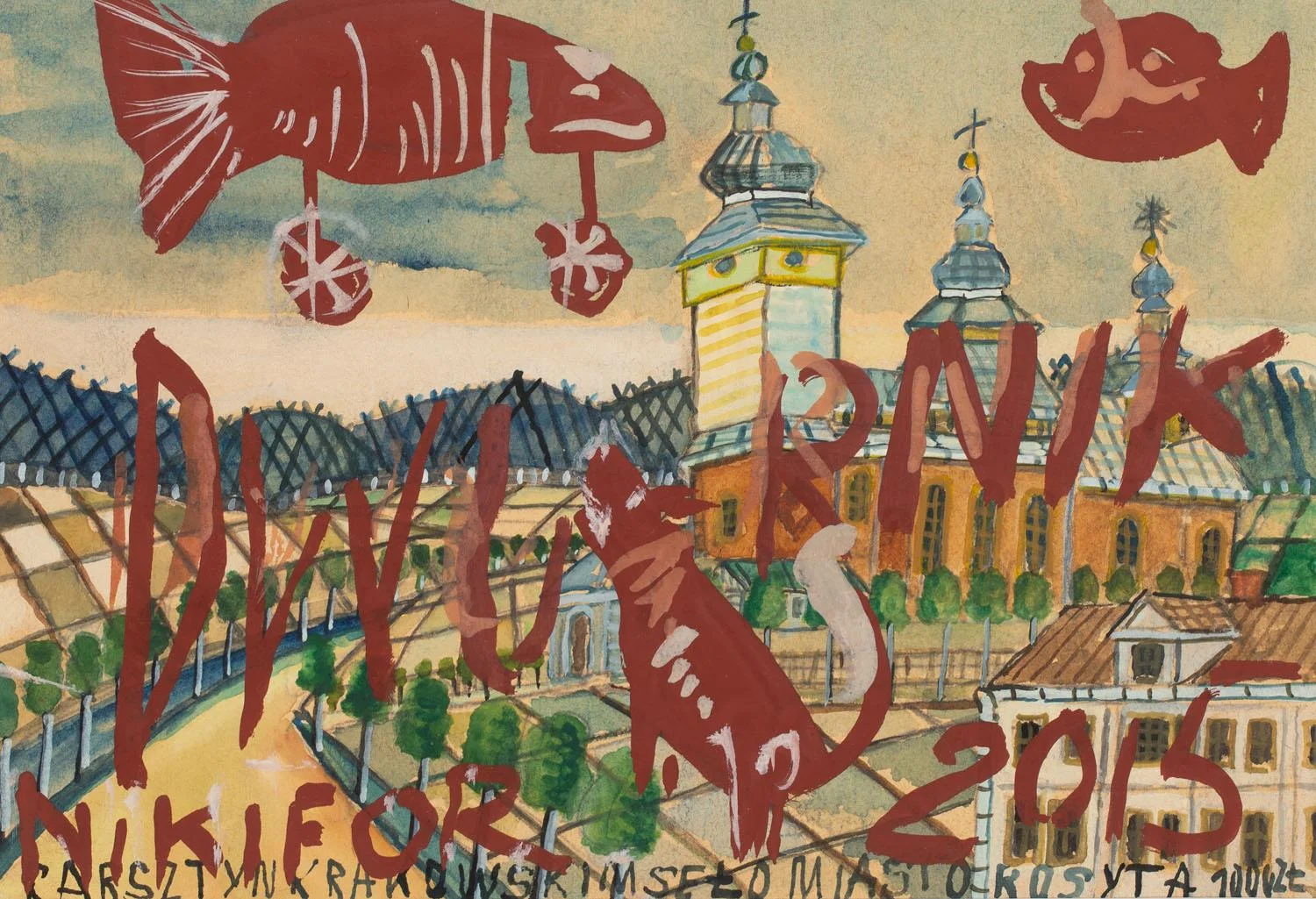
Several decades after the recognition of Nikifor's works and the establishment of his unique painting style in the history of art, one can boldly speak of a group of artists who not only patterned themselves on the "Matejko from Krynica", but also represented similar views on life and creativity. The group of artists centred around Nikifor includes, among others, Alina Dawidowicz, Marek Krauss, Teofil Ociepka. These artists, creating in a non-academic canon, using similar media, art techniques, and themes, adopted a corresponding style and unconventional understanding of the artist's role. The most recognizable figure in the art world, who relied on the reception of Nikifor's art for much of his activity, was Edward Dwurnik, the only artist in this group who graduated from an art school and at the same time followed Nikifor's artistic style. What makes Dwurnik's painting so distinct, unique, and personal is his non-literal approach to Nikifor's "lessons" on color composition and urban themes. Nikifor's influence on Dwurnik is visible in his blunt realism and grotesque, anti-aesthetic attitude, a hasty form, and self-interpreted primitivism. A formative and momentous experience for Edward Dwurnik as a painter was his encounter with Nikifor's works at the exhibition in Kielce in 1965. "Drawing No. 1", created on 13 June 1965 under the influence of this display, marked the beginning of the artist's creative activity.
"I have never experienced greater emotions than those that aroused in me his [Nikifor's] paintings seen in real life. I saw them for the first time (...) in 1965. (...) I tried to draw architecture at that time, but it wasn't until I saw this exhibition that I immediately knew how to do it. (...) He was a complete painter, wonderful, deep, he approached painting like the masters of the Renaissance, with classical honesty. (...) Everything he painted was SEEN. And later, everything that he saw, freely shuffled in his memory, imagination. He brilliantly liberated himself from the coercion of reality and created a painting, a world, their own structure. He was telling his story, he was painting his cosmos"
(Małgorzata Kitowska-Łysiak, Nikifor Krynicki, www.culture.pl).
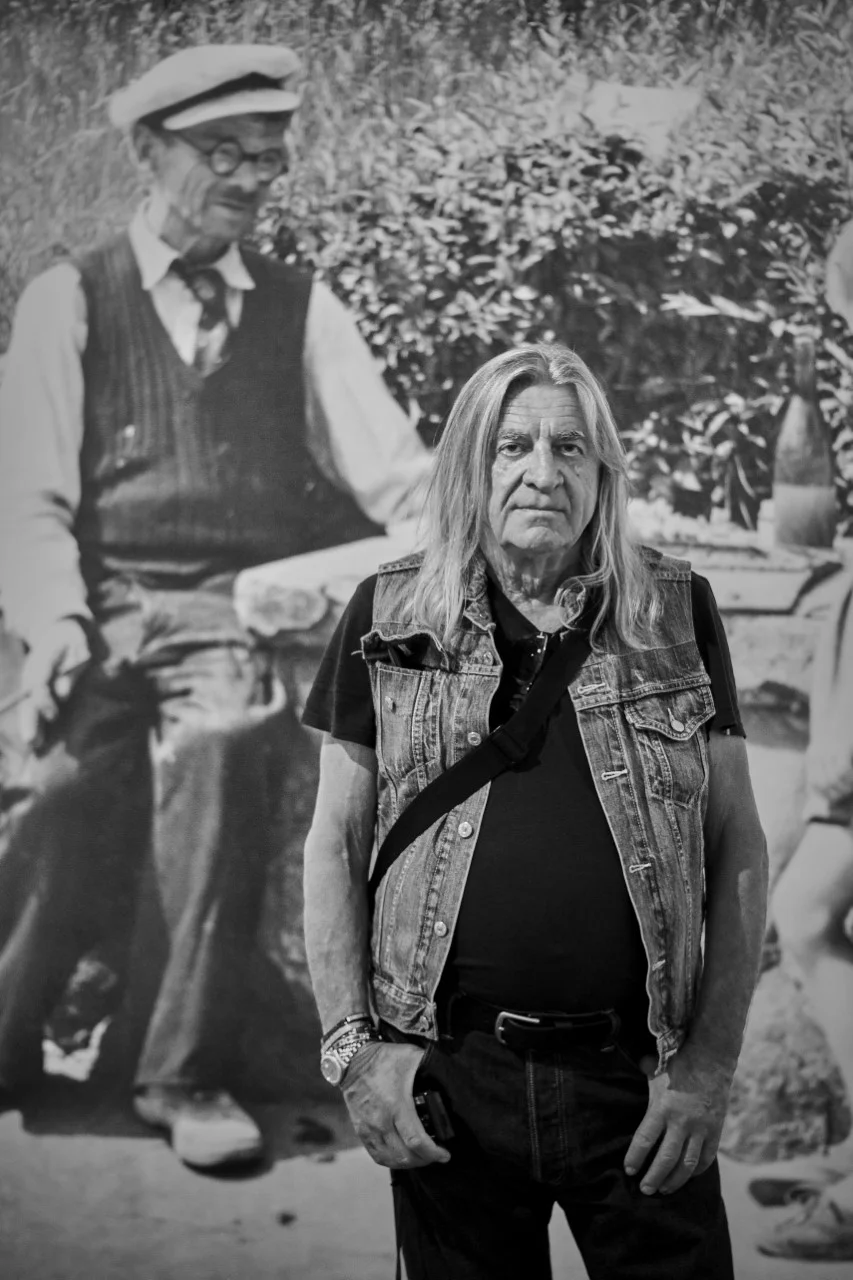
In 1965 Edward Dwurnik was still a student at the Academy of Fine Arts in Warsaw and faced certain creative impotence and confusion on the issue of his own identity as an artist. In "Short History of My Painting" ("Krótka historia mojego malarstwa") Dwurnik described this period,
"I had a problem after graduating from the Academy, actually already during my studies, because everyone painted more or less the same things, they drew the same things (...). We had narrow horizons and equally uninteresting perspectives. (…) And that's when Nikifor helped me. (…) I personally met him in 1966 or 1967, because he came to the Academy, or actually they brought him in a gray car. There was a guardian with him. Nikifor got out, sat on the bench next to us, and began drawing. He drew and drew, and I watched. (…) It's a fact that I tried to paint a bit like Nikifor then, but it was just a perverse momentum to follow my own direction. So, it's more of a joke with all that Nikifor. Nevertheless, he was very important to me then, he showed me the way."
A significant factor, in this case, was the lucky twist of fate that gave Dwurnik the opportunity to get to know Nikifor and his art thanks to the growing publicity and recognition of the painter from Krynica. This fame came at the last possible moment because when the student of the Academy of Fine Arts was forming his artistic credo, Nikifor was already a sick old man. Nevertheless, learning about Nikifor's landscape and architectural compositions, as well as his biography, prompted Dwurnik not only to devote himself to this type of iconography but also to cultivate the life of an itinerant artist suffering from hardships, facing incomprehension and rejection. For this reason, Edward Dwurnik made numerous journeys around Poland, he would sit on the streets of small towns and spend his time drawing and painting, not caring about worldliness, appreciating the naturalism of reality and its cyclical nature. After all, certain recurring motifs in Dwurnik's painting may be easily compared to the painting cycles of Nikifor Krynicki. In Dwurnik's works, the person of Nikifor is also associated with the propensity for synthesis, a prime example of which is depicting forests and trees in the form of grids and crisscrossings, flat perspective from a bird's-eye view.
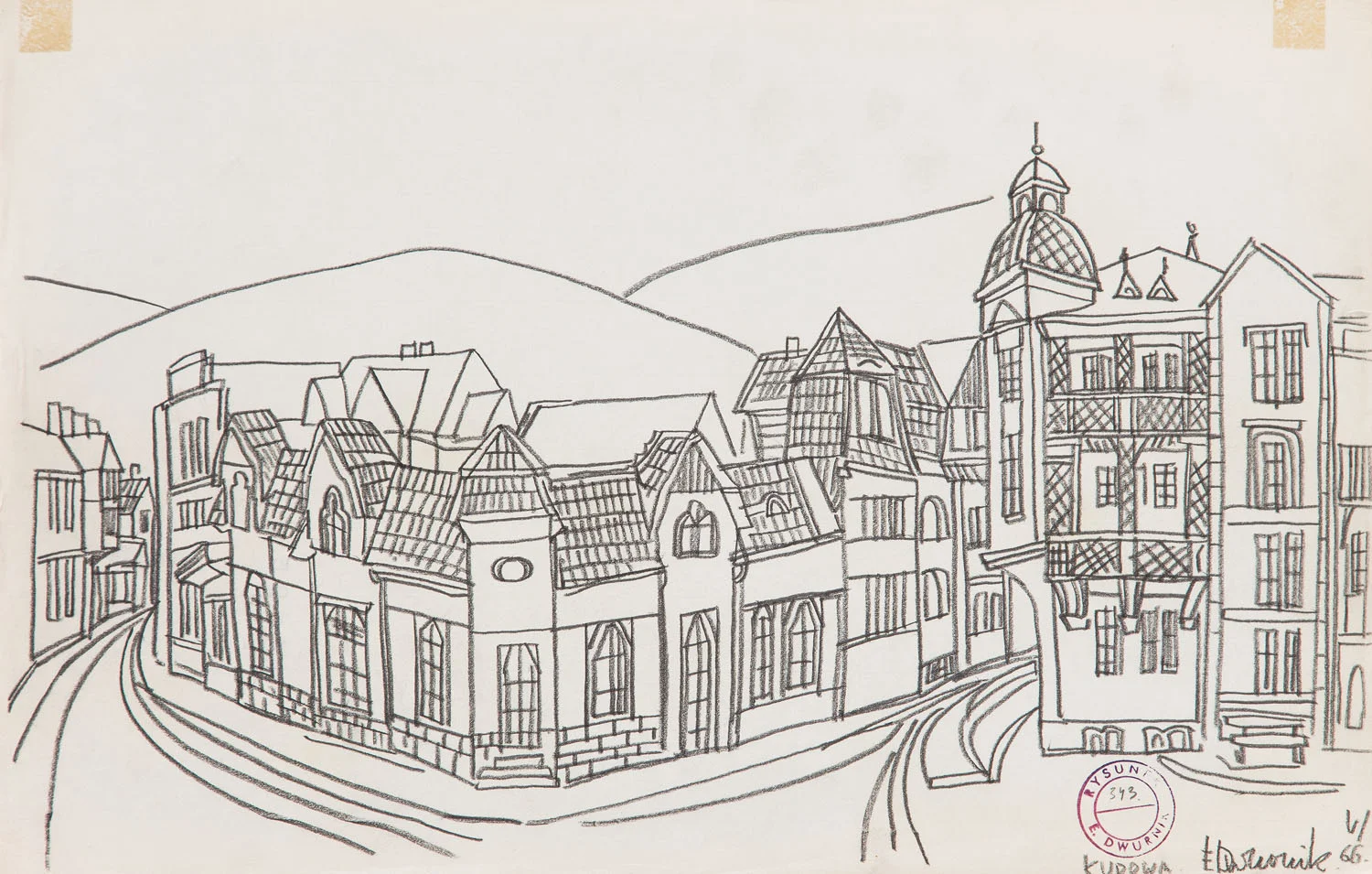
One may notice certain details and dependencies in this artistic exchange - city views by Nikifor usually present deserted, symmetrical, melancholic landscapes, devoid of human traces, while Dwurnik's cities are reports from everyday life, vibrant with the dynamics of events and a riot of colors. These differences, however, seem superficial, apparent, because each of the city views according to both artists is an attempt to confront their own emotionality with the urban and human tissue. Each of these compositions is an attempt to convey an honest painterly message.
"You just have to know that there is a certain order; when we paint a human, it needs to be a skeleton - a structure that must be covered with muscles, skin, then dressed in clothes, adorned. Nikifor always did the exact same thing. At the beginning there is a drawing - construction, then color - these are muscles, and then he once again outlines it all with a brush with different colors, depending on the situation, and eventually frames the whole picture. Generally, artists tend to forget about certain part of the process, miss something in this order, they are just messy and that makes paintings incomplete"
(About Nikifor/O Nikiforze, Mirosław Ratajczak's interview with Edward Dwurnik, "Odra" 1996, No. 4).