Melancholy encapsulted in the sculptures of Magdalena Berbeka
Jagienka Parteka
A villa reminiscent of those from Bertolucci's film "Stealing Beauty," the warmth of the setting sun, inspiration drawn from Greek mythology, and the intricacies of history intertwined with romance, crime, and war-these are the elements that form the rich, varied palette brought to life in the sculptures of Magdalena Berbeka. Through her works, Berbeka invites the viewer to engage in deeper reflection-on form, surroundings, and the emotions that her sculptures evoke. Her art beckons us on a journey, encouraging us to ask questions not only about art but also about our own identity and relationship with the world around us.
At the upcoming exhibition of Magdalena Berbeka's work, "Closer to Art: Lost in Time. Solo exhibition by Magdalena Berbeka," the focus will be on sculpture. Bronze and marble will take center stage, materials from which Berbeka draws out figures as if from a mythological bath. To better understand her creative process, we invite you to explore the interview conducted with her.
Jagienka Parteka: This may seem like a simple question, but it is key to understanding your work and desire to explore it. Where do you draw most of your inspiration from? What does your creative process look like?
Magdalena Berbeka: At the beginning, there are the obvious inspirations -seeing works at exhibitions, in museums, and drawing ideas from books, films, or music. Cultural texts give me immense motivation and space for creativity. Another aspect is that, in my understanding, the creative process is constantly taking place in my head. It's always being processed. Everything happening around me becomes material for projects in my thoughts. I try to remain attentive and absorb as much from my surroundings as possible. Lately, I've been particularly interested in the theme of grayness. As I get older, I see that many decisions or emotions aren't easy to classify-they can't be neatly labeled as black or white. Hence my fascination with gray. The emotion-or rather, state-that inspires me is melancholy. It blends certain contradictions, where longing and soul pain intertwine with lyricism and sweetness. I search for these elements in everyday life. The longing for a lost paradise, Weltschmerz, is something I find particularly intriguing in people. Everyone experiences it differently. When I reflect on this, I feel a sense of community and understanding that allows me to create different narratives. As for my creative process, I approach it with full professionalism and seriousness. A good sculpture requires sincere, hard work. I go to the studio as if it's a full-time job-at least eight hours a day, though I feel that's not enough. I often work on Saturdays and Sundays as well. It demands a lot of self-discipline, which can sometimes be challenging, but the work completely consumes me-I could stay in the studio endlessly. I imagine I might become a bit of a recluse soon.
JP: Spending so much time in your studio, are you naturally able to recognize when an idea for a sculpture is the right one?
MB: I sketch and design a lot. When I feel that something has potential, I start sculpting. Lately, I've learned that there's nothing more helpful than constructive feedback-it's an invaluable gift. I'm incredibly fortunate to know a few people whose opinions I deeply value and who are willing to share their thoughts with me. This is crucial for me because, indeed, spending so much time alone in the studio, it's easy to lose perspective on one's own work.
JP: Is there something specific you'd like to express through your sculptures?
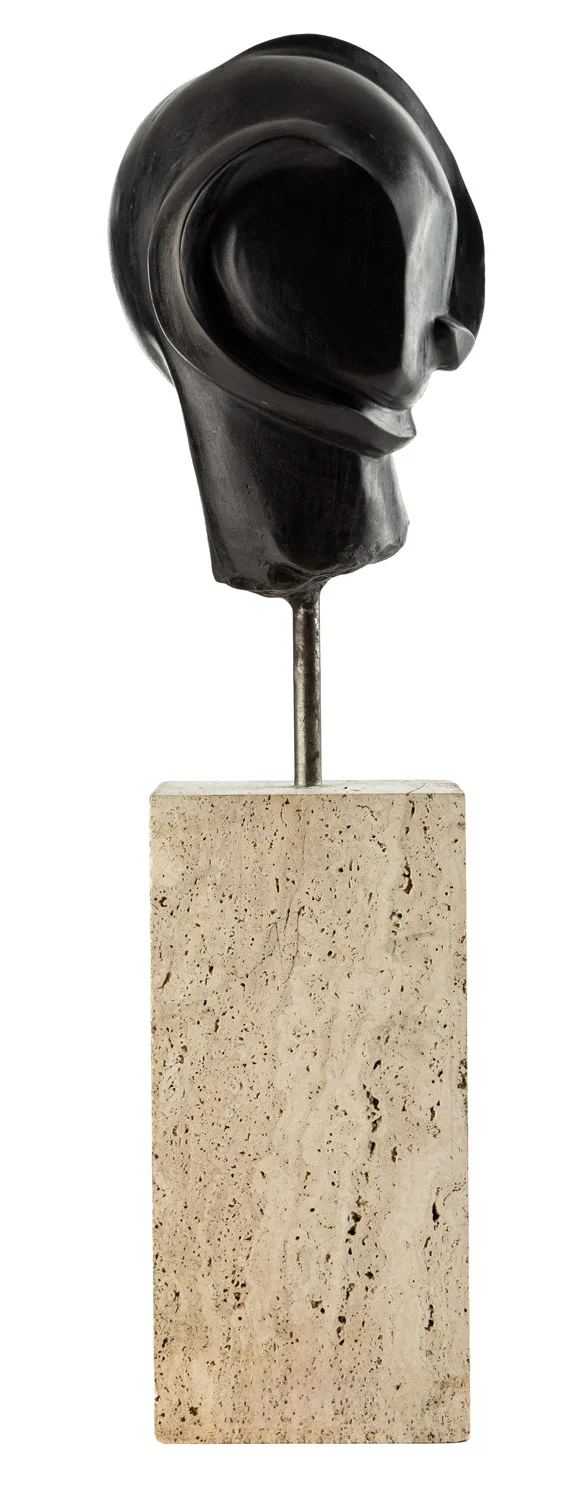
MB: For the exhibition, I made a series of sculptures inspired by the ancient Greece. In form, I've referenced art deco, the work of August Zamoyski, and pieces created at the Zakopane School of Wood Industry. I sculpted in this way for several reasons. First, I'm from Zakopane, which ties me personally to my roots. I believe that even today, there's a clear connection to that era. A hundred years have passed, and history has come full circle. I also feel a strong connection to the moods of the interwar period. The figures I've sculpted seem frozen in time, dreamlike-waiting for the inevitable fate that will awaken them. I sense that my entire generation is waiting for such an unexpected awakening, which may come from an unavoidable destiny. One of my favorite literary characters is Hans Castorp from Thomas Mann's "The Magic Mountain," who was also frozen in a sort of stasis, waiting for the greatest cruelty-war-to pull him out of his stupor. I wonder if our own slumber won't end in a similar way. By invoking characters from our cultural code and forms that have left a lasting mark over the years, I've realized that for me, this is also a story about searching for identity.
JP: Is there a way you would like your sculptures to impact the viewer compared to other forms of art?
MB: I love when someone says they feel the urge to touch my sculpture. It feels very sensual, intimate-to evoke the desire for touch in someone. I'm also fascinated by how light affects sculpture. For instance, morning light reveals something entirely different from harsh midday light.
JP: Are there materials you prefer working with while sculpting? Why?
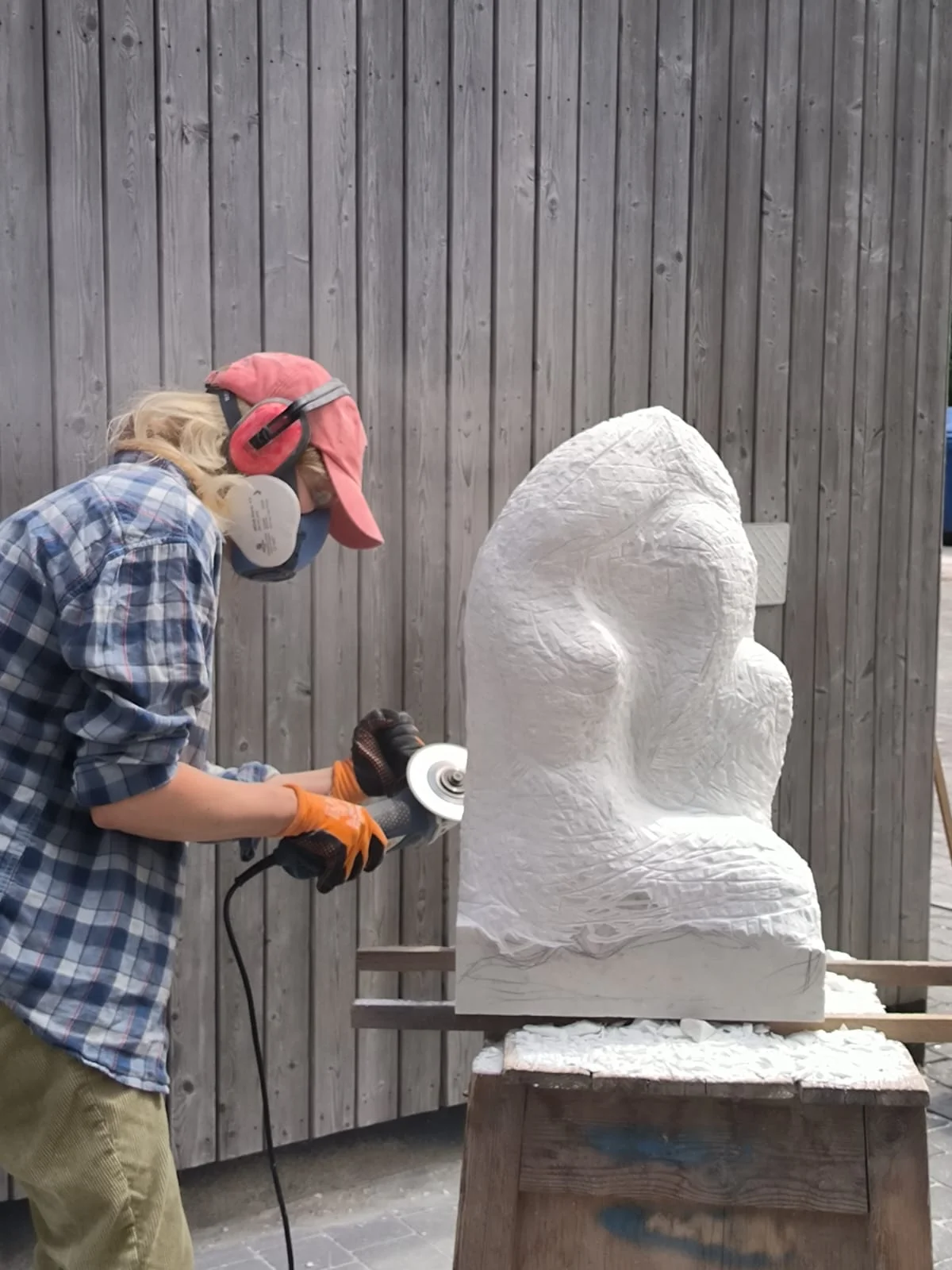
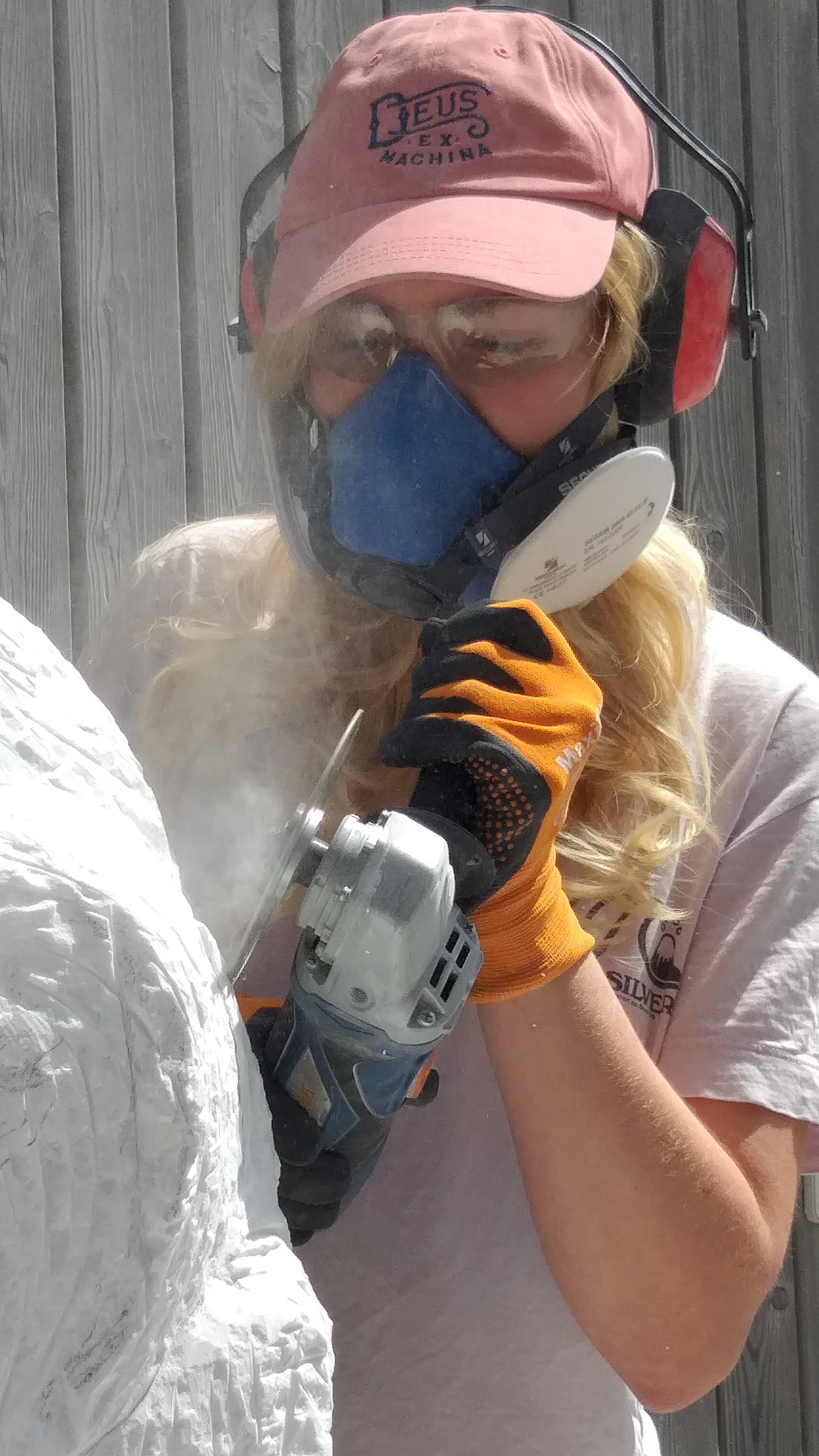
MB: I think sculptors are guided by certain intangible, intimate preferences. Currently, I work in two techniques: clay, where material is added, and stone and wood, where material is subtracted. The latter method is probably closer to my heart. Perhaps it's because I was trained at Kenar School, where we were given a solid foundation in woodworking. I'm fascinated when the material demands sweat, blood, and tears. There's also a certain risk-if you subtract too much, it's hard to fix. This combination of contradictions-working with heavy equipment like grinders or saws, yet requiring delicacy and balance-isn't that a beautiful technique? The idea that the material can give back to you is remarkable. It's as if the material works on the sculpture with me, as if, for a moment, we're partners in a perfectly planned conspiracy.
JP: Are there any places, cities, or sculpture studios where you'd like to create?
MB: For the DESA Unicum exhibition, I worked with marble for the first time. I fell in love. Now, I dream of Carrara, the land of marble. I'd love to go there and work with that material, which is so important both locally and globally. Of course, it could be another place in Italy or the south of France-the key for me is a romantic villa, a historic monument, and the atmosphere of a Bertolucci film-that's when I'll be happiest.
JP: Light, time of day, sunsets, and intimate glances, like in Bertolucci's films-it sounds like traveling to a magical land of Italy. How does your daily creative process look? Is there anything you can't sculpt without?
MB: Finances for materials-that's a very down-to-earth issue that annoys me greatly, but unfortunately, it's true. If I have that secured, I need nothing else. I'll find a way to sculpt in any conditions.
JP: Was there a specific moment in your life when you felt that you wanted to become an artist?
MB: It was a path I chose very early on-I went to Zakopane's Kenar school for middle school. Then, naturally, I went to the Academy of Fine Arts. I had some “side quests," like working as a flight attendant for a year. However, I think it was out of sheer curiosity to explore the world and the immodest pleasure of wearing an unusual uniform. Nonetheless, everything made me convinced that I want to become an artists.
JP: What is your greatest artistic dream? Has it been constant over the years, or are there newer, bolder ones?
MB: Of course, I have dreams related to materials, large formats, statues, or monuments in exceptional locations. But for now, my greatest artistic dream is very simple and prosaic: I dream of being able to live off my work. To have the means for materials, a studio, and occasionally a gin and tonic. Recently, I had to sell my favorite shoes to buy tools for work, so I might add a nice pair of shoes to that dream. If I achieve that, I promise here and now to anyone reading that I will bring the rest of my dreams to life. And I won't stop-I'll keep developing more and more, pushing further and further.
JP: Which artists' work inspires you the most?
MB: To name a few: Isamu Noguchi, Barbara Hepworth, Hans Arp, Alexander Archipenko. As for Polish artists, Katarzyna Kobro and the previously mentioned August Zamoyski, and of course, the Zakopane School. Among painters, I admire Rothko and Picasso-I'm interested in artists who dare to tackle large formats, use bold, “wild" lines, and immerse themselves in abstraction. I also have a favorite painting: "Manao Tupapau," or "The Spirit of the Dead Watching" by Paul Gauguin. This work especially captivated me after reading Mario Vargas Llosa's The Way to Paradise. The author describes a scene that could have inspired Gauguin to create the painting. The image has stayed with me deeply-it radiates a unique mood and mystery. A naked Tahitian woman lying on a bed in a dark, purple room, observed by the spirit of death, creates a vision in which two worlds intersect. I wonder how strong the message of such image may be. I often add my own interpretations: Does such a spirit retain the human traits it had in life? Is it a hidden observer of the girl's inner world, or does it belong entirely to another dimension?
We invite you to our headquarters at Piękna 1A in Warsaw, where from 5 to 19 September you can see the artist's works. See you soon!