
Kantor's Italian journeys
Nicole Lewandowska, Agata Matusielańska
Few Polish artists have achieved the status of an international phenomenon during their lifetime. Tadeusz Kantor became known as an outstanding director, painter, set designer, author of artistic manifestos, and cultural life animator. Due to his active cultural activities, he was awarded, among other honors, the Minister of Foreign Affairs Award for promoting Polish culture in 1982 and the Federal Republic of Germany Award for his significant impact on contemporary art in Europe. In Italy, in 1986, he received the "Targa Europea" award, given to distinguished representatives of culture and science in Europe.
Tadeusz Kantor was introduced to the Italian public when, in 1958, the Venice Biennale presented a film based on his conceptual titled "Attention Painting." In the following years, Kantor received enthusiastic reviews and significant recognition for his achievements in theater arts. It didn't take long for the first publications dedicated to the art of the Cricot 2 Theatre creator to appear. The memory of this extraordinary artist endures to this day, evidenced by the unveiling of a commemorative plaque in Florence in 2005 in front of the theater where Kantor and his Cricot 2 ensemble presented the famous play "Wielopole, Wielopole" in 1980. The artist's centenary was also celebrated with great ceremony. RAI's Channel Three, entirely dedicated to culture, broadcast a series of five programs on this occasion, prepared in collaboration with the Tadeusz Kantor Art Documentation Center Cricoteka in Kraków. Luigi Marinelli, an Italian researcher of Kantor's work and his former collaborator, explained the phenomenon of the Polish artist's popularity in Italy as follows:
"The triumph of Kantor and his subsequent performances after 'The Dead Class' resulted from the fact that he shook and deeply moved the audience. Like the poetry of Wisława Szymborska, there was a need in Italy at that time for such theater as Kantor's; a theater that was not an incomprehensible avant-garde but one that touched the most delicate strings of intelligence, sensitivity, and the heart of the audience."
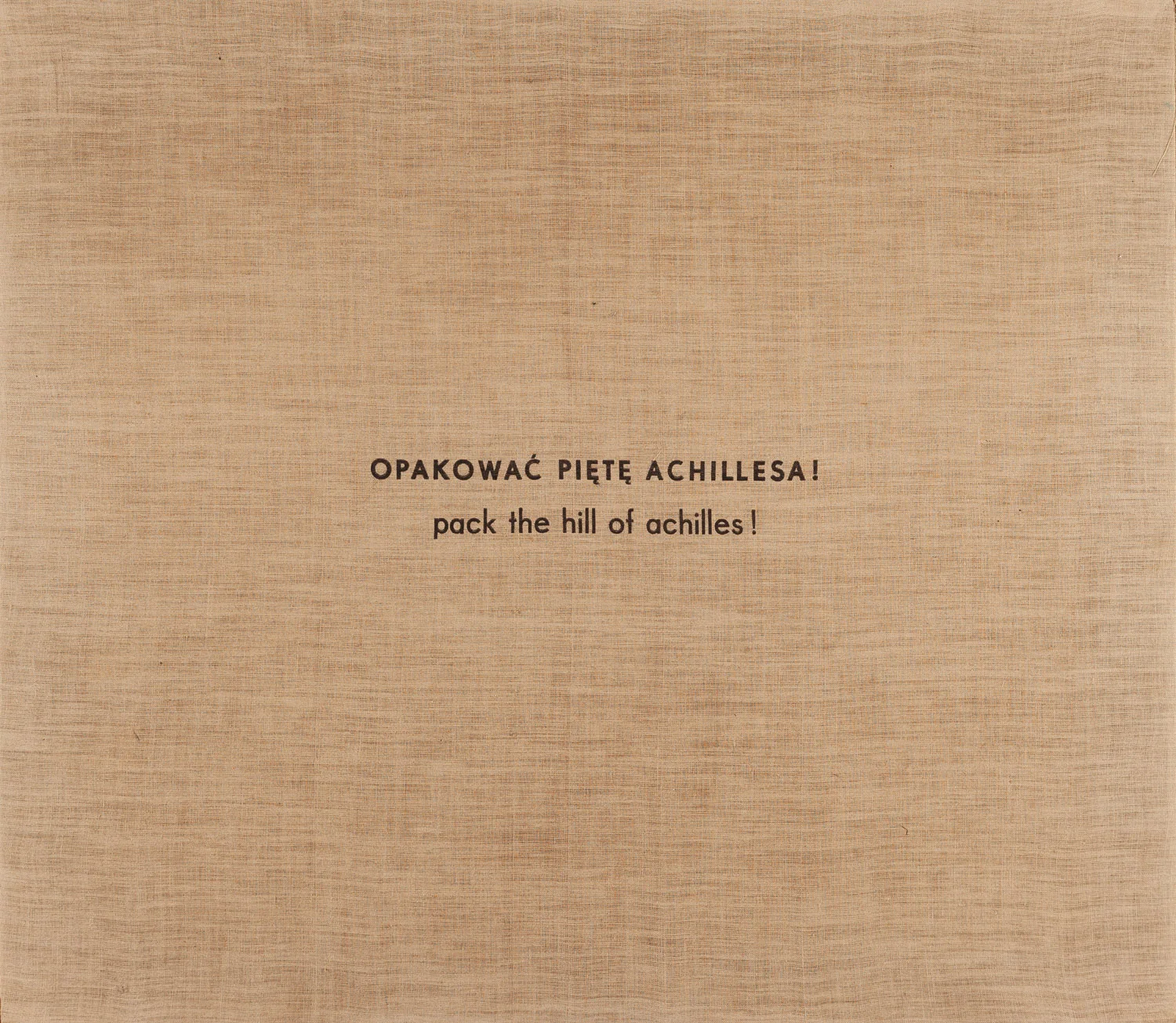
Over the years, Tadeusz Kantor gained many friends from Italy who actively collaborated with him on various projects. One of them was artist Achille Perilli, to whom Kantor gifted the painting "Pack the Heel of Achilles" from 1970, which is presented in the upcoming "Post-War and Contemporary Art" auction. The friendship between the artists was born during an art workshop dedicated to creating mosaics on the island of Korčula, in the town of Vela Luka in 1968. As Perilli recalled:
"Everything started in the summer of '68, when I was invited to participate in the Rencontre Internationale in Vela Luka (...) I found myself in a group of artists from all over Europe, gathered there by chance by the poet and critic, Jean Clarence Lambert. Fascinated by the beauty of the surroundings, we spent our days making mosaics or alternatively swimming in the sea (...) One of the artists stood out with exceptional diligence, avoiding our bathing-creative experiences. He sat with his wife [Maria Stangret – N.Z.] and Anka Ptaszkowska, a friend and art critic, in a café, writing and drawing there. That was Tadeusz Kantor. He watched me from a distance and one day invited me to his table for a conversation. From that moment, our friendship began, which lasted for years (...)"
- A. Perilli, Kantor ab ovo, Tadeusz Kantor. Cricot 2 Theatre, Odepius, Turin 2000, quoted in: Natalia Zarzecka, Tadeusz Kantor we Włoszech, [in:] Zarządzanie w Kulturze, 2004, vol. 5, pp. 137-1380.
The initial intellectual bond turned into a lasting friendship over time, and Achille Perilli, sincerely interested in Kantor's work, undertook the promotion of his art in his country.
Thanks to Achille Perilli's involvement, Cricot 2 Theatre had the opportunity to present itself at the international Premio Roma Festival with the play "The Water Hen." It was the theater's first foreign tour, which, despite not having large attendance, ended in success. After performances in Rome, Modena, and Bologna, they got the opportunity to present "The Water Hen" in Nancy, Paris, and Edinburgh. This performance marked the beginning of many subsequent foreign shows outside Poland.
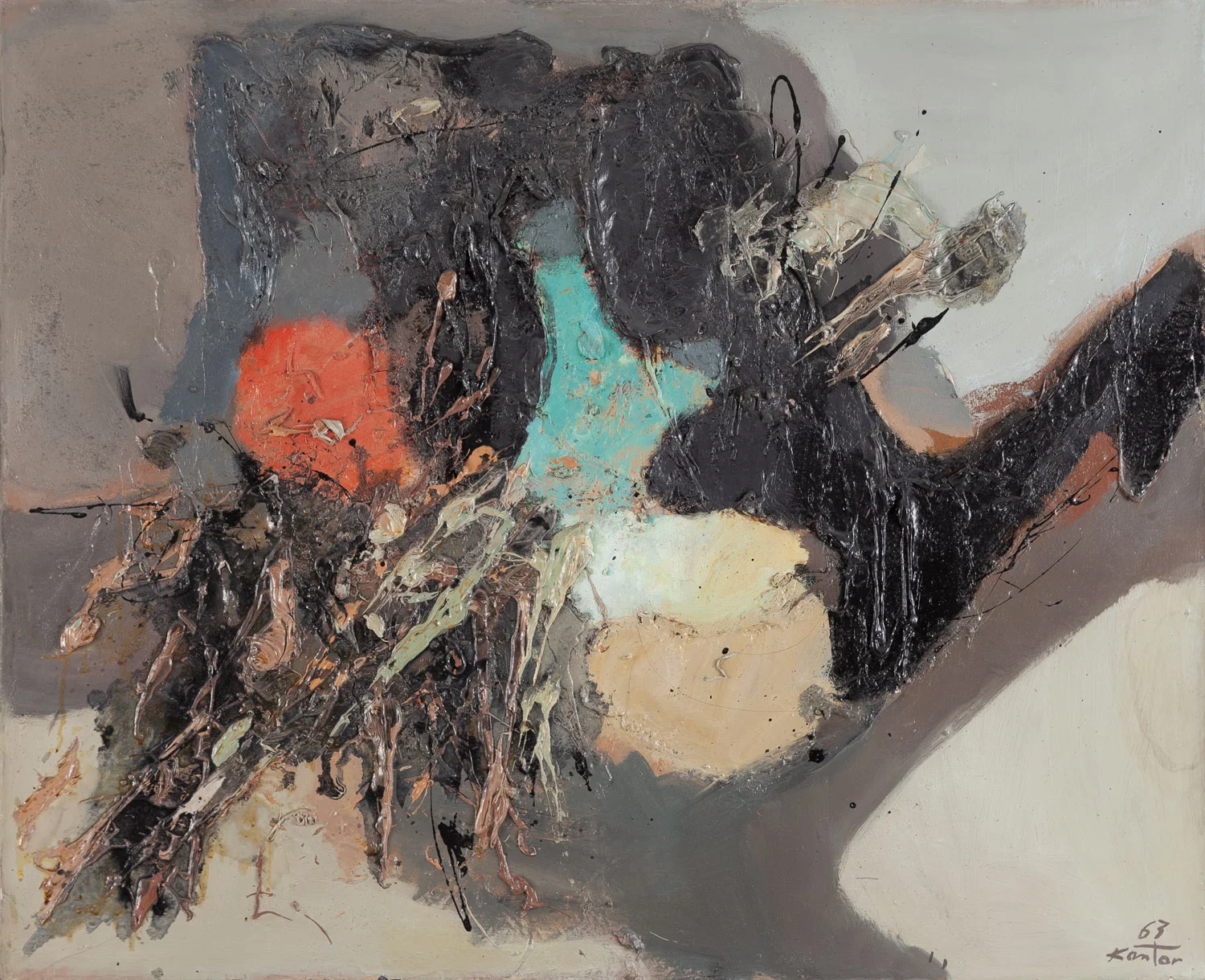
Achille Perilli also played a significant role in another important event, the exhibition organized in 1978: "S.I. Witkiewicz, costruttivismo, artisti contemporanei" ("Polish Avant-Garde 1910–1978. S.I. Witkiewicz, Constructivists, Contemporary Artists") at the Palazzo delle Esposizioni in Rome, later moved to Palazzo Reale in Milan. The exhibition showcased the work of the Polish avant-garde, starting with Witkiewicz, Dadaism, Surrealism, and Constructivism. The Italian public was presented with works by artists such as Maria Jarema, Maria Stangret-Kantor, Zbigniew Gostomski, Kazimierz Mikulski, Andrzej Wełmiński, and Roman Siwulaka. Tadeusz Kantor was the author of the show's concept and arrangement, and Achille Perilli (along with Konstantyn Węgrzyn) took the position of exhibition commissioner.
Stefania and Dario Piga also significantly contributed to promoting Kantor's work. Stefania Piga worked as a correspondent for RAI TV, Italy's official radio and television broadcaster. Due to her professional duties, she was often sent to Eastern European countries and eventually arrived in Poland for a conference. During her travels, she met many prominent figures from the art world, including Tadeusz Kantor. The couple quickly became acquainted, and Stefania fell in love with Polish art and culture. It was then that the idea was born to bring this part of Europe closer to the Italian audience. Stefania decided to open a gallery in Rome dedicated to promoting Polish and Central European art. As she recounted the process:
"Gradually, a project matured in me to bring and spread Polish art and that of other Central European countries - referred to as the East - in Italy. In the Italian collective imagination, this vast area of Europe was, and I think still is, more associated with historical-political events than with contemporary and modern art."
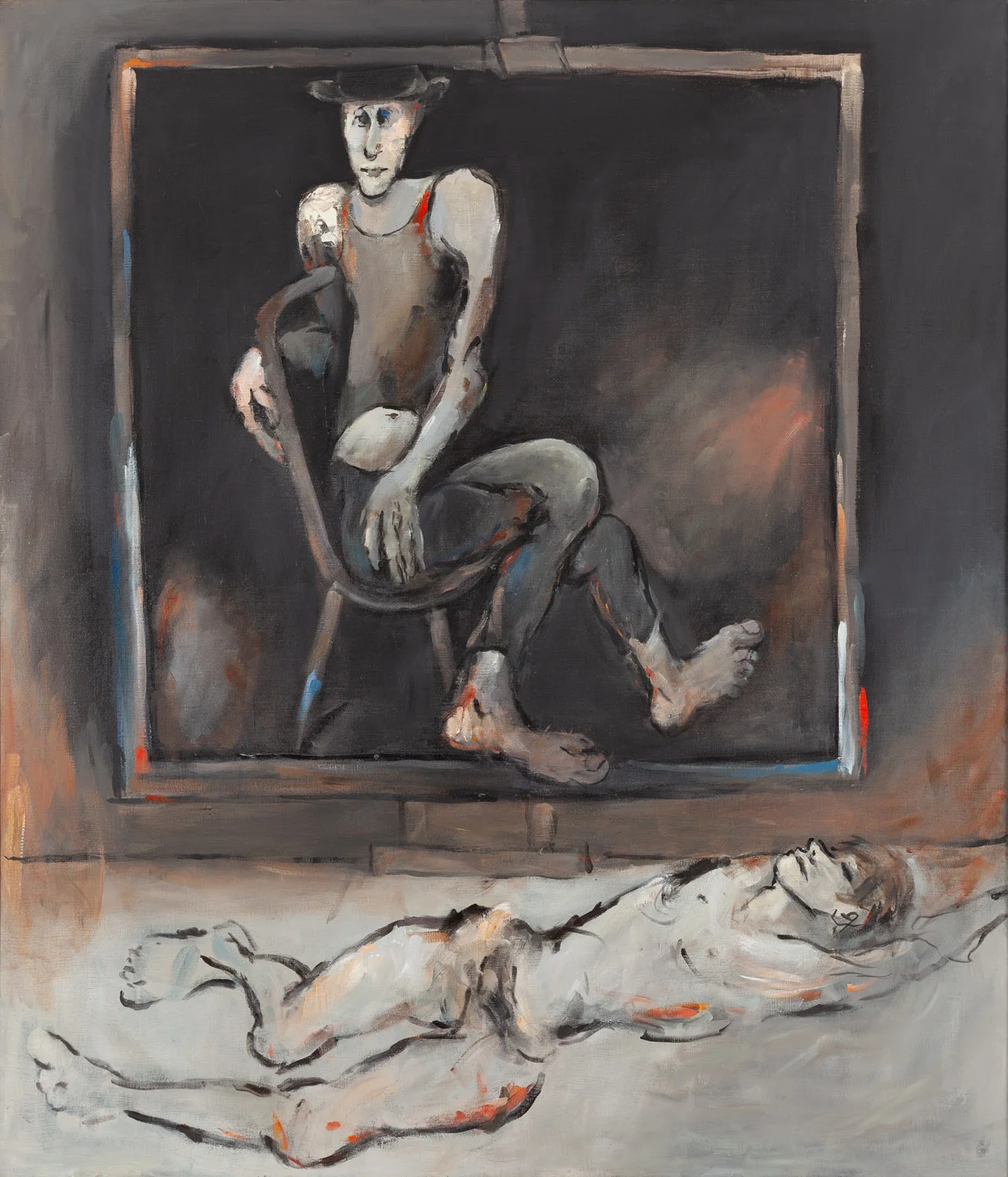
Thanks to the involvement of numerous investors, Stefania realized her dream. Tadeusz Kantor himself became the director of the Spicchi dell'Est gallery. The institution opened on June 11, 1990, attended by prominent figures from the Italian art world and numerous critics. The exhibition "Tadeusz Kantor. Opere dal 1956 al 1990" (11.06- 20.07.1990)" was a great success! It was during this event that the famous Italian actress, regarded as a cinema legend, Virna Lisi, purchased the painting "Some Figure Has Fallen out of the Picture and Turned out to be Only a Fiction," which is the last painted self-portrait of the artist, depicting him in two figures.
The gallery run by Stefania Piga was created to present art from Eastern Europe. During its 25 years of operation, the institution showcased works by artists such as Tadeusz Kantor, Henryk Stażewski, Tomasz Tatarczyk, and Franciszek Starowieyski. But the Pigas didn't stop with the most famous names. They continually discovered the universal dimension of the work of successive Polish, Lithuanian, Romanian, and Hungarian artists, organizing exhibitions and professional promotion for them. In November 2023, the exhibition "Tadeusz Kantor Café Europe" (13.11.2023-25.02.2024) at Cricoteka presented works by Tadeusz Kantor from the Pigas' collection.