
It Is Outrageous! Maria Balowa as Malczewski’s Model
"(...) A genius like Malczewski needed love as a theme and creative stimulant, in addition to longing (...) love had to be present in his life (...). Besides, unhappy love provides a lot of artistic inspiration."
- Michalina Janoszanka, Wielki tercjarz. Moje wspomnienia o Jacku Malczewskim, Poznań 1936, p. 261
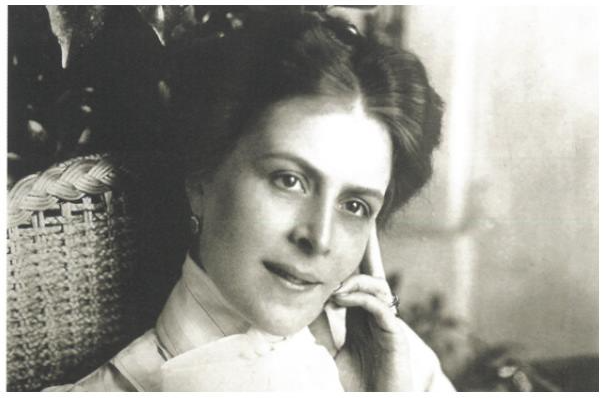
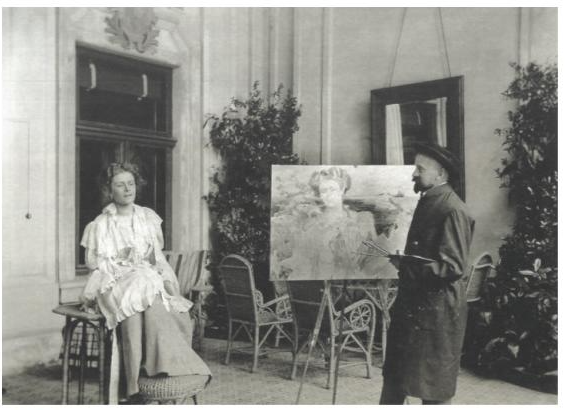
Located near Jarosław and Przemyśl, Tuligłowy became, as Stefania Krzysztofowicz-Kozakowska writes, "a sort of Eden for Jacek Malczewski, an escape from domestic and family troubles" (Jacek Malczewski. Życie i twórczość, Kraków 2008, p. 32). The estate was home to the district governor Stanisław Bal and his wife Maria, called Kinga or diminutively Kinia. Stanisław Bal became a patron and collector of Malczewski's works, and the estate housed an outdoor studio for the painter.
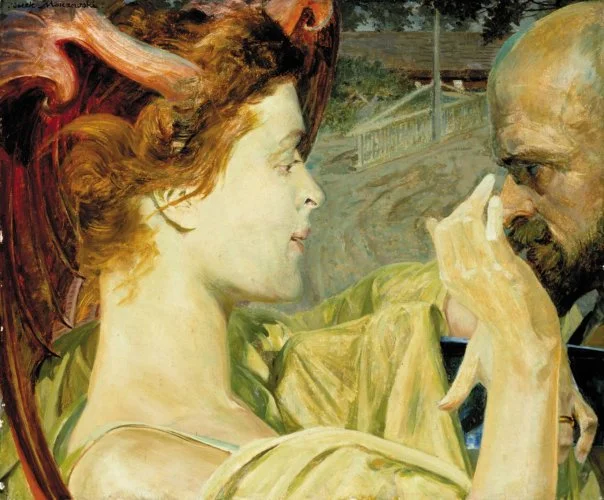
What drew Malczewski to Tuligłowy was Maria Balowa (1879-1955), the artist's beloved and muse, 25 years his junior. Regarded in her time as a red-haired beauty, she met Malczewski around 1900. Balowa, a salon lady with extensive artistic and intellectual horizons, proved to be an excellent companion for the painter. In 1906, they secretly traveled to Italy together, and their preserved correspondence provides ample evidence of the couple's deep affection. Balowa entered his life and his work: the figures of death, chimeras, muses, and harpies in many of his early 20th-century paintings are covert images of the artist's lover. The married artist did not hesitate to portray Balowa in scenes openly referencing romantic feelings. "She was Malczewski's lover," wrote Józef Czapski, "you often see her: all those angels have her face. And then she broke off sharply with him, I don't know why. It wasn't talked about" (Józef Czapski, Świat w moich oczach, interviews conducted by Piotr Kłoczowski, Ząbki-Paris, p. 167). The reasons for the lovers' abrupt separation remain unknown. It is believed today that it was Maria Balowa who ended the relationship, which lasted about 13 years.
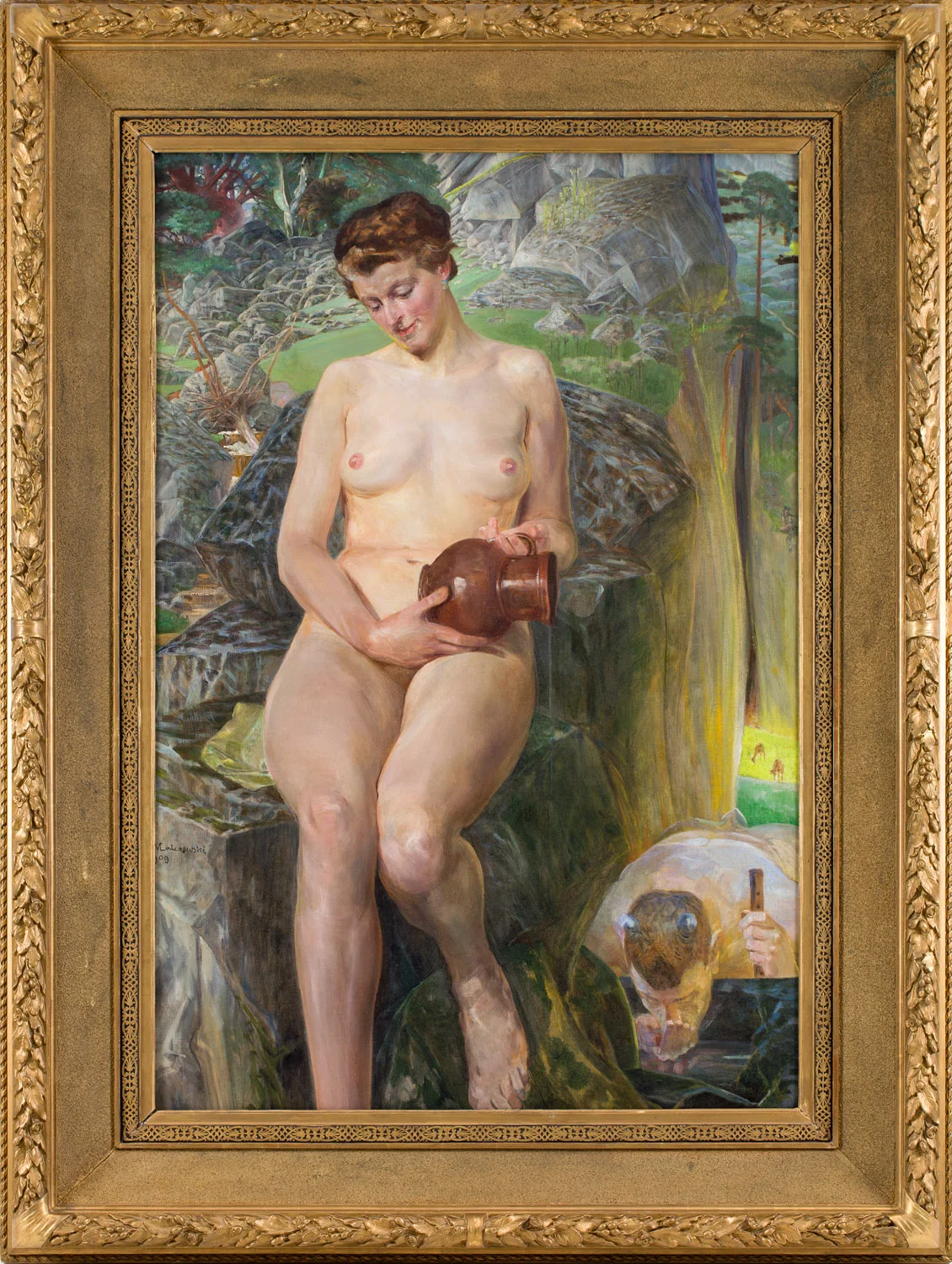
"There must have been exceptionally many rumors and speculations sparked by the composition titled 'At the Source of Truth', noted Paulina Szymalak-Bugajska. The face of Maria Balowa combined with a female nude, for which she herself did not pose but a professional model did, surely caused a stir among those aware of her relationship with the painter" (Paulina Szymalak-Bugajska, Malczewski. Zbliżenia, Warsaw 2023, p. 128). Though the scandalous impact of the painting must have been apparent at the time of its creation, the symbolic vision contained in the work points to the affection for Balowa. In other paintings, Balowa often plays the role of terrifying mythical figures, while in "At the Source," she nourishes a thirsty faun, bringing life-giving energy.
Malczewski's artistic education took place in the 1870s. In 1872, he began studying drawing in Krakow, first under Leon Piccard, then as an irregular student under Władysław Łuszczkiewicz at the School of Fine Arts. From 1873, he studied regularly with Łuszczkiewicz and Feliks Szynalewski, additionally taking private drawing lessons from Florian Cynk. In 1876-77, he studied under Henri Ernest Lehmann at the École des Beaux-Arts. This period gave rise to the rare academic studies such as the oil painting Nude (1876, private collection). Paulina Szymalak-Bugajska indicated that "a year-long stay in Paris allowed Jacek Malczewski not only to work on his artistic technique, realizing his shortcomings in this area but also helped him free himself from the shadow of Jan Matejko and his concept of historical painting" (Paulina Szymalak-Bugajska, Malczewski. Zbliżenia, Warsaw 2023, p. 22), which he absorbed in the circle of the Krakow School of Fine Arts.
Although historiography eagerly highlights Malczewski's rebellion against Matejko and his art, it rarely emphasizes how much the painter owed to European academic art. The names of his early teachers indicate that young Malczewski moved in circles strongly traditional and adhering to post-Renaissance principles of art. His studies in Paris undoubtedly deepened these initial academic skills, developing not only his painting technique but primarily his drawing skills. According to academic doctrine, it is possible to determine the truth about art, and by this measure, the mastery of a work can be assessed. Truth is linked with the concept of beauty, which in the modern era was idealized through the works of the Ancients. The Renaissance canon assumed that art should imitate nature, but within the Academy's circle, this nature was to be stripped of all imperfections. It was through the Renaissance that modern Europe inherited the Greek image of the body, clarified in the 5th century BCE, embodying ideal beauty and harmony of the world in miniature through construction based on logical, almost mechanistic principles. Historical painting, which André Félibien placed highest in his academic hierarchy of subjects, was fundamentally based on the primacy of the human figure.
Malczewski's Parisian master, Henri Lehmann, was a well-known author of large decorative academic compositions and a pupil of the most important French neoclassical painter, Jean-Auguste-Dominique Ingres. The eccentric renditions of the female nude took a central place in the work of this unorthodox classicist, admired by subsequent generations of artists for formal perfection. Ingres almost codified the model of a smooth, flawless body, repeated throughout the 19th century. The connection between Malczewski's "At the Source of Truth" and Ingres's work was noted by Jadwiga Puciata-Pawłowska in 1968, comparing the presented work to Ingres's famous "The Source" (1820-1856, Musée d'Orsay, Paris). Art historians justified this inspiration by the imagined artistic kinship between Malczewski and Ingres, rooted in both painters' admiration for the art of drawing.
"At the Source of Truth" also brings to mind the painting of Swiss artist Arnold Böcklin. Like Malczewski, Böcklin, drawing from his academic training, cultivated symbolic painting grown from his fascination with antiquity. "At the Source of Truth" can be associated with Böcklin's Nymph at the Fountain (c. 1855), housed in Sammlung Schack in Munich. Although during his stay in Munich in 1885-86, the artist was already engrossed in Siberian visions, he went there to "advance in technique." Numerous Böcklin paintings displayed in the public gallery of Count Schack in Munich undoubtedly provided significant inspiration for the artistically developing Malczewski. This experience's subtle reflections can be seen in the 1909 composition. Malczewski placed a naked figure at the center of this large composition, adhering to academic ideals in art.