
Imaginarian
“The dark force is the force of instinct. It is the power of sexuality, eroticism, and all that we push into the subconscious, that reveals itself in our disturbing dreams." - Łukasz Korolkiewicz
Łukasz Korolkiewicz is one of the most outstanding artists active in Poland at the beginning of the 21st century. The artist made his debut in the 1970s and already at that time he developed a unique painting formula. Even today, he remains faithful to it. From the beginning of his activity on the art scene, he did not follow the mainstream, the artist has remained in opposition to contemporary styles and neo-avant-garde tendencies. In addition, he has not been interested in political issues (with one exception in the 1980s, when Korolkiewicz depicted the harsh reality of martial law in Poland). His paintings have been dominated by isolated, private scenes, located somewhere outside of social life. Some of them are numerous flashbacks and memories related to the artist's childhood. He draws attention to the unnoticed moments in our everyday lives, aiming at giving them proper status. He seems to be fond of the play of light on glass bibelots or muslin curtains that vibrate under the influence of the wind. It is there that Korolokiewicz's painterly depictions take place.
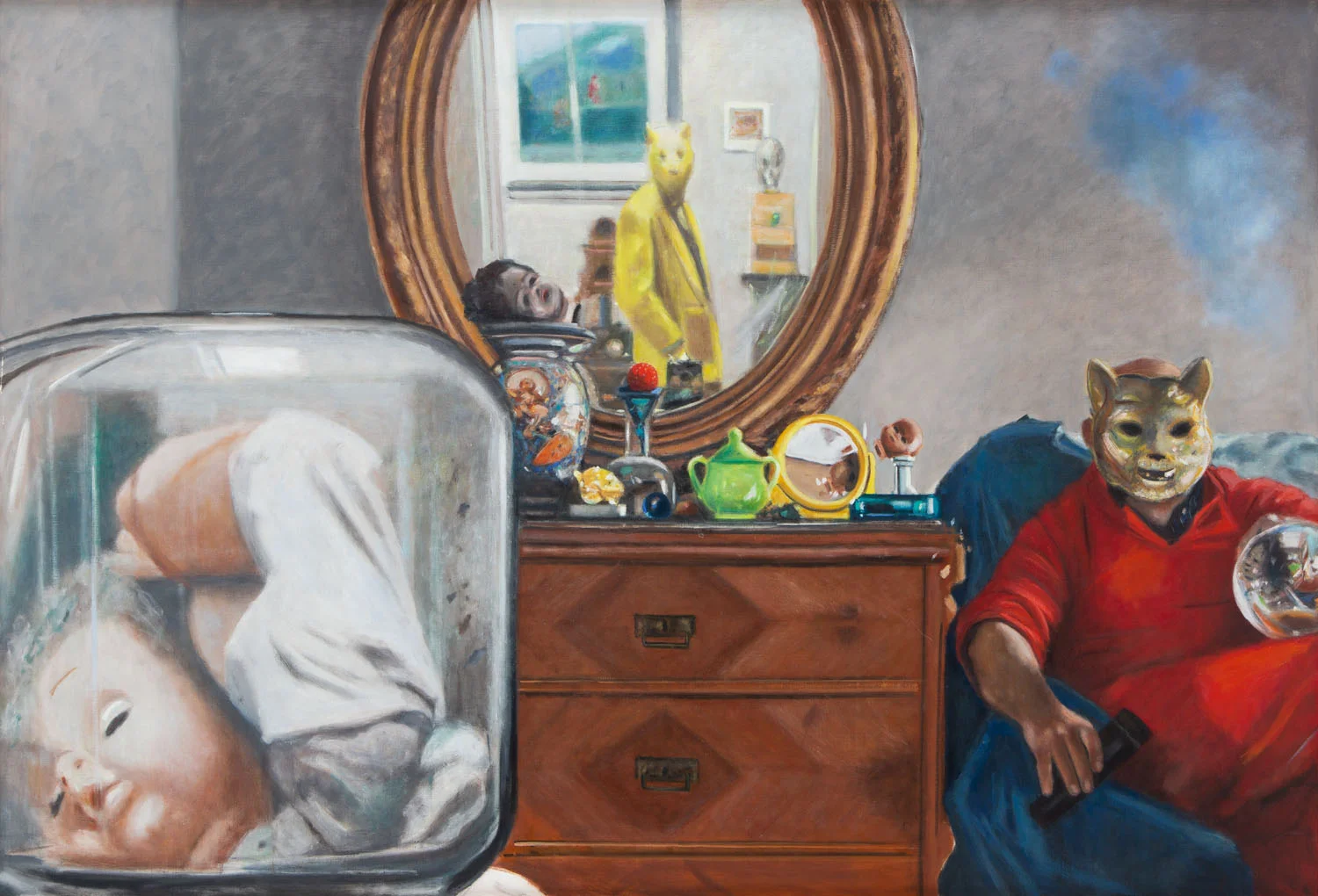
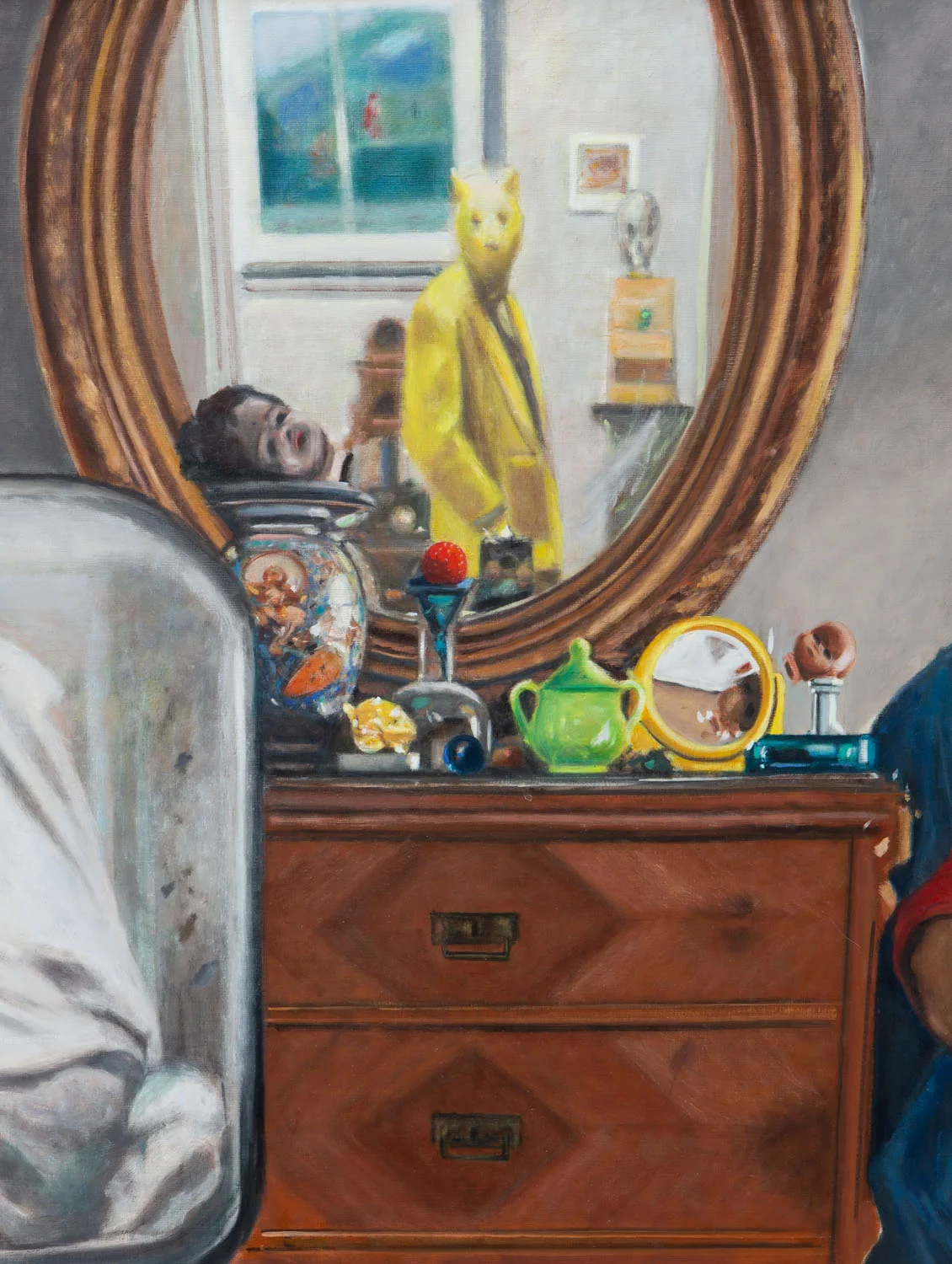
The painting "Imaginarian" from 2011 was maintained in such a tone. The work presented at the exhibition "Łukasz Korolkiewicz. Periphery" shows a fragment of an interior. The eyes of the viewer and the painter depicting this scene fall on the vanity table with a mirror. The furniture is covered with bibelots. On the left side, there is a glass container, inside of which there are detached doll elements: head and hands. On the right side, we see a masked figure dressed in red who is sitting on a blue armchair. The man holds a glass ball. The characteristic, hairless head, which peeks out from behind the golden wolf mask, may suggest that it is a self-portrait of Korolkiewicz. Another masked figure is reflected in the mirror - the scene is probably presented from the perspective of this person. The artist juxtaposes seeming light-heartedness with something mysterious and disturbing, which is very typical of his art. In a characteristic manner, the work depicts an interior of a private apartment and the peculiar lighting that brings to mind the 18th-century Dutch painting. However, the artist emphasized that he is more interested in the atmosphere than in a visible and recognizable reality. As Korolkiewicz himself once said,
"My style of painting has perhaps more in common with painters of the turn of the 19th and 20th centuries than with contemporary creators, for example, photorealists. Consequently, I often do not consider myself a so-called modern painter at all. Such a painter usually uses quite flat forms that are very simplified. These images are somewhat board-like. I don't like them very much, because they present only the things they present. There is no second or third layer in them, at least for me, which can be noticed after long contemplation. In my paintings, you can notice such things. I try to look at the world in an "old-modern" way and the painting matter in my works is actually very traditional."
(Łukasz Korolkiewicz, Prof. Łukasz Korolkiewicz: Staram się patrzeć na świat w sposób "staroczesny", 16.05.2018, https://www. polskieradio.pl/8/3869/Artykul/2121895,Prof-Lukasz-Korolkiewicz-sta- ram-sie-patrzec-na-swiat-w-sposob-staroczesny, accessed on: 6.09.2021).
Kinga Kawalerowicz, the curator of the exhibition where the "Imaginarian'' was presented, wrote,
"Korolkiewicz's careful look freezes in the frame of his painting the visual aspects of the reality around us that often seem uninteresting, devoid of meaning, sometimes embarrassing in their poverty and grayness. Under the artist's influence, they gain unexpected expression, and seduce the eye with their suggestiveness of painterly magic, as if in spite of selected motifs. Sometimes, the paintings take place in home interiors, in which surprising objects, some bizarre bibelots and remote-controlled toys, enter into secret relationships with each other, as well as with the melancholy director of these ironic and poetic arrangements - the artist. In this painterly world, color and light create a whole range of emotional atmospheres, which make up the unique, melancholy and ambiguous, character of Łukasz Korolkiewicz's paintings. The images presented by the painter raise anxiety through the understatements typical of his art, maintaining his depictions on the border of reality and imagination. They refer to our subconscious mind, to what is hidden, to our own psychic peripheries."
(https://www.atak.art.pl/pl/wystawy/archiwum/110-lukasz-korolkiewicz-peryfe- rie.html)
See more