
Family Mourlot. Generations of lithography masters
Studio Mourlot is one of the most significant places on the map of printmaking in modernism. Here, lithographs were created by everyone, from Matisse, Braque, Miró, Chagall, Ernst, Picasso, Buffet, Delvaux, and Magritte, to Lichtenstein and Hockney. Thanks to the Mourlot family, printmaking entered salons and became a fully-fledged art form, both for artists and collectors.
The history begins in 1920, when Fernand Mourlot changed the purpose of one of the family printing house's premises (operating since 1852), focusing exclusively on printing lithographs and artistic posters. The beginnings were not easy, but Mourlot's continuous experiments with inks, mixtures, and techniques led to a breakthrough. This occurred in 1937, when the studio created two posters based on paintings by Matisse and Bonnard for the "Maitres de l'Art" exhibition at the Petit Palais in Paris. Their quality resonated widely in the artistic community, and the studio began collaborating with the leading art magazine "Verve." Mourlot prepared editions of the highest quality lithographs for "Verve," featuring Matisse, Braque, Bonnard, and Miró. Thus, after years of producing wallpapers, maps, and packaging, Studio Mourlot became one of the most important centers for the distribution of 20th-century printmaking art, and Fernand Mourlot became a close friend of the greatest artists of that era.
Marc Chagall
Chagall was one of Mourlot's most important clients, so it is not surprising that he was assigned a dedicated craftsman, Charles Sorlier, who eventually became a great friend of the artist. Sorlier was responsible for printing most of Chagall's lithographs. The prints featured not only the artist's signature but also the name of the engraver of the lithograph, underscoring the importance of the process, technique, and trust.
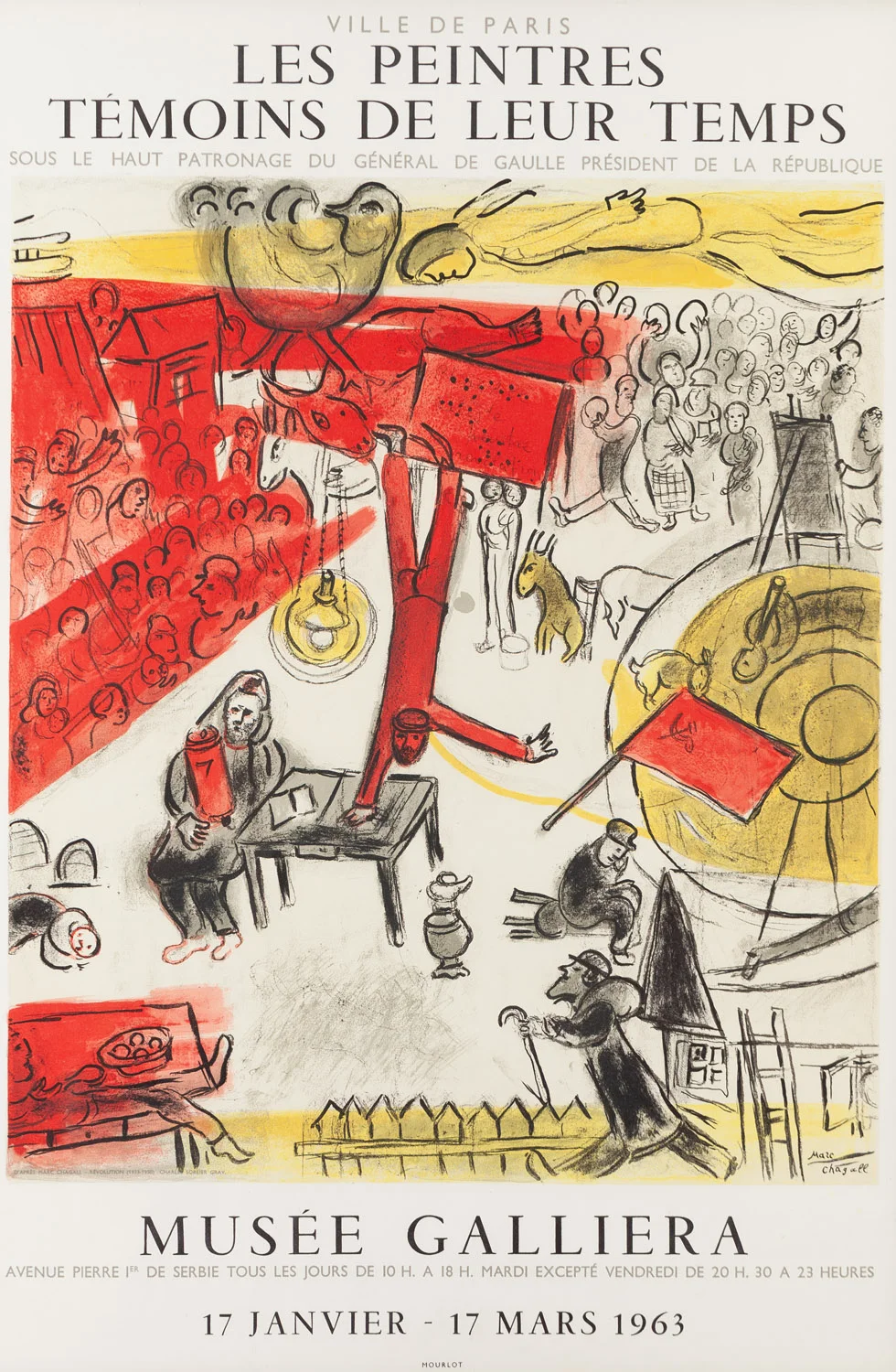
An example of this collaboration is the lithographic poster from 1963 for the exhibition "Les Peintres Témoins de Leurs Temps" ("Painters: Witnesses of Their Times"). The central figure is Vladimir Lenin, doing a handstand on a table, dropping a red flag with a sickle and hammer.
Another example of the collaboration between Chagall and Sorlier is two lithographs on wove paper (cover and double-sided insert with the work "Mystical Crucifixion") published by Maeght Éditeur in the legendary periodical "Derrière le Miroir" (No. 27-28 from 1950). It is worth noting that Studio Mourlot printed all lithographs for this art magazine until issue 115, when Adrien Maeght decided to establish his own printing and lithographic workshop – ARTE. This illustrates how, both artistically and in business terms, lithography became crucial during that time.
"It's incredible how many people don't understand what a print is, thinking it's just a reproduction, but it's not. (...) (…) It's a medium like any other."
- Eric Mourlot.
Pablo Picasso
In 1945, most likely thanks to Georges Braque, Pablo Picasso appeared in the Mourlot workshops. Picasso, with his extravagance and constant experiments (using substances such as turpentine, gasoline, and wax in working with the stone), gave lithography an entirely new dimension, becoming a kind of "enfant terrible" of this printing technique. "He arrived as if going into battle," observed Fernand Mourlot.
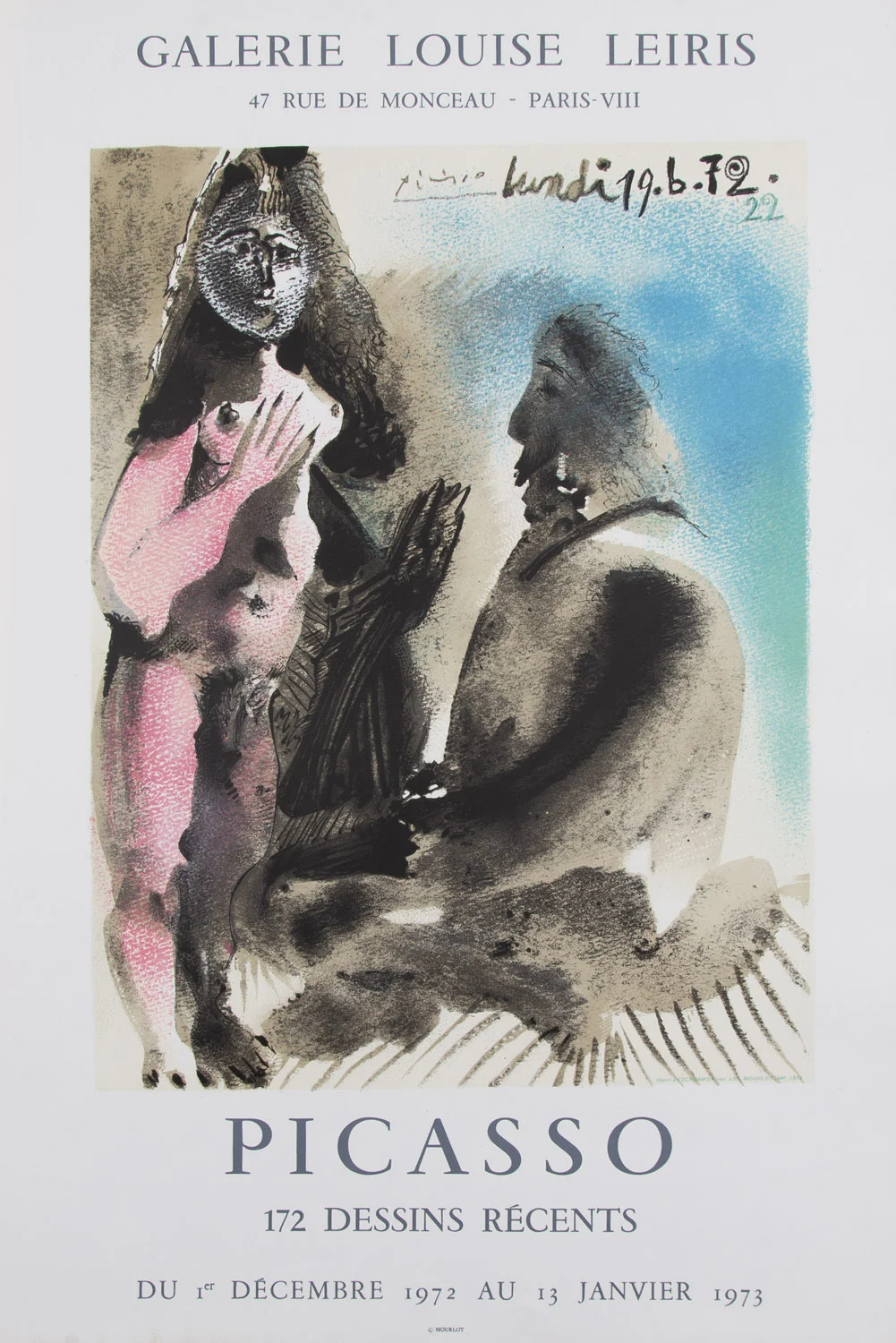
But even Picasso needed a trusted assistant who could materialize all his wildest and strangest ideas. Once again, it turns out that the art of lithography is teamwork, and Picasso's team partners were printing master Gaston Tutin (responsible for most of the nearly 400 works by Picasso produced in Mourlot until 1969) and Henri Deschamps, who transferred the Master's images and drawings to lithographic stone. The name of the latter can be found on the poster for the exhibition "172 Dessins Récents" (172 Newest Drawings) at Galerie Louise Leiris in 1972. The original drawing of a young woman with the aging artist was reproduced by Deschamps just a few months before Picasso's death, concluding almost three decades of their collaboration.
Max Ernst
Max Ernst, one of the most important representatives of the Dada movement and later Surrealism, also had a lively collaboration with Mourlot. Here, for example, is his lithographic poster for the exhibition "Le Surréalisme. Sources - Histoire - Affinités" (Surrealism. Sources - History - Affinities) from 1964 in an edition of only 500 copies.
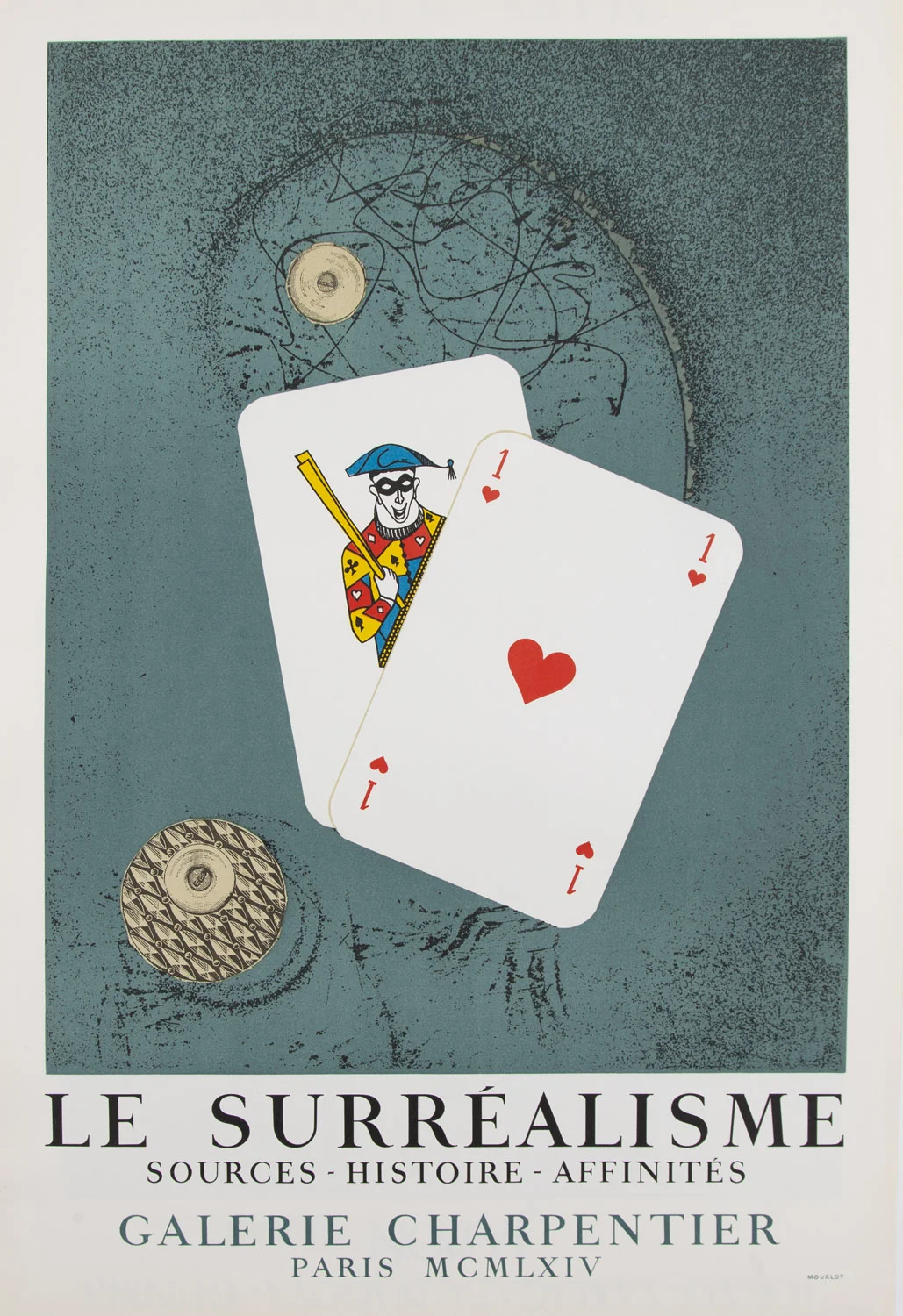
In 1967, Ernst's work adorned the poster for the opening of the Mourlot Studio branch in New York, where Fernand's son, Jacques Mourlot, would continue his father's work, collaborating with artists such as Rauschenberg, Bacon, Lichtenstein, and Katz, creating contemporary lithographic masterpieces.
"An artist takes a fatty, oily substance, which is lithographic ink, and draws directly on the stone. It has to be limestone; the best limestones are from Bavaria. We have some in France, but they are not as good."
- Eric Mourlot
Rene Magritte
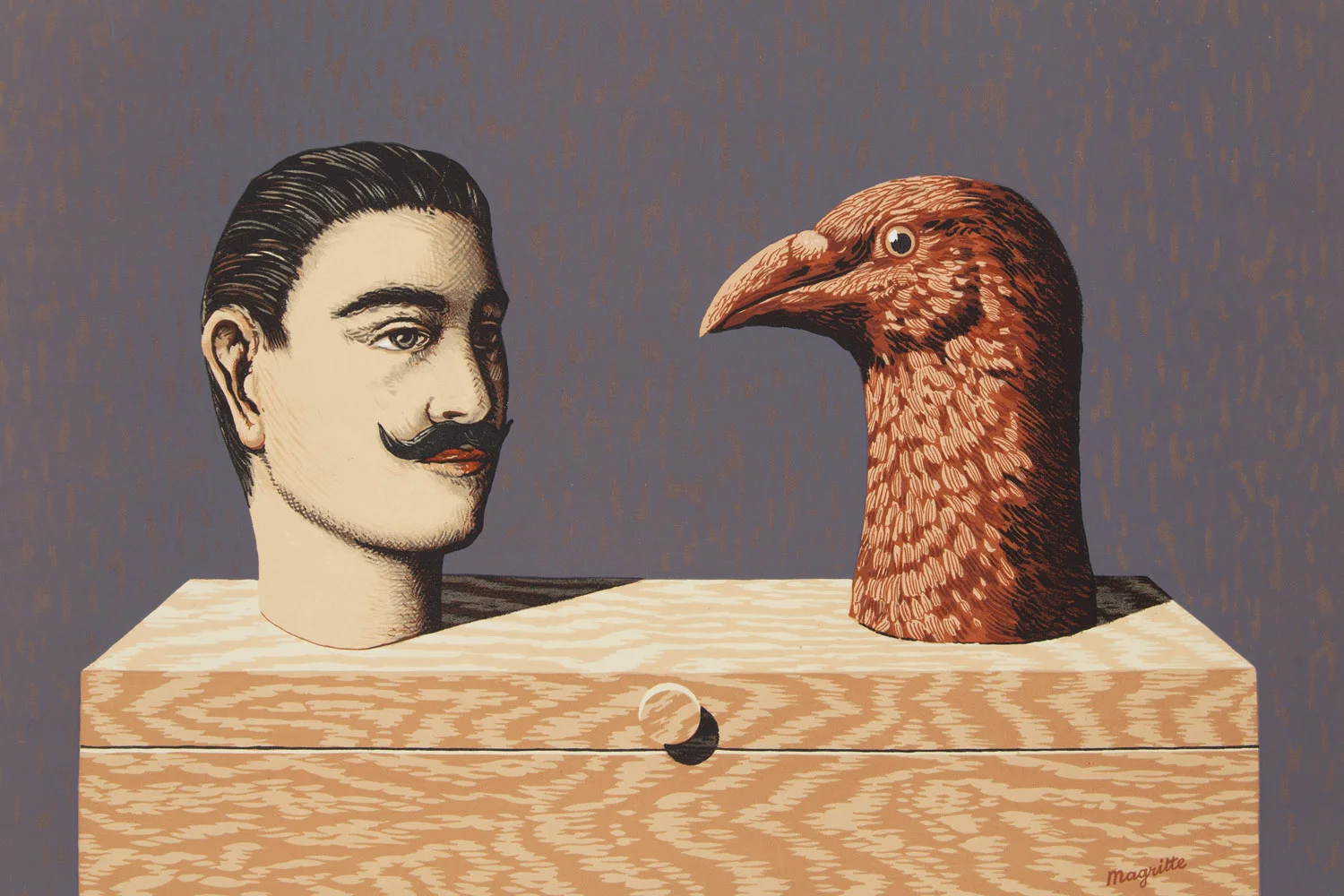
In 1968, Mourlot published a collection of twelve lithographs by René Magritte, titled "Les Enfants Trouvés" (Found Children), prepared and approved by the artist during his lifetime and released shortly after his death. This represents a kind of artistic testament, the legacy of one of the most important artists of the 20th century, bringing together his favorite themes, ideas, and symbols. From this collection, issued in an edition of 350 copies, comes the work "Pierreries" (Stones), printed on wove paper and signed in pencil by Fernand Mourlot himself.
Studio Mourlot closed in 1999, but the gallery run by Fernand's grandson, Eric Mourlot, still operates in New York, promoting printmaking and artistic graphic design. Our auction presents a snapshot of almost 50 years of the atelier's activity in artistic lithography. The oldest print offered is a pre-war poster by Bernard Naudin commemorating the 150th Anniversary of the French Revolution. It is worth taking a closer look at the rare work "Le lézard aux plumes d'or" by Joan Miró from 1969, or the three posters by Dalí printed for the opening of his Teatro Museo in Figueras in 1974. The last lithograph presented is a poster for Chagall's exhibitions in Japan, printed shortly after the artist's death by the aforementioned Charles Sorlier.
"I would like to become a printer again. I still have a few presses, and maybe someday I'll return to it. I really like printing – I learned it as a child, working in the studio, cleaning rollers, and so on. It was such a wonderful, happy place."
- Eric Mourlot