
Ewa Kuryluk. Anxiety of existence
Ewa Kuryluk abandoned hyperrealistic painting in 1978. At that time, she had achieved numerous successes worldwide and was at the peak of her career. The bold step of giving up familiar means of expression resulted in deepening the ambiguity of representations and the significance of the painting substrate. At the end of the 1970s, she started creating works on canvas without a stretcher. The main means of expression for Ewa Kuryluk became a minimalist drawing applied to sheets, which the artist began to loosely hang on walls, objects, and furniture, as well as arrange on the floor. The first spatial installation was presented at the Eastern Wall Gallery in Warsaw in 1979.
Kuryluk has always led a nomadic lifestyle, frequently moving for political, personal, or professional reasons. From an early age, she changed countries and continents, finally settling in Paris in recent years. These numerous changes of location had a significant impact on her work, which needed to be easily transportable. In the 1980s, fragments of fabrics in the form of scarves, veils, and tents dominated Kuryluk's work. The light and small form allowed for easy transportation of objects-and consequently, traveling with them. Thanks to the ease of shaping, the images began to acquire new artistic values and became works on the border between painting and sculpture. In 1981, the path of life led Ewa Kuryluk to New York. The stay, forced by martial law in Poland, became highly significant for her art. Living and working in the United States, Ewa Kuryluk began placing installations and individual works in the landscape. The artist presented veils in public spaces, mainly to photograph them in various locations. At that time, installation became a leading artistic discipline in the United States. The first textile art show by Ewa Kuryluk, held at Helen Schlein's, was classified by the "Boston Globe" as one of the best exhibitions of 1982. After a successful presentation, she was invited to numerous symposia and exhibitions. Her name, as well as the art she created, became recognizable.
Małgorzata Baranowska described Kuryluk's works on fabrics as follows:
"The form found by Ewa Kuryluk constitutes a separate world. The painter uses various vivid genres. Moreover, they have been known to humanity for centuries and millennia. And what is a discovery if not looking around and discovering species existing in a completely new function? What are we talking about? About a scarf, a veil, a curtain, lace, a screen, a mat, a doily, a ribbon, a tent. Chosen by Kuryluk, the form contains a lot, even symbolic books that appear on a scroll inspired by ancient Egypt. From a piece of fabric thrown on a chair to a book, scarf, veil-all installations cover sparse in color but extremely vivid portraits, self-portraits, and nudes. Kuryluk draws the human body very precisely. She does it afterwards, after draping, creating an unusual impression thanks to the twists of the 'basic' drawing on canvas or silk. Additionally, some installations are double fabrics, with a mystery that emerges from under the lifted corners of the outer fabric or from specially cut holes. This cut layer hangs like peeled skin and sometimes creates an unsettling impression. Especially since you cannot be sure what will emerge from under it. It may be densely covered with text in black, red, or blue on the lower layer. Or a face may appear, or we may see bloody traces. Although Kuryluk tries to carry with her the skin of the image itself, sometimes she reveals the next, unexpected layer"
- Małgorzata Baranowska, Effi Briest [in:] Ewa Kuryluk. Rysunki. Instalacje, exhibition catalog in the Manggha Museum of Japanese Art and Technology in Krakow, Krakow 1997, s. 9.
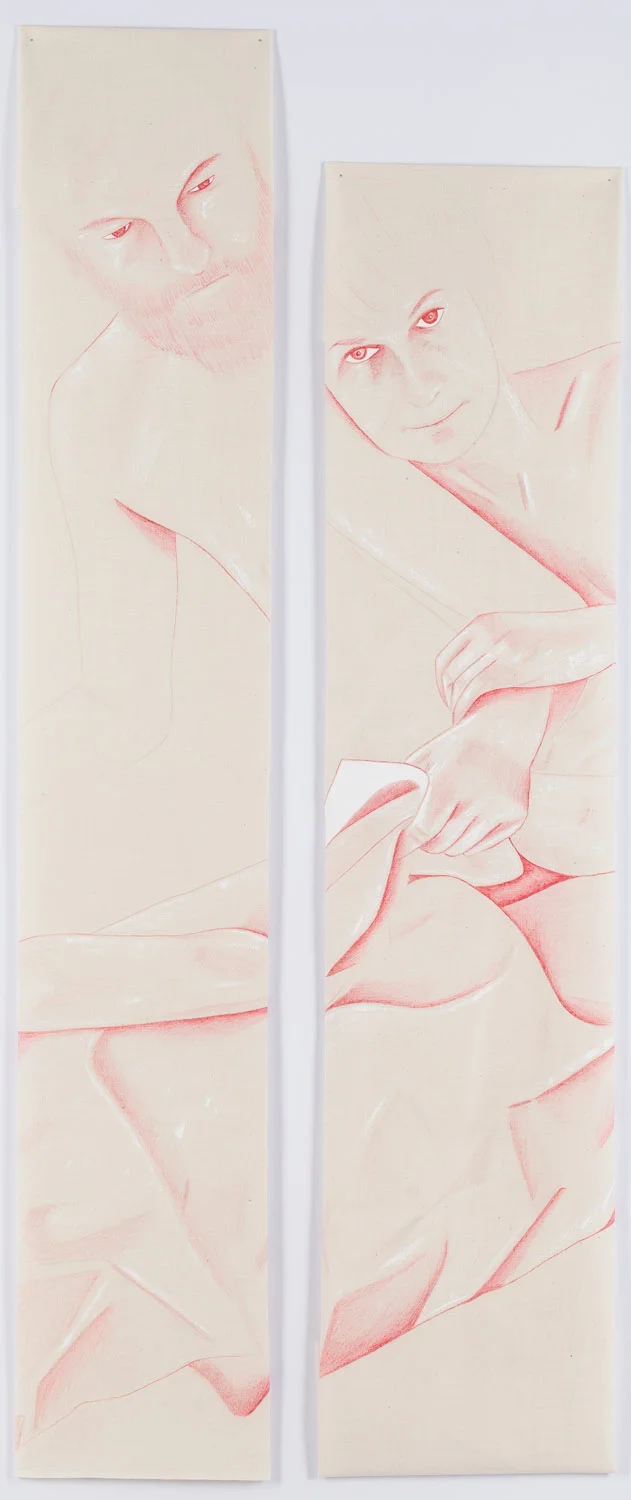
Kuryluk's choice of material is never random. The artist emphasized that the material she chooses has enormous significance. Fabrics wrinkle in different ways and carry different associations and cultural contexts. The cotton material used in the work "Together," according to the artist, "forms a sculpture by itself." It is worth noting that the artist formed the draperies behind the glass of the frame. The material was not bleached, so it retained its naturally yellowish color and straw scent. Kuryluk sketched herself in red ink on the material alongside her beloved partner, Helmut Kirchner. Ewa Kuryluk's textile works have always been very intimate. The autobiographical nature of her art resonates in most of her works. The artist records stories, both her own and those of her close ones and family, through drawings on fabric. Colors in Kuryluk's works also carry meanings. Pink is associated with a sign of salvation and hope for her, while red leaves a bloody trace of existence, becoming a record of suffering and desires. When Ewa Kuryluk created a portrait of her brother by drawing his likeness with rust-colored ink on a small piece of cotton fabric, she noted:
"I understood that I act vicariously. Instead of the body, I will 'pin' its 'shadow'; I 'injure' a semblance of skin." Here, she referred to the legend of the girl from Corinth, the first creator of the idea of "outlining a shadow" and immortalizing love. Another reference found in her works is to the Veraicon, or the veil of St. Veronica, on which, according to beliefs, the image of Jesus Christ was miraculously reflected. However, Ewa Kuryluk focuses not on the sacred, religious aspect but on the sensual, bodily one. The veils strongly emphasize sexuality. Kuryluk identified the chosen fabric with skin and the drawing with its mutilation. She spoke of the "desire to make a copy of the unique fate of an individual in art, to perpetuate their outline and gesture, heartbeat, and words, shadow."