
Awangardowy panteon. Witkacy, Linke i Schulz
Julia Olszewska
Stanisław Ignacy Witkiewicz (Witkacy) – painter, draftsman, playwright, philosopher, and art theorist – was highly avant-garde in his endeavors, moving within equally avant-garde circles. Among the group of notable figures close to Witkacy, two artists stand out: Bronisław Wojciech Linke and Bruno Schulz, with whom he shared a friendship and artistic bond.
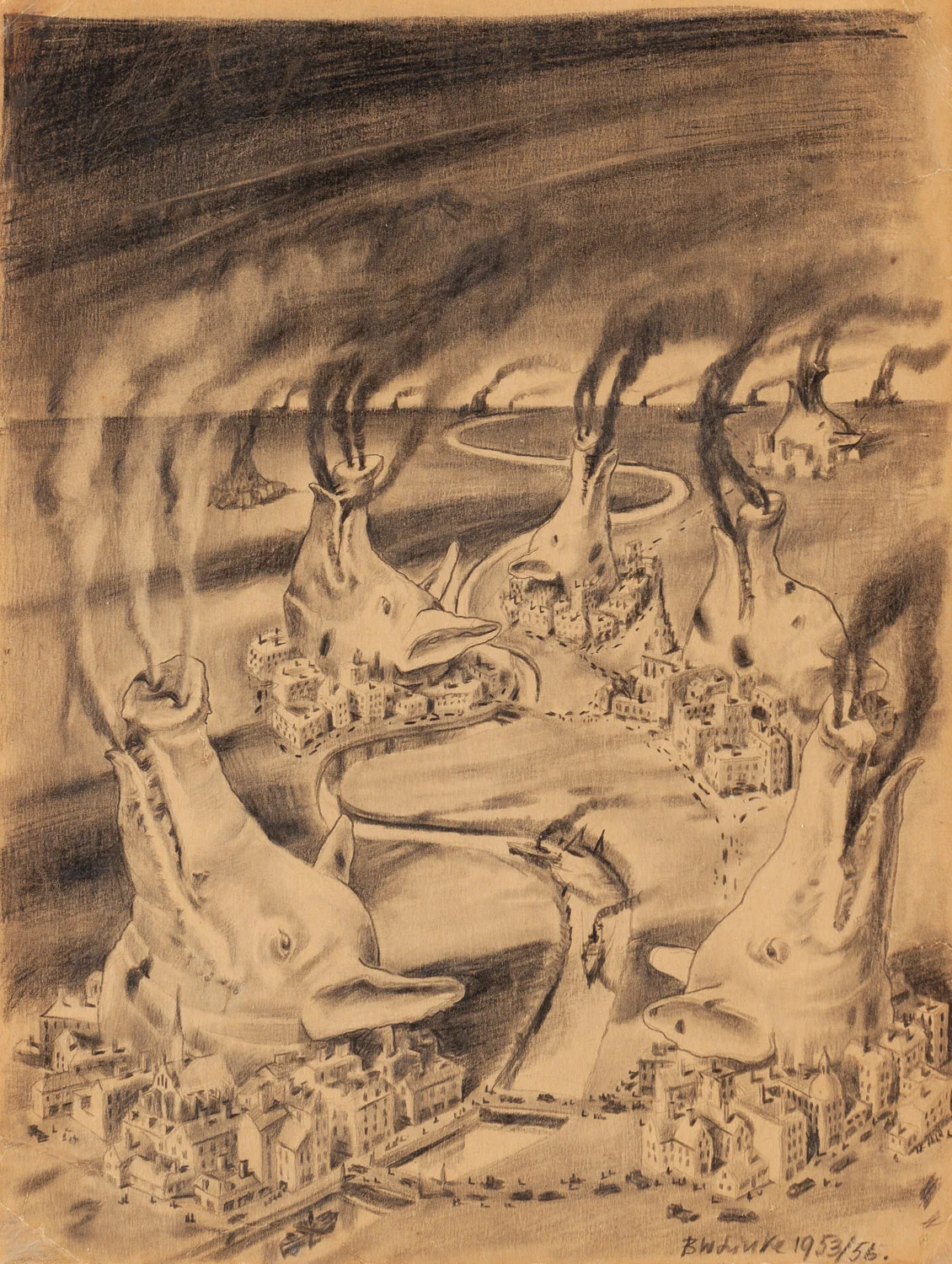
Linke likely entered Witkacy's life in 1935, though how exactly they met is unclear. However, it is known that in 1936 the two men embarked on a trip through Silesia, which had a significant impact on Linke's future work. From a young age, Linke had been exposed to fear, terror, and horror, witnessing revolutionary scenes in Estonia. This experience led him to create socially engaged art depicting a brutal, unjust reality. The trip to Silesia inspired Linke's Silesian Cycle, a series that metaphorically and somewhat grotesquely portrayed social inequalities, exploitation, and the tragedy of human existence. At that time, Witkacy wrote to his wife: "Linke never leaves the smelters and poverty shafts" (quoted in: J. Degler, Kronika życia i twórczości Stanisława Ignacego Witkiewicza, in: Witkacego portret wielokrotny, Warsaw 2009, p. 104). Observing Linke at work during this trip prompted Witkacy to write the text Hut ab, meine Herren – ein Genie! (A Thing about the Artistic Work of Bronisław Linke), in which he expressed admiration for his friend, for whom he was also something of a mentor. Between the lines of Witkacy's theory of Pure Art, we can read: "Linke is a school and a class intrinsically, and probably the highest class at that... […] In the face of the pure intensity of ‘Linkeism', one can only speak of congeniality: such intensity can only come from the most essential innards of an individual, never from some reworking of someone else's stuffing or form, no matter how perfect" (quoted in: S.I. Witkiewicz, Hut ab, meine Herren – ein Genie (Rzecz o twórczości malarskiej Bronisława Linkego), in “Tygodnik Ilustrowany" no. 8–9, 1936). Witkacy also noticed in Linke's work references to the horrific, “nauseatingly democratic" reality, repulsive in its hypocrisy. It seems, therefore, that both artists shared a view of the metaphysical decay engulfing not only humanity but the world itself. Linke's art was entirely dedicated to the human cause, condemning capitalism, fascism, and all dictatorships. His visual works addressed the same themes that Witkacy explored in his dramas. The visual art of both men hovered on the boundary of reality, metaphysics, and nightmares. Wrapped in grotesque and irony, they exposed the illusory nature of the material world. Catastrophism was an element that accompanied both artists in their daily lives, finding its outlet in their visual art. Although their friendship did not last long, only until 1939 when Witkacy died, their mutual understanding and admiration for each other's views and work were undeniable.
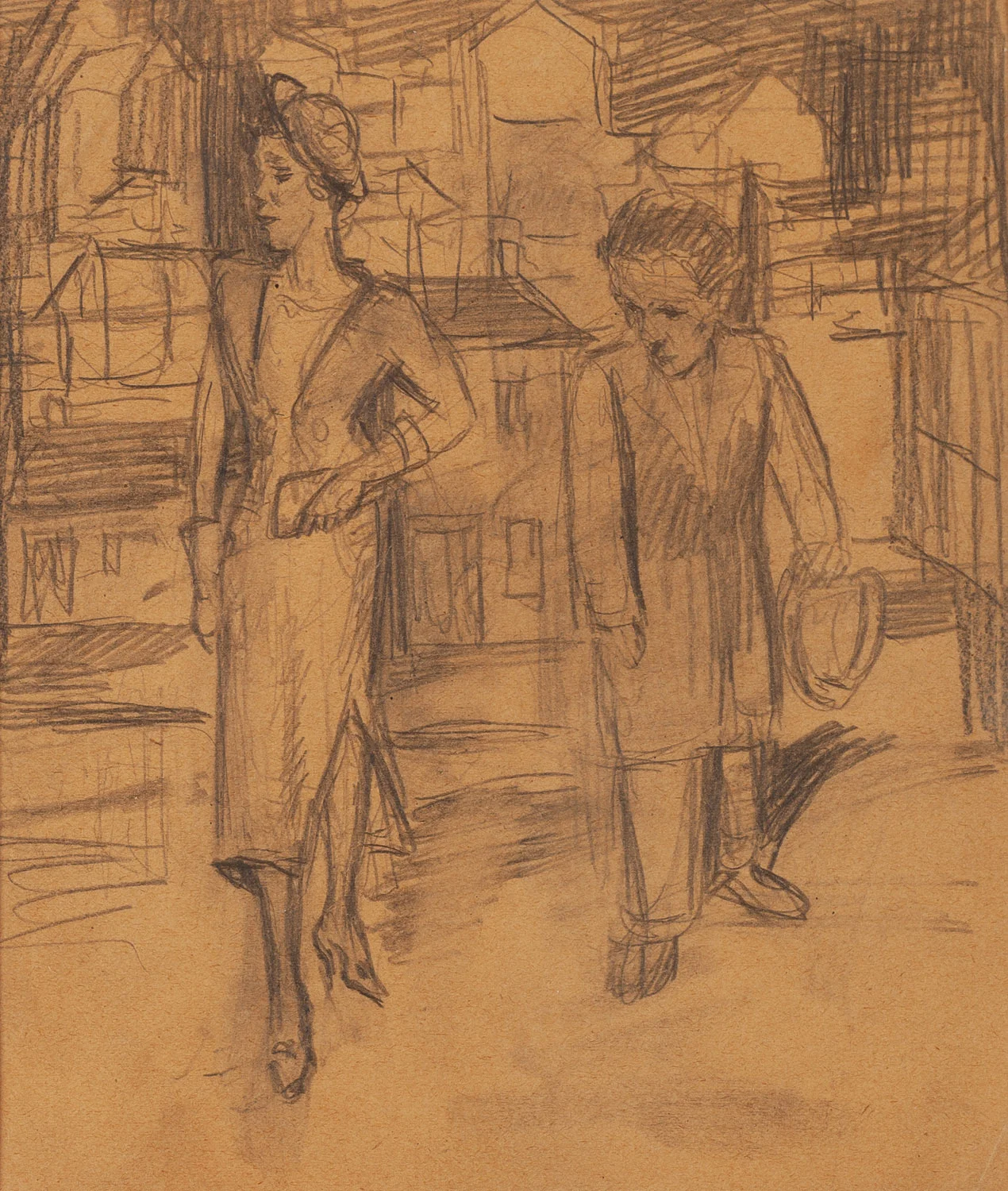
Witkacy undoubtedly regarded Linke as a genius, no less than he considered another of his friends – Bruno Schulz. Witkacy's fascination with Schulz initially manifested on a purely literary level, as he was captivated by The Cinnamon Shops, which Schulz published in 1934. This collection of stories marked the beginning of a close friendship between the two artists. Witkacy saw in them a reflection of the nightmare world he himself lived in. The two artists exchanged correspondence, with Schulz often including drawings in his letters at Witkacy's request. In one of his letters to Witkacy, Schulz wrote: "To the question of whether the same theme appears in my drawings as in my prose, I would answer affirmatively. It is the same reality, just different fragments of it. The material and technique serve as a principle of selection. Drawing imposes narrower boundaries through its medium than prose. That's why I feel I have expressed myself more fully in prose" (quoted in: Do Stanisława Ignacego Witkiewicza, “Tygodnik Ilustrowany" 1935, no. 17). Witkiewicz immediately identified with both Schulz's prose and his drawings. In fact, he did the same thing in his own work. The two artists spent much time discussing art and exchanging ideas. Their frequent debates also touched on the relationship between men and women, a theme present in the works of both. Witkacy regarded Schulz as an expert on female sadism combined with male masochism, which together formed a unique blend that Witkacy also portrayed in a somewhat more surreal manner in his works.
Witkacy shared much with both Linke and Schulz, though in slightly different ways. With Linke, he shared a metaphysical view of the world's collapse and its falsehoods, as well as a critique of capitalism. With Schulz, he shared an obsession with women and a vision of a nightmare-like world. These three artists, writers, and philosophers earned a well-deserved and lasting place among the avant-garde figures of the 20th century.