
Artistic Journeys of Julian Fałat - Artist’s Profile
5 MINUTE WITH...
Jan Rybiński
During his lifetime, Julian Fałat (1853-1929) quickly gained recognition and international fame. In 1886, he was invited to Berlin to serve as one of Prince Wilhelm of Prussia's court artists, carrying out the court's commissions for the ensuing ten years. In 1893, he was nominated as a member of the Berlin Royal School of Art. Two years later, Fałat became the principal of the School of Fine Arts in Krakow, radically reforming its educational curriculum. He offered a professorship to a group of the most outstanding modernists, opening a new chapter in the history of Polish artistic education and laying the foundations for the Academy of Fine Arts, established in 1900. The artist became the head of the University in 1905.
Fałat's artistic path and evolution were comparable to those of many other artists during the modernist Young Poland period: beginning with realistic scenes, through adaptations of lessons in impressionism, and finishing with integrating elements inspired by Japanese art. Our upcoming auction “Works on Paper. 19th Century and Modern Art" presents you with examples of the most significant motifs undertaken by Fałat, starting with portraits, through synthetic landscapes inspired by Japanese art, ending with a unique portrait of the artist's wife maintained in the modernist poetics.
Beginnings
Fałat was born into a peasant family and, since his early student years, the artist was forced to find ways to support himself. In his diaries, the creator recalled that while still a student, he often painted portraits and heads. These commissions allowed him to earn a living. The “Portrait of a Girl in a Blue Dress" featured at our auction comes from such a creative period. As we know from his diaries, the image was presumably created during his stay in Zurich in July 1879, when he was employed as a drafter for the construction of the Tosstahlbahn train station. Mr. Wilde, the head of the Orell Fussli bookstore in Zurich, commissioned the artists to paint portraits of his two daughters. These depictions were highly appreciated by everyone, not only the parents of the girls, and led to more commissions for Fałat. Fałat wrote about the circumstances for painting the portraits as follows:
“In July, I went to Zurich to make the commissioned drawings; I brought some figurative works and heads, which encouraged Mr. Wilde (the head of the Orell Fussli bookstore) to order portraits of his two daughters in a similar style. These two portraits, which the parents found pleasing, sparked the next five and then even more commissions; I now paint portraits of children from a number of wealthy families in Zurich, such as the Muralts, the Wunderls of colonel Hubert, and others. " -
- Julian Fałat, "Pamiętniki", Warsaw 1935, pp. 78
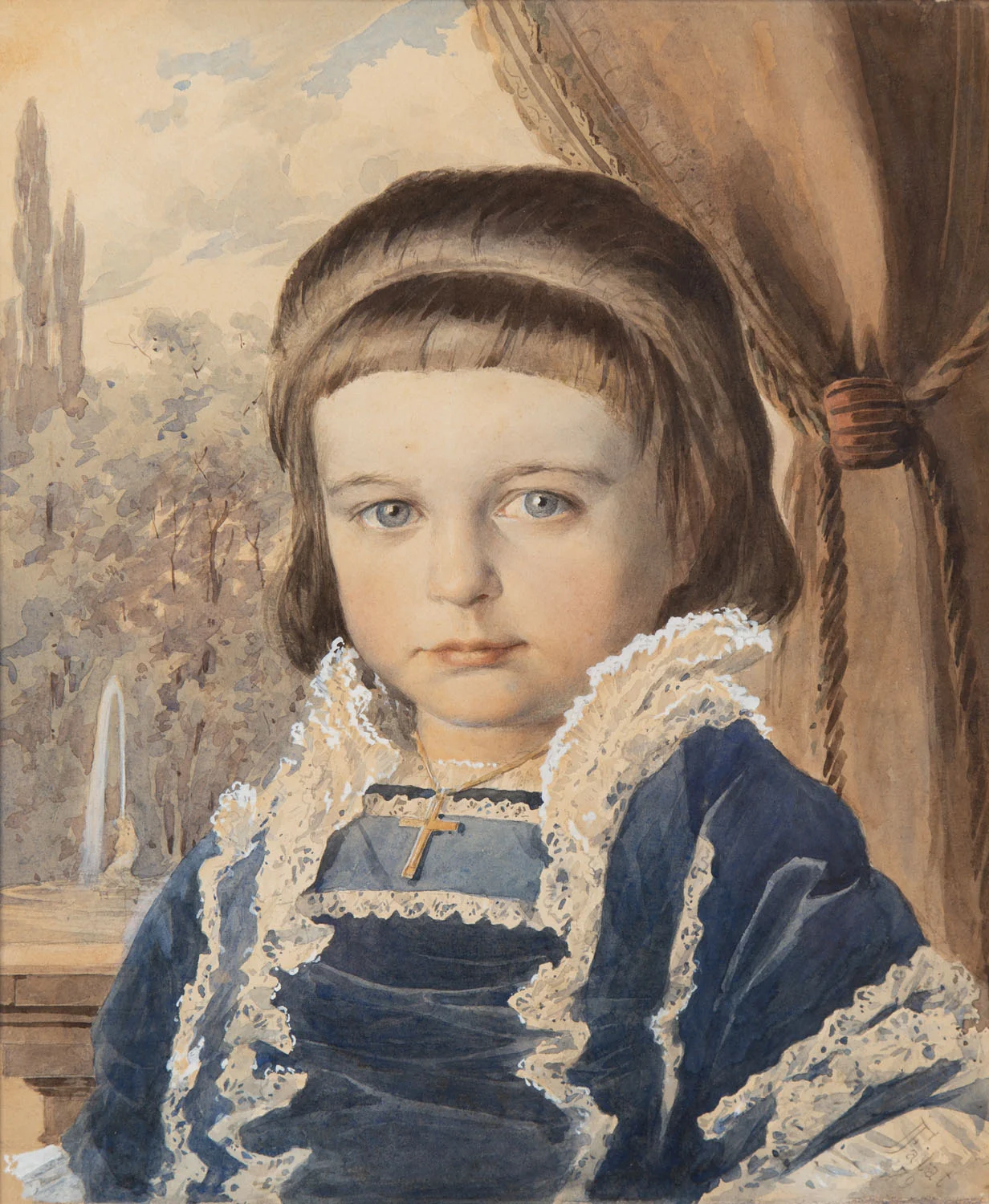
The image is characterized by meticulous realism and pietism in the rendering of the details, which was typical of Fałat's early work. The drawing of the face is incredibly detailed, while the landscape is more consolidated. In this part of the composition, one may notice more causal spots of color, soft tones, and flowing contours. Some elements of the landscape and the girl's clothes are left without color, with the artist taking advantage of the natural hue of the base surface. In the following years, this technique would become the artist's hallmark.
Nature and Japonisme
In 1885, Julian Fałat went on a journey around the world. When recalling his stay in Japan, the artist wrote a lot about his impressions that accompanied him while discovering the Japanese landscapes and getting to know the incredible significance they play in the lives of the locals. Their admiration and genuine regard for the natural world allowed them to appreciate its beauty in even the slightest detail. Getting to know places, the atmosphere, people, and their mentality, as well as new means of artistic expression, gave him an opportunity to enhance the methods of developing his paintings.
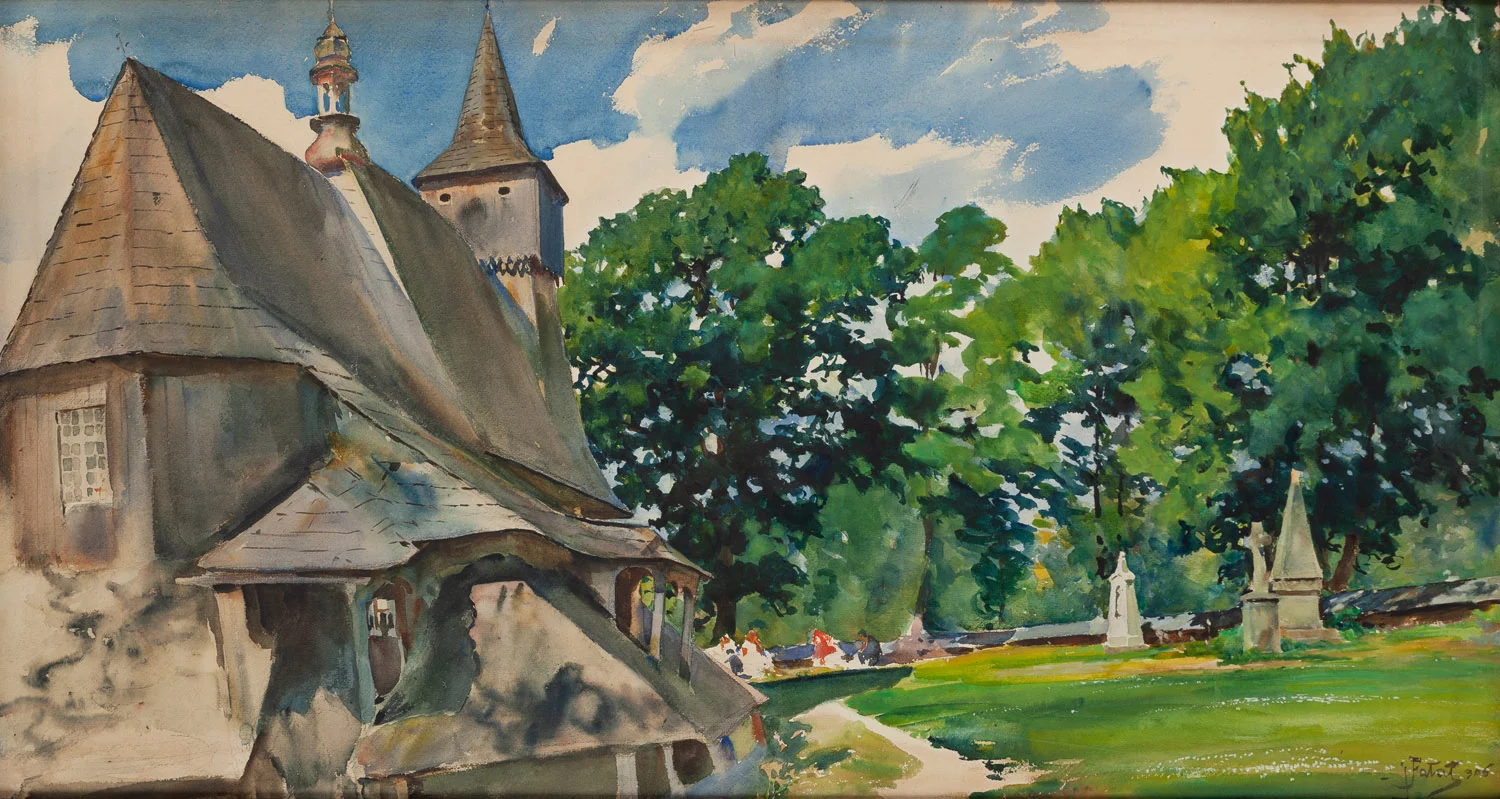
It is visible, among others, in his series of landscapes presenting views of a church in Osiek and Zakopane, captured from various perspectives. His technique of framing, with the outlines of churches and monumental trees in the foreground overshadowing large parts of the composition, originated from the artist's fascination with Japanese woodcuts. Other traces of his inspiration with the Far East are visible in the asymmetrical framing - the “empty" space, a plane of white with strong light contrasts, plays an important role in his compositions. In the presented watercolor, which is representative of the artist's mature work, the body of the church in Osiek is reinvigorated by sunspots breaking through the foliage of the trees. Flat color spots, derived from Japanese art and Art Nouveau as well, are also a noteworthy feature of the composition.
Young Poland's Portrait
The composition titled “Portrait of Artist's Wife" offered at our auction somewhat sums up Julian Fałat's artistic experiences. The work reveals almost all the sources of inspiration used by the artist. In this case, the most important point of reference is Young Poland's painting tradition. Wearing a delicate white dress, the wife is presented in an indeterminate interior scene. Fałat placed a dog, a Frenchbulldog, in front of her, at her feet. The portrait, which is at the same time a record of an intimate, private family scene, strikes with the wife's “absent" facial expression, denoting that the figure is immersed in her own thoughts. Her gaze fixed on the dog, carefully avoiding contact with the viewer, gives the impression that the character is internally isolated, sunk in their own world, and indifferent to her surroundings. The absent gaze of a woman, characteristic of Young Poland's painting, may be interpreted as a symbol of a person's immersion in unhappy thoughts, a sense of helplessness, and apathy engulfing body and mind. However, in the case of the artist's wife, we cannot be sure whether we are not looking at a painting showing a somewhat surrendered woman who was persuaded to pose for the artist, even though she did not feel like it.
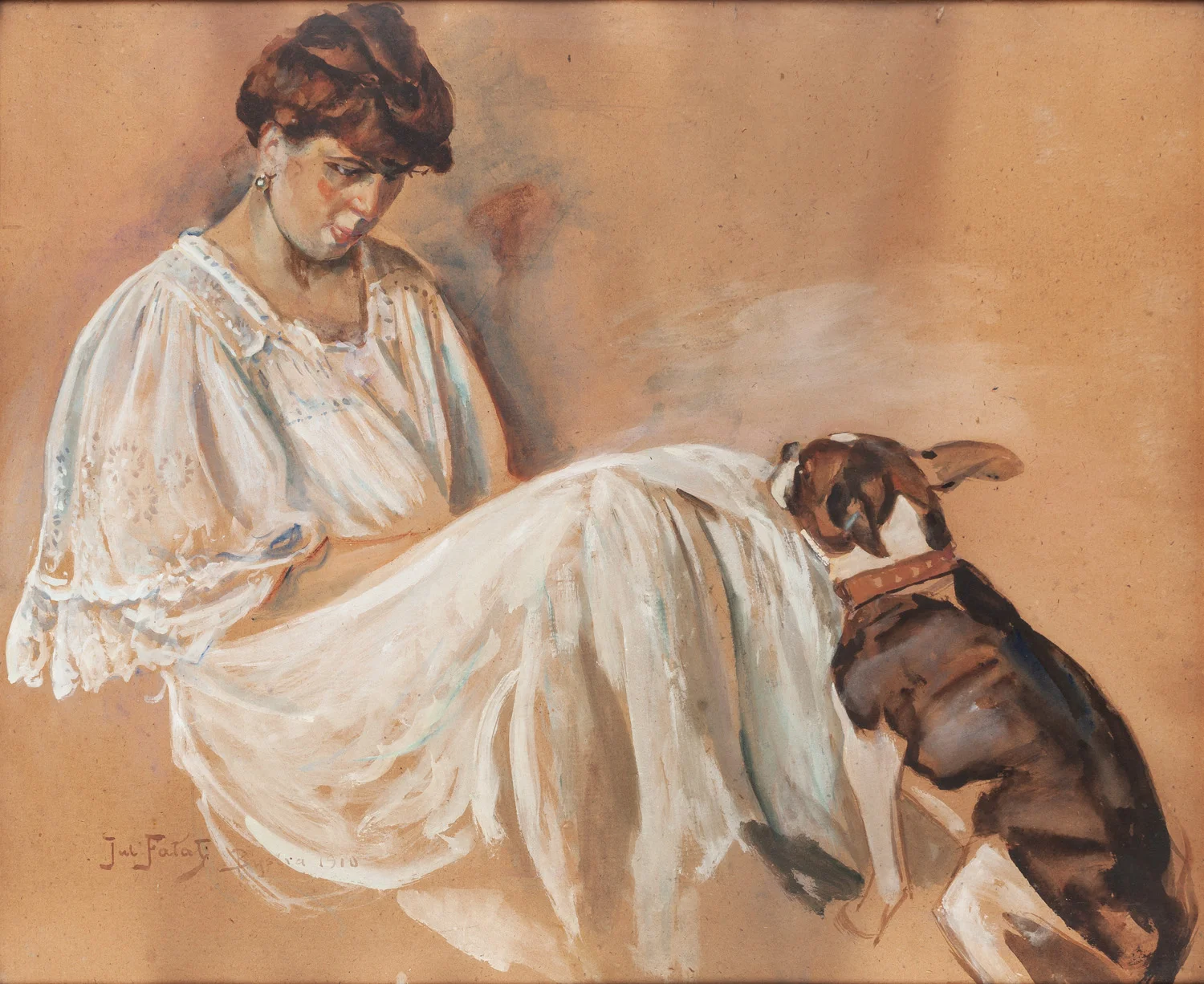
Similar portraits were created by other Young Poland artists, with Wojciech Weiss and Stanisław Wyspański leading the way. These works were mysterious and complex. The way of capturing the models, their arrangements of hands, and turning the eyes away from the viewer, intensified the atmosphere surrounding them and revealed their spiritual state. The portraits readily incorporated the narrative technique of isolating the figure, revealing their spiritual state, deforming the space, and shifting away from the naturalistic illusion, leaning towards the flattening of the depicted shapes and blending them into an increasingly "painterly" and ambiguous background. Depicting the silhouette on a flat, neutral background, the subdued and limited color range, are also significantly related to the fascination with the art of Japan.