
ART INFORMEL AND ACTION PAINTING
In Poland, the ‘epidemics of art informel' began due to Tadeusz Kantor. The exact moment of high popularity of formless painting can be pinpointed at the date of his and Maria Jarema's exhibition that took place at the end of 1956 at the ‘Po Prostu' studio. The popularity of the mentioned style most probably would have never arisen in Polish art had it not been for the ‘relaxation' caused by the collapse of the socialist doctrine. Kantor treated it as a pretext for another trip.
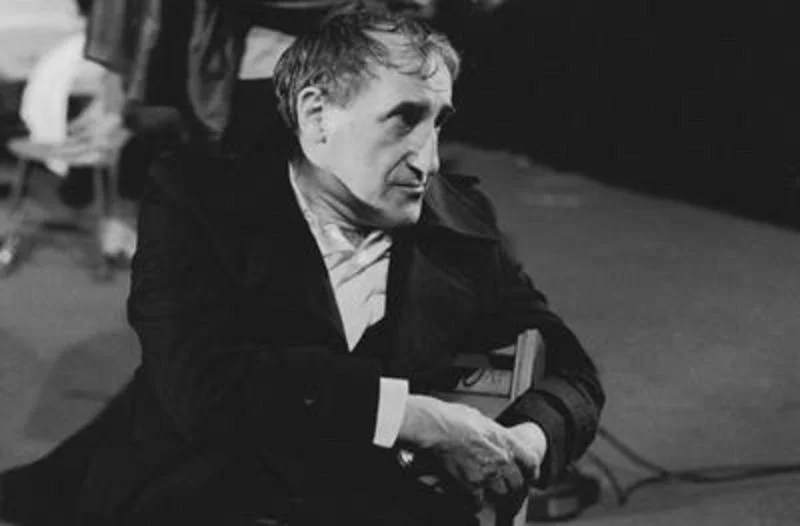
Out of all national artists, it was him who listened most carefully to the pulse of artistic life in Western Europe and the United States. He believed in progress and continuously looked out for new, not yet used forms of artistic expression. For that reason, each of his trips resulted in the import of new Western directions and tendencies to Poland. In 1955, Paris has once again become an inspiration for further explorations. Similarly, almost a decade earlier, the leader of the Cracow bohemians became fascinated by French surrealism. The artist became a stage designer for repertory theatres at the ‘Theater of the Nations Festival' (Festival International d'Art Dramatique) in Chatelet. It was there, in the centre of the art world as it then was, Kantor learnt about the works of great artists, such as Claude Georges, Mathieu, Arnala, Tinguely, or Wols.
. After coming back to Poland, he published the ‘Paris Notes. On the contemporary French painting.' (Literary Life, no. 47) ("Notatki paryskie. O aktualnym malarstwie francuskim") (Życie Literackie, nr. 47) In 1957, an article by Kantor, ‘Abstract Art is Dead – Long Live Abstract Art' (‘Abstrakcja umarła – niech żyje abstrakcja') was published in the Literary Life magazine. The article concerned the decline of geometric abstraction and the simultaneous heyday for tachisme and art informel. It was around that time, that the first abstractions, described as him as ‘his interior's secretions', emerged from under his brush.
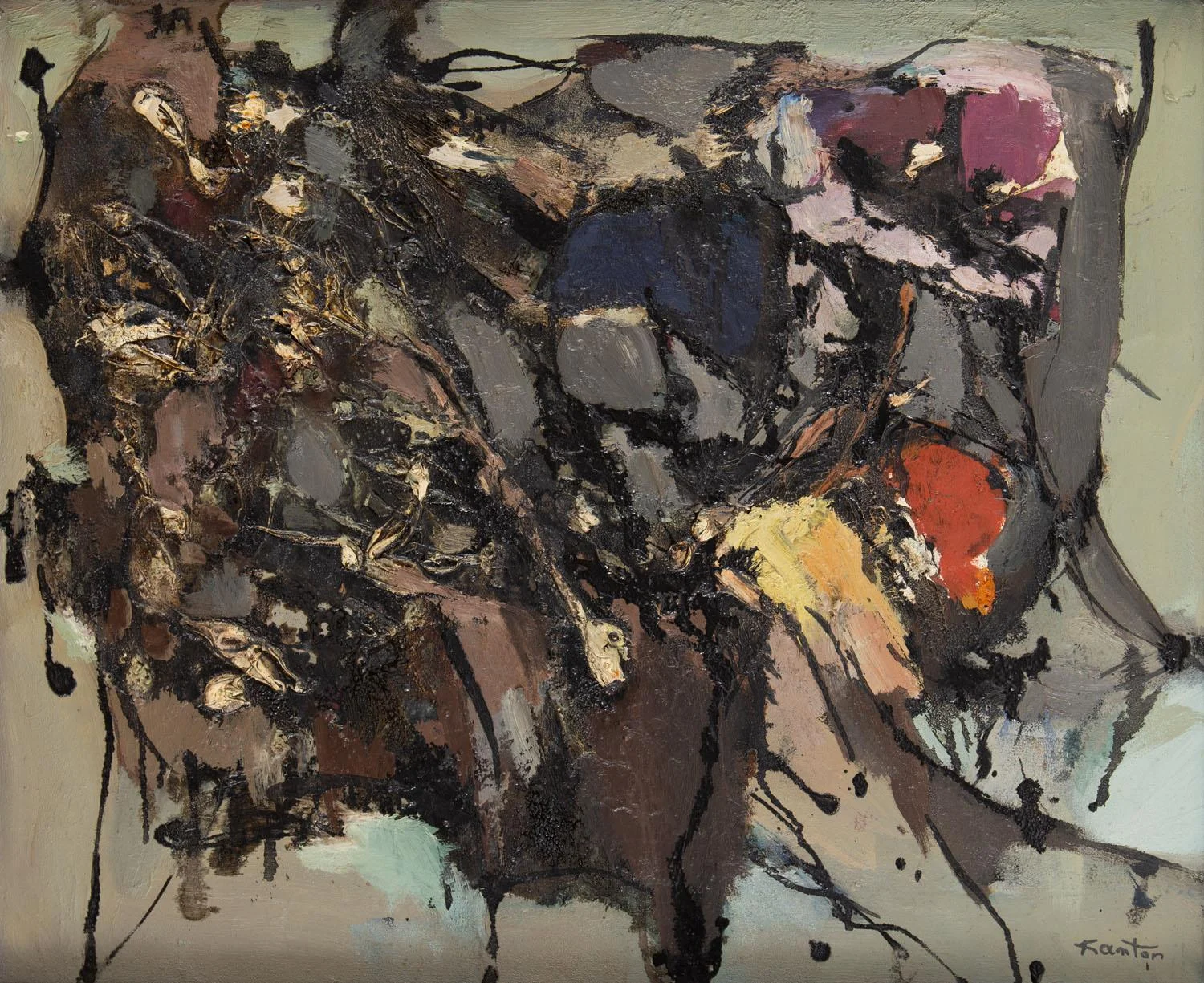
‘The upcoming painting, manifested an end of all calculations, intellectual restraint, and in consequence, an end of the immediate experience. It faced the forces of darkness and spontaneity, revealing their nature and mechanisms. Painting is situated beyond all forms and aesthetic considerations. To me, it became a manifestation of life and the continuation of not art, but a continuation of life.'
- Tadeusz Kantor
Yet, the painting formula that Kantor worked out between 1956 and 1963, differed significantly from the Parisian source of inspiration. In the works of the Cracow artists, one cannot see copying of the aforementioned artists, whose works were a real sensation at that time in the city by the Saine. Mieczysław Porębski commented on Kantor's attitude to the works of other great painters and wrote:
‘Kantor infallibly grasps the vivid immediacy of the developing rhythm of contemporary art. He later openly ‘brings it to his workshop', as he knows the essential strength of a modern artist lies in the continuous reinventing and the constant creative participation in the one, common, and unbroken process. He is not afraid of the ‘foreign text' that he takes up in a given moment. He knows he chose it on purpose and that on its basis he will create his own, independent work - that he will handle his own thing.'
(Mieczysław Porębski, Maria Jarema, and Tadeusz Kantor in the ‘Po prostu' studio, ‘Po prostu,', no 52-53, 1956).
It was only after many years passed, that Kantor referred to his art as art ‘informel'. He referred, primarily, to the ‘formlessness' of painting and not the use of spots and gestures (as is the case with tachisme). Thus, Kantor proved his uncompromising independence for which he was known. The moment that art informel won over critical acclaim, Kantor abandoned it and undertook new mediums; he started creating assemblages and performance art. It is, however, worth noting that art informel was not merely a ‘trampoline' to the next stage, nor a kind of artistic warm-up before new endeavours - it constituted a separate, closed, and finished epoch in Kantor's work.
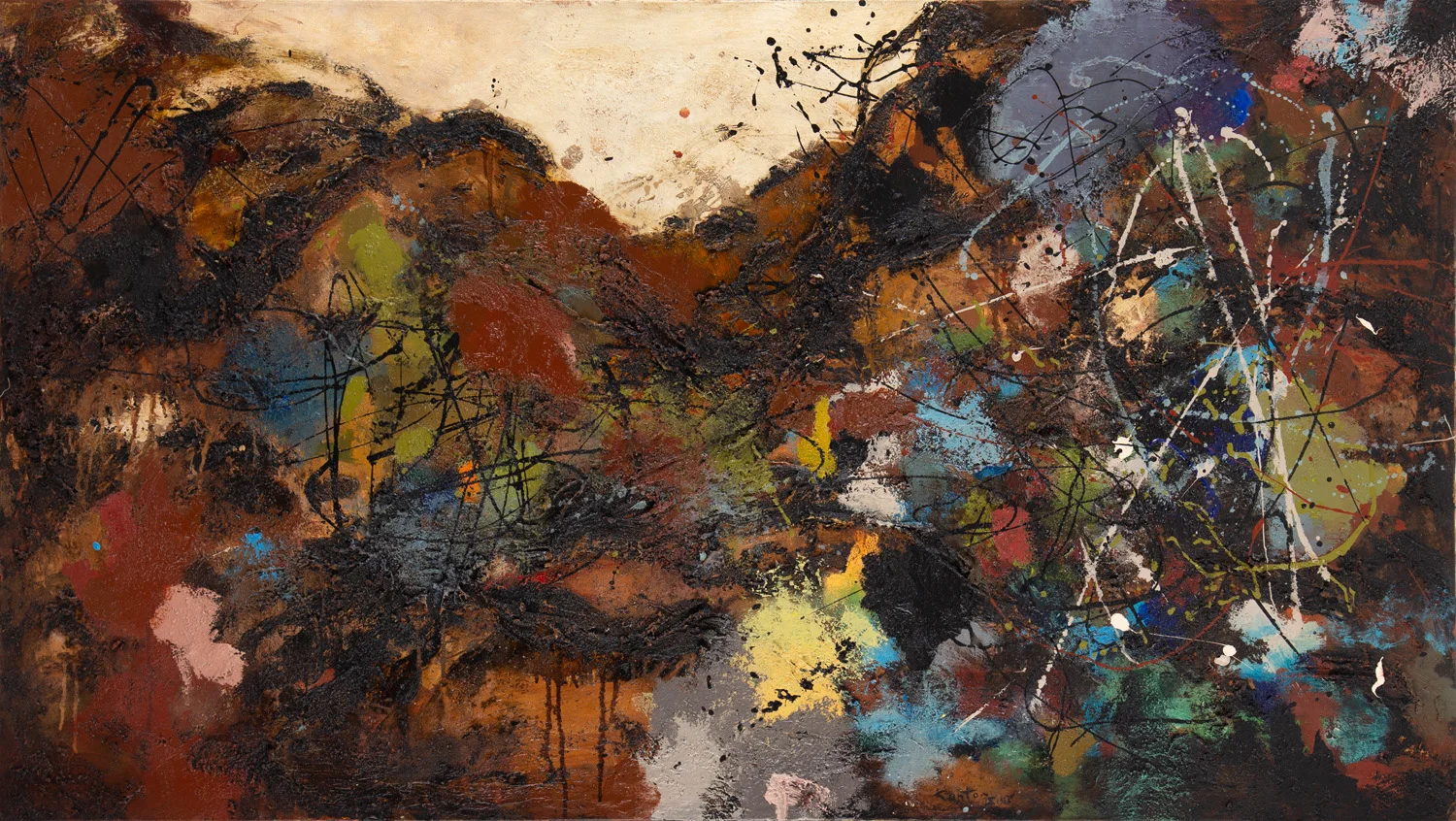
At the upcoming ‘Post-War and Contemporary Art' auction, two abstract works by Kantor from the mentioned period will be offered. One of them is the superb painting from 1958 - ‘Peinture' - which can be representative of the art informel trend in Kantor's work. The work was created in September 1958 in Stockholm, during the artist's journey of several months to Sweden and France. In the composition itself, key tachisme painting tendencies are clearly visible. One of them is gesture painting, as the work's composition comes from the artist's spontaneous idea and, in effect, it is a reflection of his spirit.
There is also inventiveness where the painting is a register of the artist's individual and vivid ideas or reactions. There are no tangible connections to forms, known to us from experience, which would point towards any kind of connection to reality. Colour spots are applied spontaneously, yet at the same time, they create a harmonious colour dramaturgy of the painting. The background layer is covered with broad paintbrush strokes in different shades of brown, beige, and grey. The top layer is painted using varied, but mostly thin brush strokes. Here, the colour palette is extended by shades of green, blue, purple with strong cobalt accents, or orange. All are covered by thin lines of black paint. Looking at the canvas, there is a visible tendency which Kantor developed in his tachisme compositions a few years later, when he used solutions taken from matter painting. At the time, he introduced ready-made, usually non-traditional materials into his works such as sheet metal pieces, rag pieces, boards, etc.
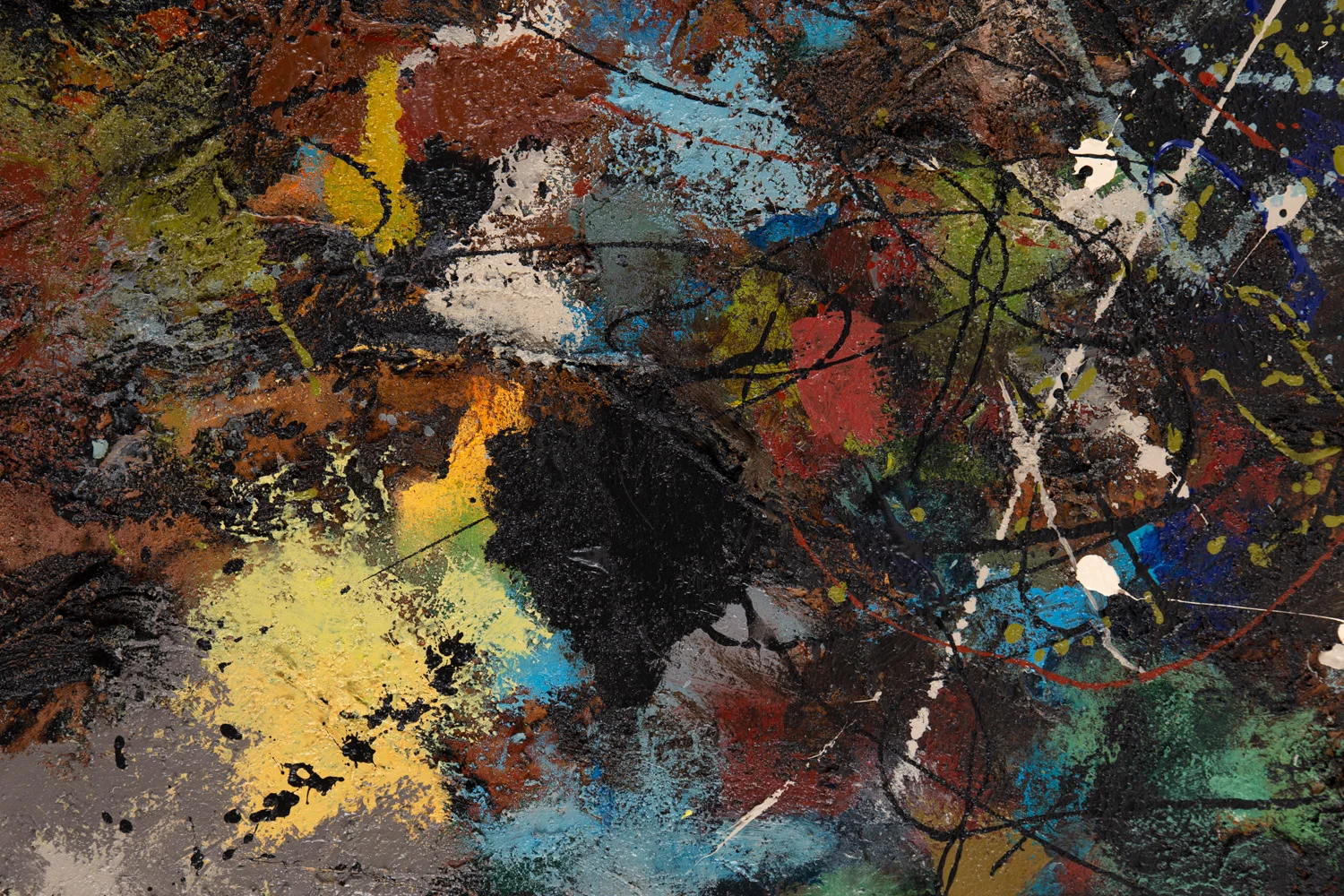
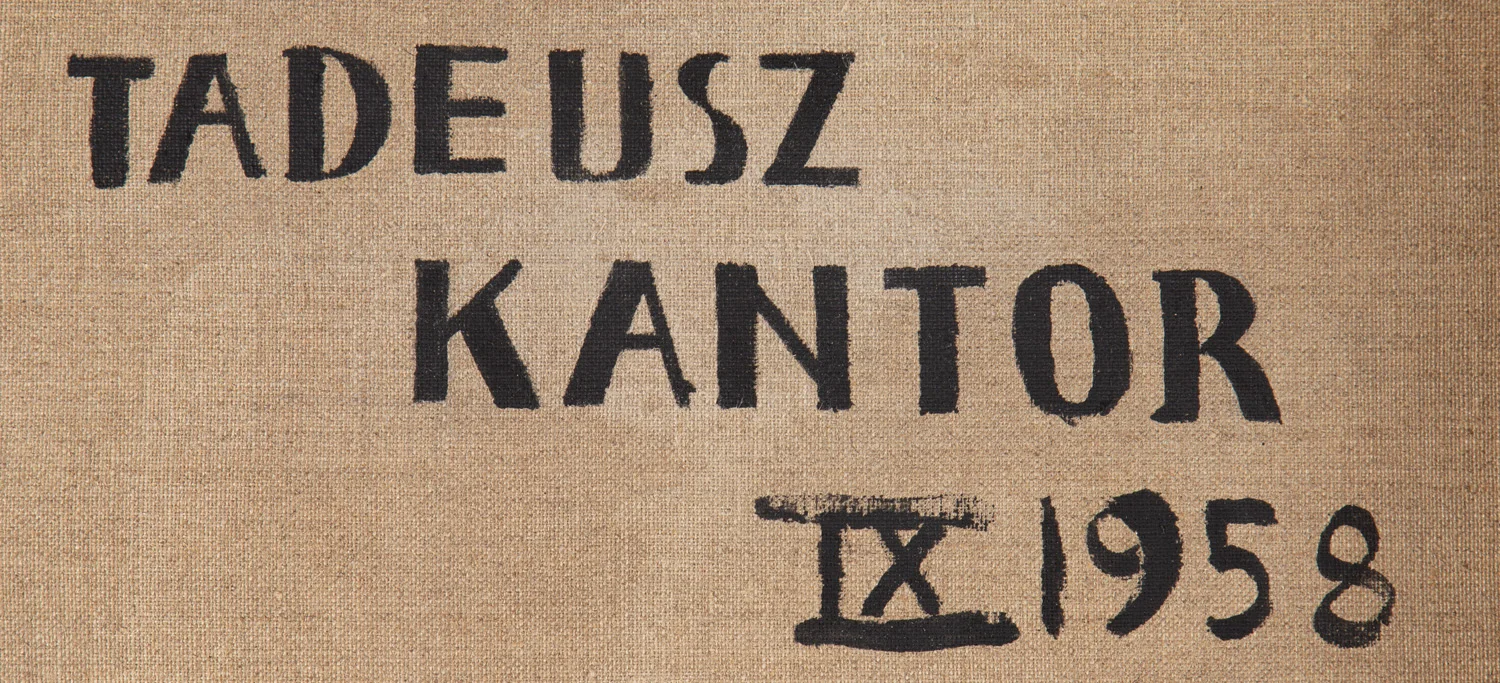
The painting in question refers to this phenomenon - the paint has been applied to a structure fixed to the canvas, made probably of foil and gauze, which gives an impression of a relief work. When compared to other works from that period, the presented painting is truly remarkable. It can be distinguished by its size, refinement of detail, composition consistency, valuable notes on the back, as well as the place where it was created.