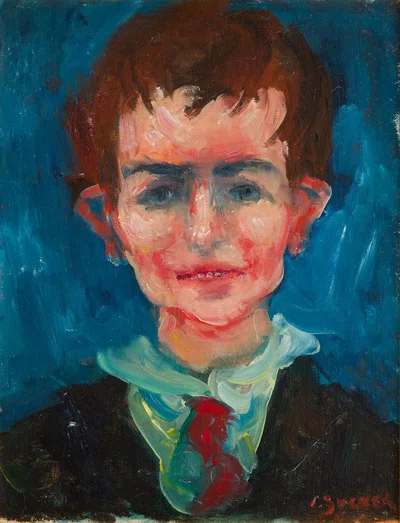
Zucker and expression
Maria Markowska
Jakub Zucker's artistic vision was based on his personal experiences and emotions, which directly determined the formal means of expression. Like an uninhibited painter, he created in a manner that brought him pleasure, disregarding current trends or established academic principles. Thus, Zucker's work was remembered as joyful and filled with admiration for the world, centered around an independent creator painting according to his own rules.
This bold and free approach contributed to the formation of a distinct style by the painter, one that was unique to Zucker alone. The artist depicted scenes from life, portraits, and landscapes. In line with his joyful attitude and the idea of seeking only what is beautiful in art, the painter used bright, vivid hues, especially evident in his multicolored, cheerful landscapes. Bold, thick brushstrokes applied in various directions created flat patches of color. The painter often abandoned perspective and shading in favor of clear communication and highlighting the essence of the image, which became characteristic of his portraits.
The painted figures commanded the viewer's full attention, and the background, approached casually as if with negligence, perfectly complemented the composition, adding to its expressiveness and dynamism. Although Zucker painted according to his own canon, this does not mean that he was not influenced by emerging trends and artistic personalities whom he had the opportunity to encounter during his visits to Paris. It is certain that the painter visited museums, where he viewed works by great masters and became acquainted with contemporary painters exhibiting in Parisian salons.
Paris in the first quarter of the 20th century was the artistic center of Europe, a source of inspiration and creative freedom. Painters representing various artistic movements gathered around the two artistic districts, Montmartre and Montparnasse. Zucker was inspired by the works of the Impressionists and their predecessors; he admired the paintings of Pierre Bonnard and Auguste Renoir. However, the style of his paintings goes beyond impressionism and the depiction of fleeting natural phenomena. Bold splashes of color, intense hues, distortions of form, and dynamic rhythm allow us to associate Zucker's works with the emerging expressionist movement in Europe. Whether Zucker was familiar with the works of leading representatives of the German expressionism is unknown.
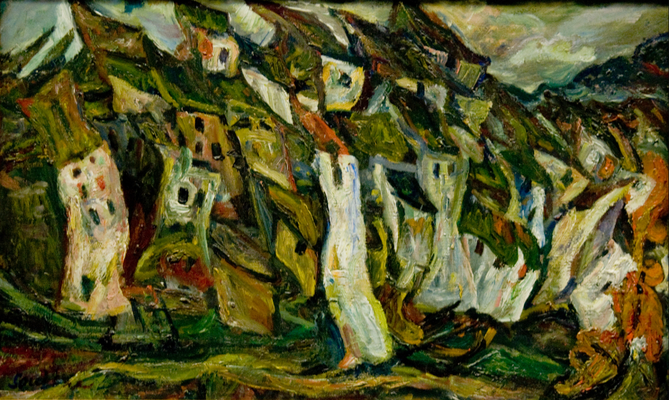
Chaim Soutine, The houses, 1921, Musée de l’Orangerie, Paris, source: Wikimedia Commons
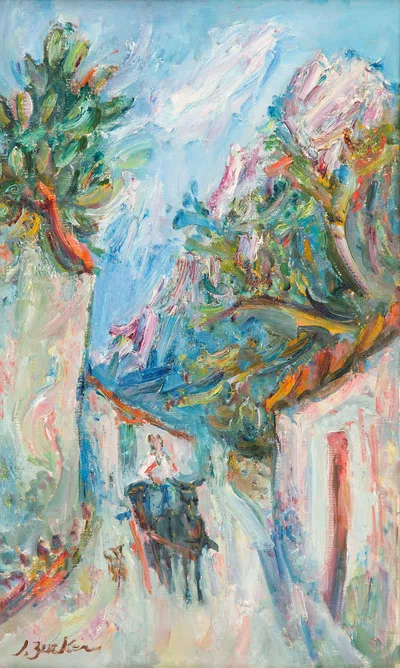
Jakub Zucker, Landscape with a boy on a donkey, circa 1960
It is certain, however, that while living in a small hotel in Montparnasse, he was neighbors with Marc Chagall and Chaim Soutine. The work of the latter strikingly converges with Zucker's both formally and in terms of meaning. Chaim Soutine, a Jewish painter born in Belarus, emigrated to Paris in 1913 and became one of the representatives of French expressionism. The lively landscapes he created seem to be in constant motion, with twisting trees and buildings with curved forms swaying rhythmically. When painting portraits, Soutine focused on elements he deemed distinguishable, such as protruding ears, huge eyes, or distinctive parts of clothing, highlighting them amidst the succinctly rendered whole.
Comparing portraits of young boys by Zucker and Soutine, we can easily discern formal similarities in the anatomical features and the use of colors. The intense navy background is almost identical, as are the shapes of the heads, collars, and ties (Jakub Zucker, Portrait of a Boy). Some of Zucker's landscapes (e.g., Landscape with a Boy on a Donkey) present the same distortion of the image that Soutine employed, using curved lines while abandoning perspective.
Zucker was not a representative of expressionist thought based on the power of aggressive expression often with a pessimistic undertone. However, he drew from expressionist means that lent a specific meaning to his optimistic paintings. The cheerful scenes he painted were not photographic and indifferent representations of reality but rather testimonies to the emotional depth and sensitivity with which Jakub Zucker approached art.
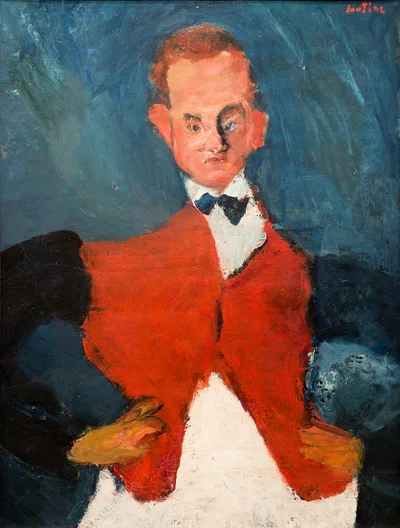
Chaim Soutine, Le Garçon d'étage, 1927, Musée de l'Orangerie Collection, Paris, source: Wikimedia Commons