
Zbigniew Makowski's treatises
The works of Zbigniew Makowski (1930–2019) have been attracting the attention of art enthusiasts and collectors for many years, always intriguing and encouraging new interpretations. When referring to his paintings, the artist said that "he treats them as an invitation to his insight, experience, understanding, and dream of the world". A characteristic feature of his art was the combination of various poetics and painting methods within one work. In addition to painting, drawing, and book illustration, he dealt with the theory of aesthetics and wrote poetry. In his painting compositions, Makowski combined signs, numbers, and letters with figurative elements, achieving symbolic and surreal effects, creating an extremely original and individual painting language.
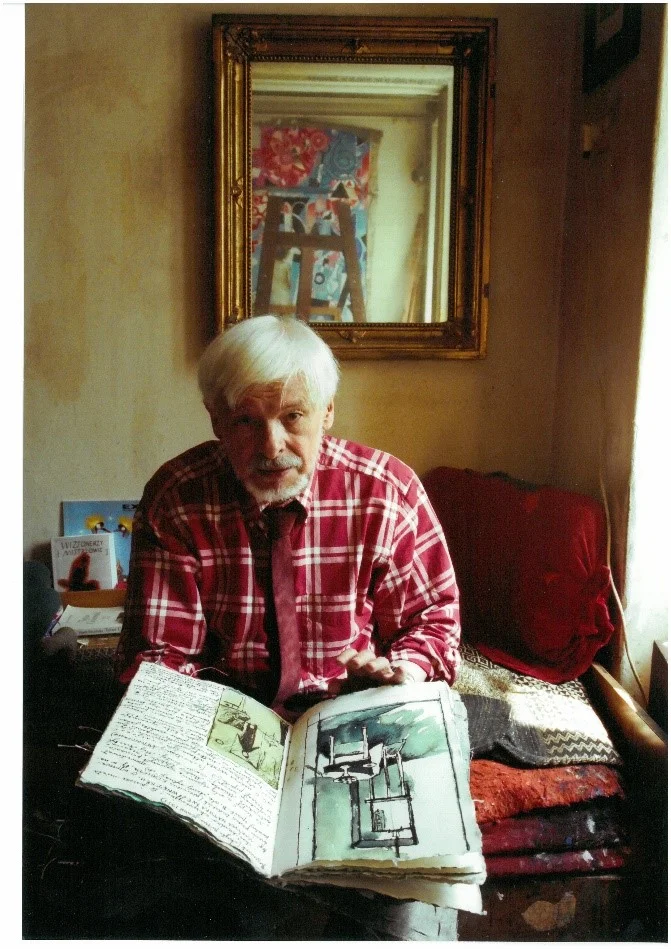
Apart from painting, the artist was passionate about various fields of science and art, e.g. music, mathematics, Eastern culture, and Kabbalah. During his stay in Paris in 1962, the artist met André Breton and members of the international group Phases. While in France, he took part in the exhibition "Le Mouvement Surréaliste et le Mouvement Phases" in Paris in 1962. Nonetheless, he did not engage in the surrealist movement and its ideas for a long time, the artist followed his own path and referred only to their poetics. He made use of free associations, seemingly loosening the composition of his pictures, which, at the same time, was always carefully thought out. The artist did not paint fragments, as he himself admitted, for Makowski the most important thing in art was the image of the whole. His combinatorial juxtapositions make an impact with their accumulated meanings. The artist created his paintings using magic signs, symbols, and props, as well as sentences and longer texts.
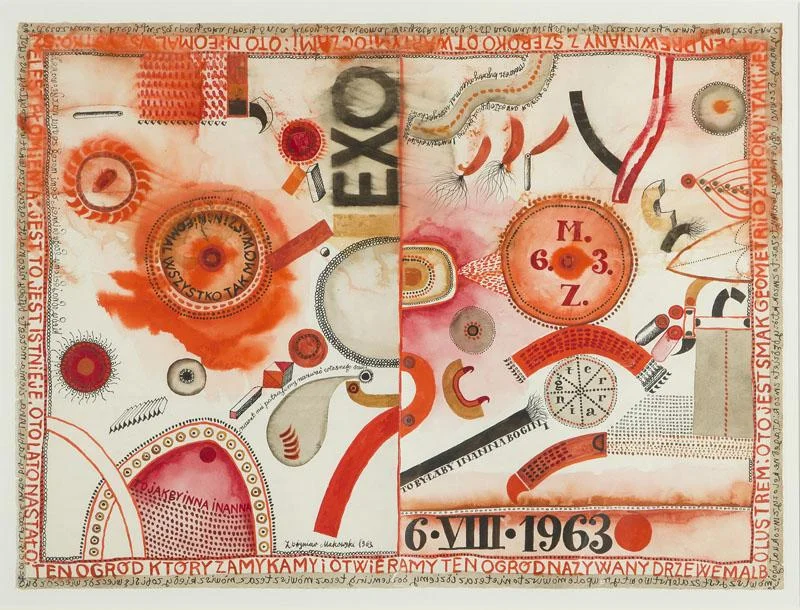
Zbigniew Makowski's works presented at the July online monographic auction constitute a full repertoire of themes reoccurring in his art - signs, numbers, geometric figures, including circles considered by the artist to represent absolute perfection, keys, fragments of architecture, quotes written in calligraphically developed script, which he treated on par with drawing, almost as an ornament.
The painter was particularly keen on using paper as a base for his works, even when he created large-scale compositions. He most willingly used specially prepared, refined, and sometimes even patinated sheets. The artist created original and suggestive books made of handmade (wood-free) paper. These were his original compositions, rich in symbols and signs. These volumes, like the artist's other works, constituted pictorial and verbal "treatises", supplemented by lectures on art, excerpts from literature, and poetry from various eras and cultural circles, being at the same time a kind of artistic journal.