
Why is the Giraffe Burning? On a Peculiar Motif in the Works of Salvador Dalí
Małgorzata Gonia
The works of Salvador Dalí express the belief that the only way to release hidden fears is through the liberation of one's imagination. This drive to reveal inner fantasies and imaginings results in a multitude of peculiar, difficult-to-explain motifs in the Spanish surrealist's art. The August auction titled "Salvador Dalí. Prints" (PL: "Salvador Dalí. Grafiki") provides an opportunity to explore some of these motifs. Among the items offered, there is one that might raise many questions.
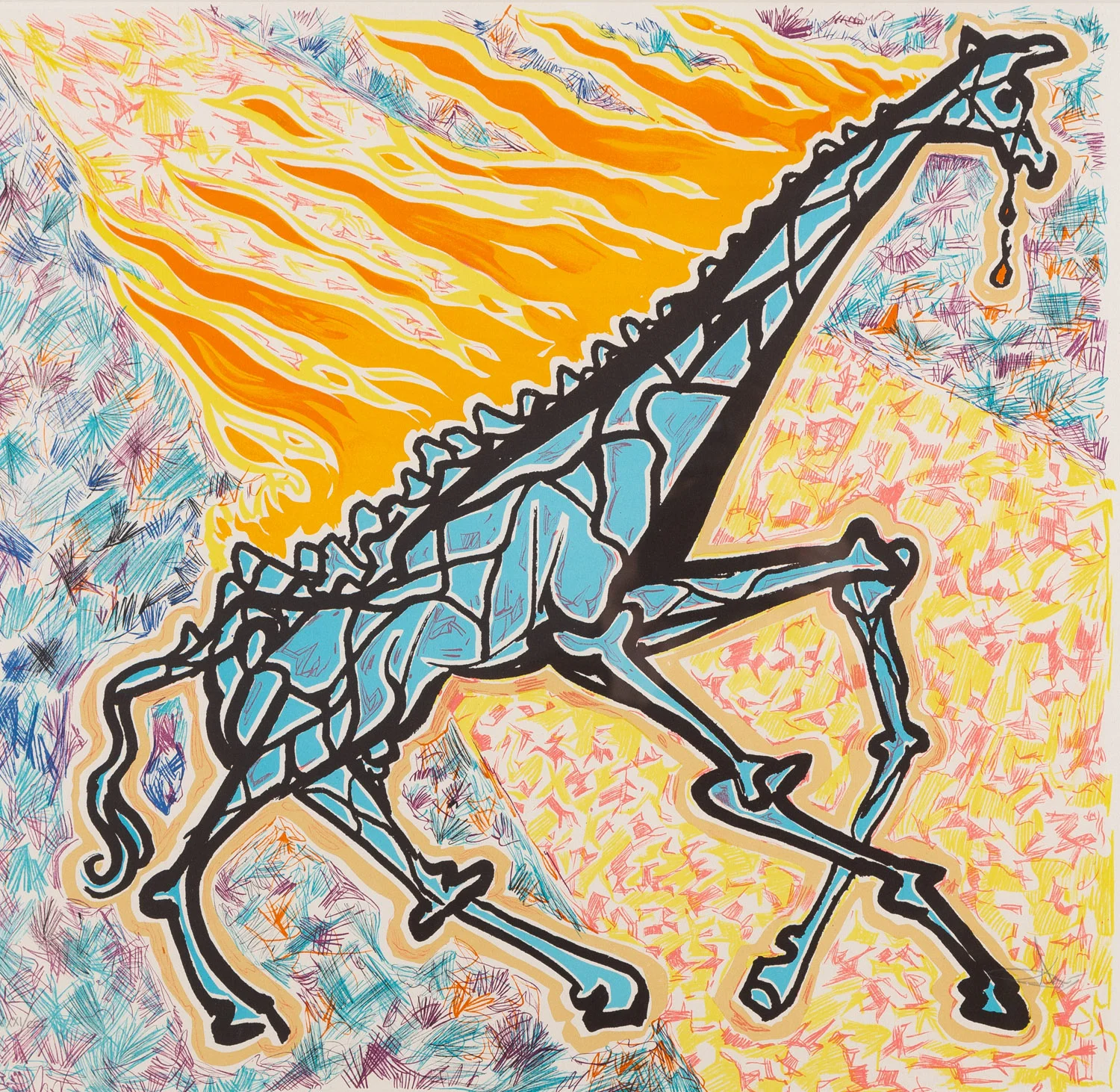
This refers to the lithograph “La girafe en feu" (“The Burning Giraffe"), whose subject, as the title suggests, is a giraffe in flames. The animal's figure occupies almost the entire composition of the work. Dalí depicted the giraffe's blue body within an irregular, black contour that strongly highlights the central figure against the background. Tall flames engulf the entire back of the giraffe, resembling a wild, flowing mane. The giraffe's face shows terror and fear. What exactly was Dalí trying to convey by depicting the animal at the moment of its death? Can we decipher the meaning he assigned to this theme?
The answer to these questions might be found by reviewing other works by the surrealist. Interestingly, the motif of the burning giraffe was used by Salvador Dalí several times. It first appeared in 1930 in the film “L'Âge d'Or" (“The Golden Age"). Seven years later, the artist depicted a giraffe in the background of the paintings “The Burning Giraffe" and “Inventions of the Monsters." After 1937, giraffes disappeared from Dalí's repertoire, only to return with doubled intensity in the painting “Giraffe Avignon," created in 1975. This painting is a visual record of the pyrotechnic show “Dalí in Avignon."
"Dalí reaches the skin and the inside, digs into dreams and the recesses of the mind, triggering an avalanche of experiences and provoking the recipient. This created world only seemingly lacks sense,"
- wrote Anna Włodarczyk about the surrealist's paintings.
Surrealism as an artistic movement was not only an expression of a new idea and intellectual movement but also a method for deeper understanding of humanity, revealing hidden aspects of psychological and spiritual life. The goal of the surrealists, led by Dalí, was to liberate unconscious areas suppressed by reason. The exploration of the unconscious, dormant within humans, stemmed from a fascination with Sigmund Freud's method of psychoanalysis. In each of the mentioned works, the motif of the burning giraffe can be interpreted primarily as an artistic attempt to reflect the darkest corners of the human psyche: trauma, fear, a sense of impermanence, and the inevitability of fate.
It is probably no coincidence that the burning giraffe appeared in two of Dalí's paintings in 1937, two years before the outbreak of World War II, during a period of heightened political tension. The death of the animal could then be seen as a forewarning of the impending destruction and chaos, expressing the artist's deep anxiety. The validity of such an interpretation can be confirmed by Dalí's own words, in which he called the giraffe "a masculine, cosmic monster of the apocalypse."
The lithograph offered at auction, however, differs from the discussed oil paintings. First of all, Dalí used a bright color palette, dominated by shades of blue and orange. The artist abandoned the grays and browns characteristic of his earlier works. The composition also shows a synthetic approach. Apart from the giraffe engulfed in flames, there are no objects or people to amplify the meaning of the work. It seems that in this image, Dalí attempted to portray the apocalyptic theme through a sophisticated play of colors. The bright aura surrounding the giraffe's silhouette and the luminous background make the giraffe's body glow, almost melting under the heat. The lines creating the spots give the animal the appearance of a shattered glass figurine. Through simplified artistic means, Dalí achieves extraordinary suggestiveness in the depicted scene, revealing himself as a versatile artist aware of the vast possibilities inherent in printmaking techniques.