The zodiacal system of Winiarski
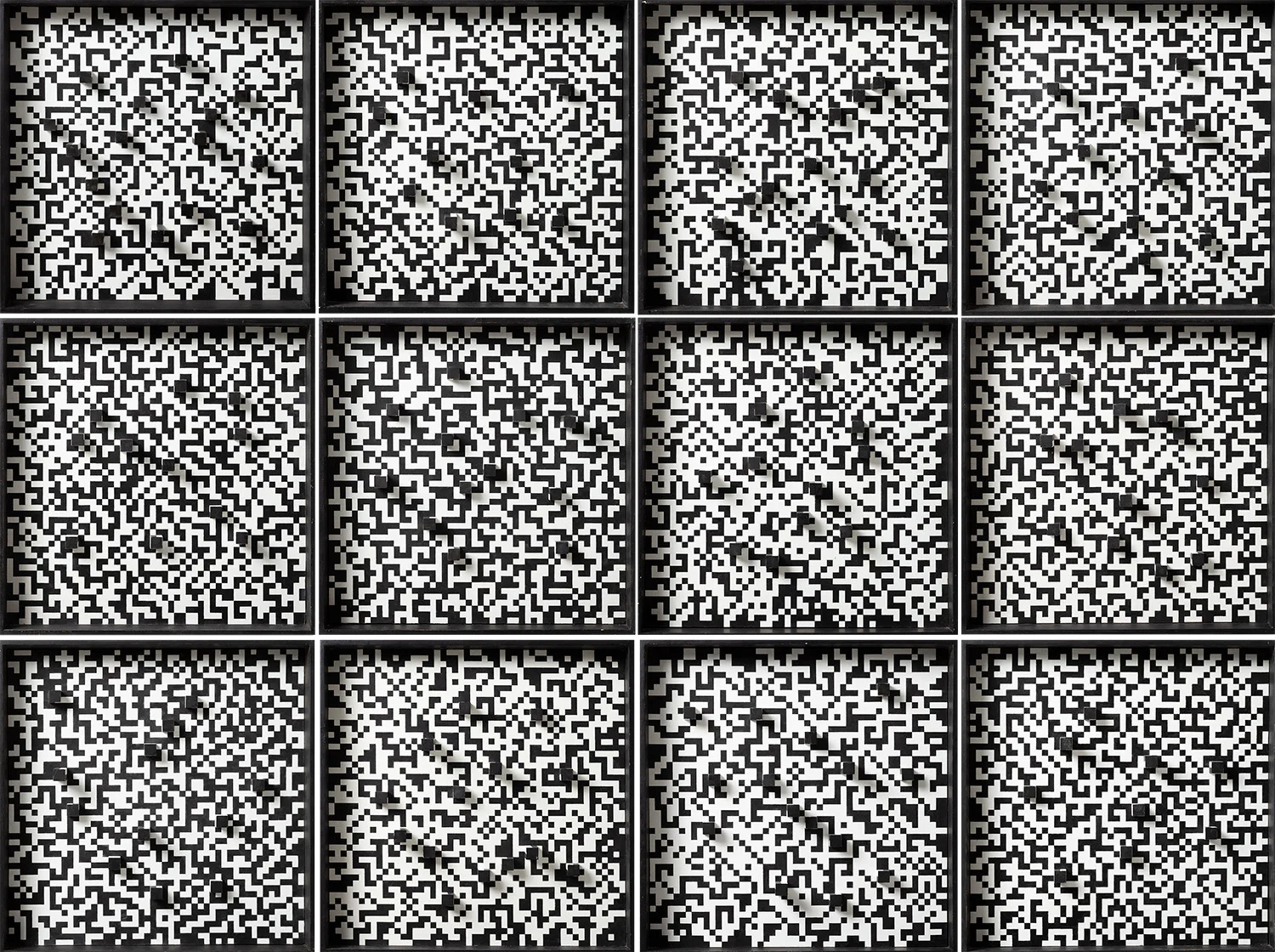
The work of Ryszard Winiarski is best known for two series of his works – "Territories" and "Penetrations of Space." However, the artist's interest in astrology and the actions taken in this theme can be considered a puzzle and, at the same time, a novelty. In this context, the series of 12 works attributed to all zodiac signs becomes extremely mysterious.
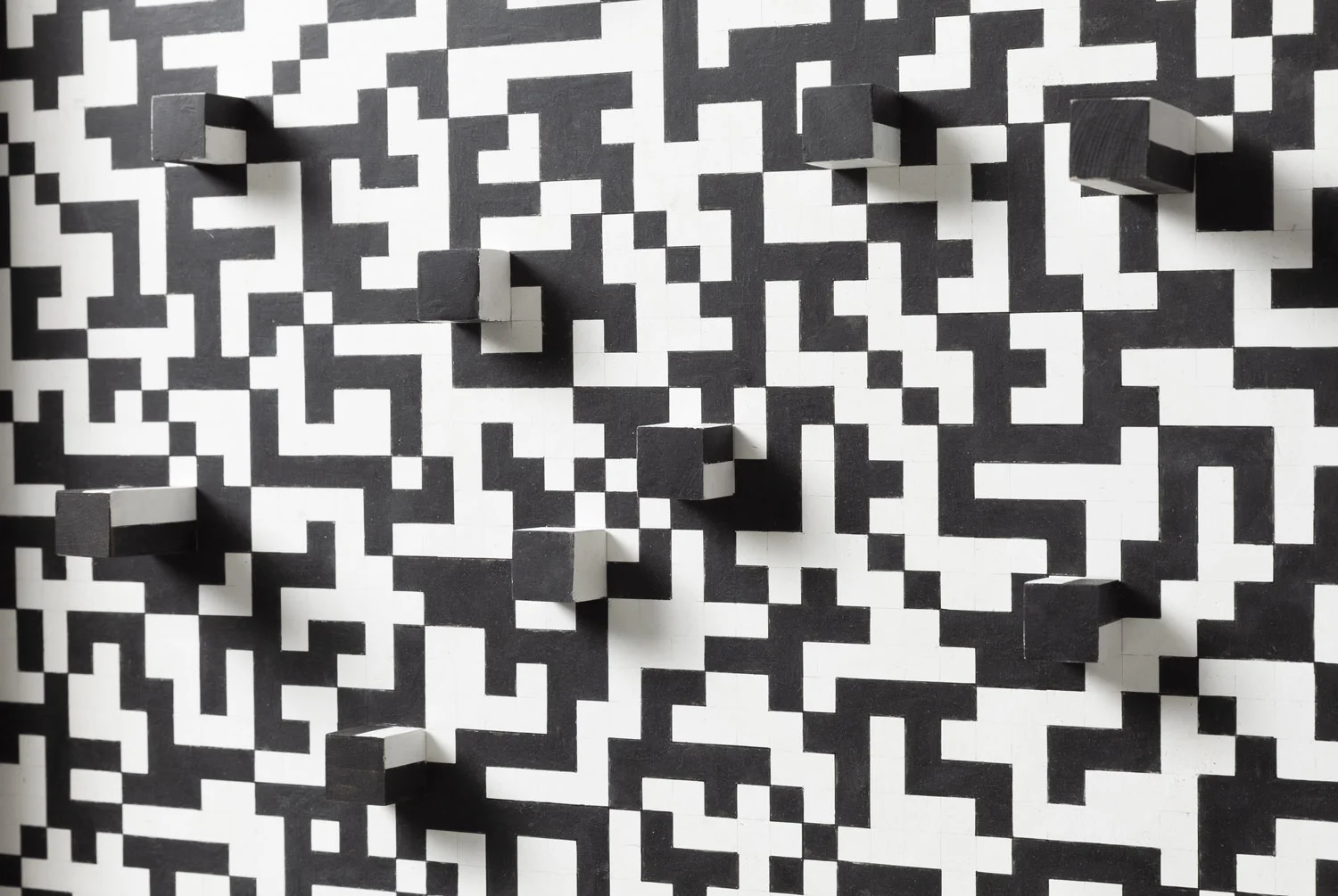
The individual elements of the work "Zodiac" were created in the 1970s, concurrently with Winiarski's most significant compositions at that time. Also, they are consistent with the "spatial penetrations" in their form and most likely constitute a variation of this cycle created for a specific and special purpose. The theme of the astral system is also closely connected to the artist's interests, whose way of defining art was an extraordinary example of combining exact sciences with creativity. For Winiarski, the logic governing the laws of individual zodiac signs could be an ideal tool for his consistently applied practice based on the probability calculus. At the same time, in the "Zodiac" series, it is difficult to discern specific forms resembling commonly accepted zodiac symbols. Abstract compositions are built on numerical algorithms, measures, and characteristic arrangements of black and white squares reflecting the binary system. The rejected aesthetics here was completely subjected to scientific values, and the entire process of creating the work proved to be more important than the final result.
"To this day, all my work, broadly speaking, is built on these two objective mechanisms, on order and chance. By order, I mean those experiences that are assigned to numerical sequences, and by chance, those in which a certain random mechanism has been activated."
- Ryszard Winiarski
Winiarski's random system of composing works, based on throwing dice, can also be fully compared to the principles of randomness developed by astrologers. In their opinion, specific zodiac signs determine human life, which in turn indicates the dependence of the future on the laws of chance. We can see here the game theory, on which Winiarski decisively based his work. Explanatory notes on its rules were attached to some works. In the case of "Zodiac," the artist left it to the viewer to determine the principles of the presented system, allowing full immersion in the illusory space. At the same time, this freedom of interpretation is narrowed by limiting the means of expression aimed at the full transparency of individual elements of the work. In his work, Winiarski reflects on the specificity of human nature and the motives behind his actions. Although the foundations of this reflection were developed in the 1970s, the breakthrough turned out to be in 1983, when he fully realized that his creativity based on the exact sciences could ultimately become an object of contemplation. As he admitted: "(...) after all these years, I believe that my paintings have in them a charge that could be called mathematical mysticism – they provide contact with what is immeasurable, unnamed, non-transparent" (Zbigniew Taranienko's interview with Ryszard Winiarski conducted in 1990 [in:] Ryszard Winiarski, exhibition catalog, Opera Gallery, Warsaw 2017, p. 9)."