
The Magic of Piotr Horodyński's Paintings
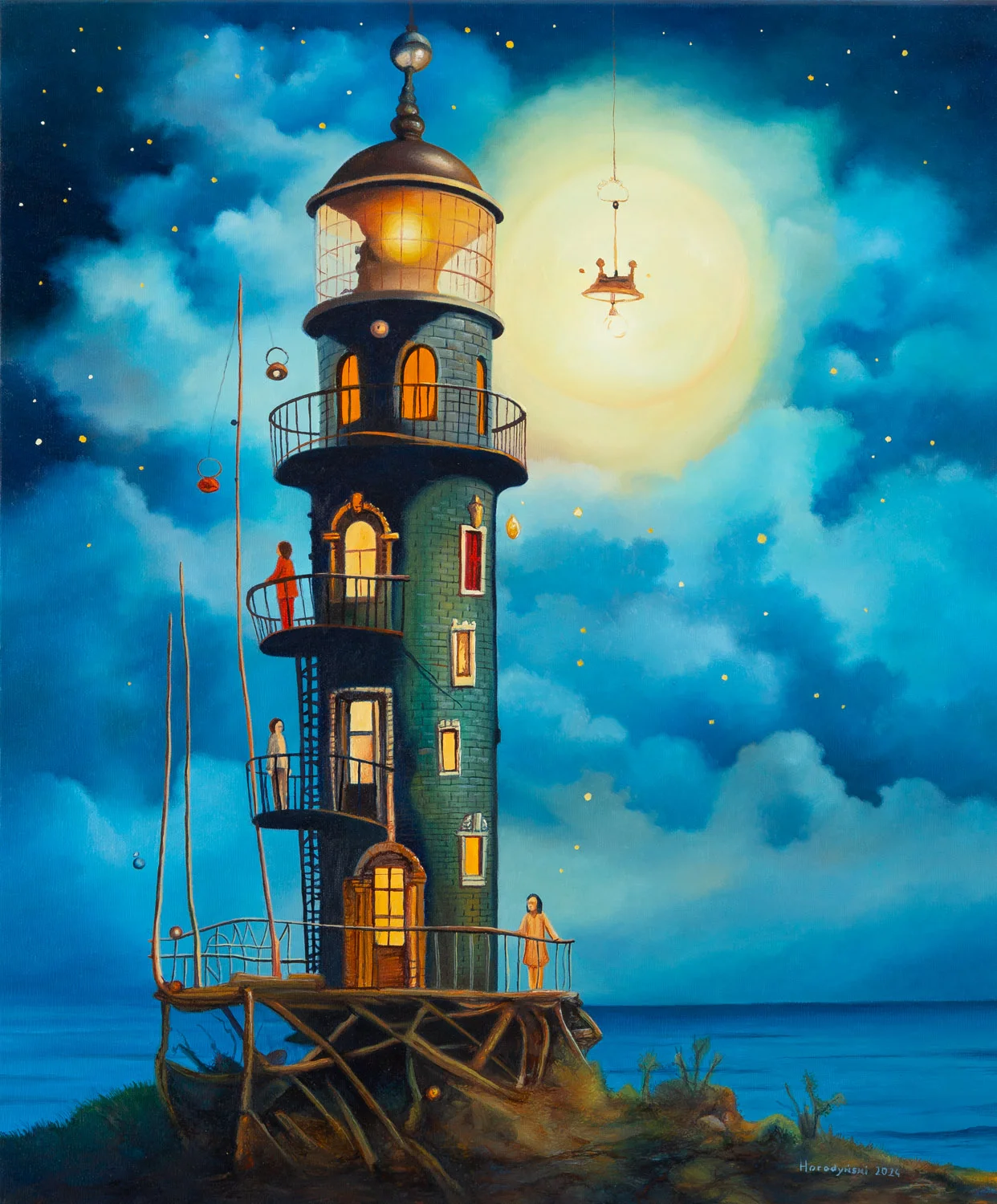
Young Art in February attracts with a blaze of colors. In the latest offer, you can find many magical paintings. One of the leading artists creating works full of joy and magic is Piotr Horodyński. The artist graduated from the Graphic Department of the Władysław Strzemiński Academy of Fine Arts in Łódź.
Piotr Horodyński's paintings are in private collections in Poland and the USA. Art has always been his passion and an integral part of his life. For many years, he has been exploring modern techniques and graphic forms. He is a painter, as well as a designer, illustrator, animator, designer, photographer, author of song lyrics and children's literature. In the interview below, the artist talked about his multidimensional interests, rich inspirations, and chosen artistic path.
Paulina Brol: When did you discover the artist's soul within yourself?
Piotr Horodyński: I've always wanted to paint. I was extremely lucky because my Mom had the soul of a true artist, she drew beautifully herself and understood me perfectly. She let me paint literally everywhere, even on the walls. Today I do what I love and I love what I do. Nothing better professionally could have happened to me. I also remember two incredibly important moments that probably determined my future. In high school, I participated in a convention for fantasy enthusiasts. At the time, there was an exhibition organized, and my graphics were displayed next to those of my hero, Wojciech Siudmak. I was proud and very, very happy. The second such moment was playing hooky, during which I went for a walk in my hometown of Łódź and on Piotrkowska Street I saw an exhibition of photos by Ryszard Horowitz. It was like a revelation. I felt then that the Academy of Fine Arts was the only possible choice for me.
PB: What do you want to convey through your paintings?
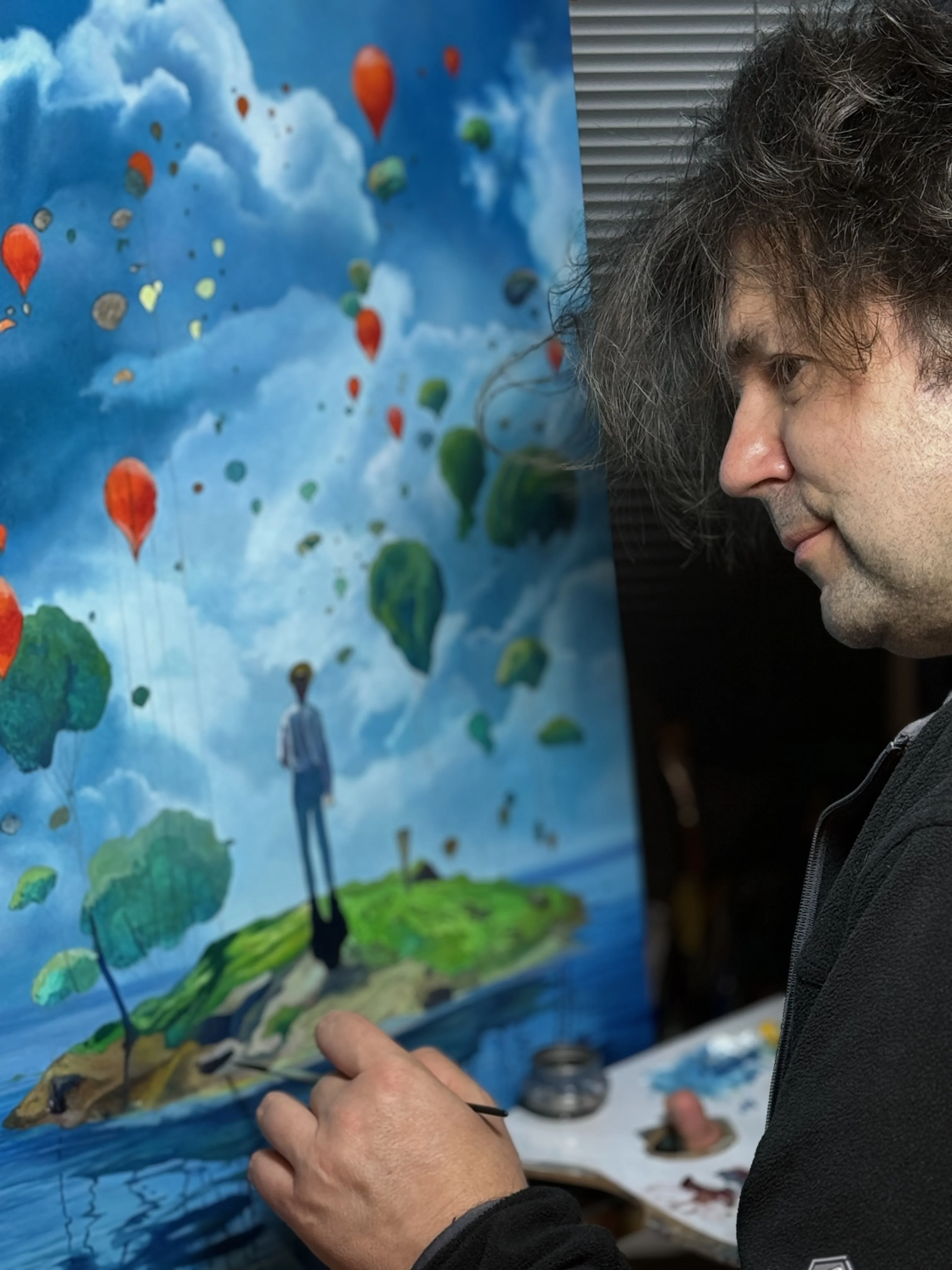
PH: I would like everyone to read my works according to their own experiences, thoughts, and needs. If I manage to evoke some emotions in the viewer - that's wonderful. And if I manage to encourage them, provoke some thoughts - even better. Emotions are sometimes fleeting, short-lived. Thoughts stay with us longer, especially when they are not obvious to us, when they somehow surprise us. I am often asked what a particular painting is about or what I wanted to say through it. Such interactions with viewers make me very happy and give me great satisfaction. But I also know that my words are not enough to express everything. Besides, words can be a source of misunderstandings. I like to encourage with my paintings to immerse oneself in the world of fantasy, into the land of fairy tales. As children, we spend a lot of time in this world, and then for some reason, we abandon it. I think it's a great loss. In my paintings, I also like to address issues strictly related to human life. With the path we choose either to fulfill our own dreams or (which is a tragedy) to satisfy the desires of others. The theme of rising after a fall, searching, striving to achieve our own goals is important to me. These are just some of the most important motifs. I believe that the time we are given is a priceless gift and it must be used wisely. To live in harmony with ourselves, constantly seek what brings us happiness and inner peace.
PB: So each of your paintings speaks of a journey into oneself, but in its own individual way?
PH: Sometimes I hear questions, why do I paint something different every time. This is not entirely true because I like to return to some topics. But indeed, I have a lot of ideas. In fact, images are created in my head all the time. Basically, new images are constantly emerging in my head. And because what I see, hear, and feel is diverse, diversity can be found in what I create. Some are more illustrative, and some encourage their own interpretation. This probably results from the "need for change", the need to pour onto the canvas at least part of what is happening in my head. After finishing work on a painting, I most often have a subconscious desire to do something completely different. Then I distance myself from what I have done - I gain distance to look and think about a given painting in a different way after some time. The common and most important feature of my works is simply the untamed need to create them and the joy derived from the process itself - inventing something new, sketching, and finally working on the canvas. I like and need to address new topics, work through different thoughts and emotions. I like to experiment with form, style, and colors. Painting according to externally imposed or self-imposed norms and limitations is not for me.
PB: Is painting the only art form in which you express yourself?
PH: Painting is undoubtedly the most important field of art. But I'm fascinated by many other things. For many years, I have also been involved in computer graphics. I love creating illustrations for children. I have also written two books for the youngest readers. I have made many animations, as well as two music video clips. I have noticed that over the years, photography has also become increasingly important to me.
PB: From what experiences do you draw the most inspiration?
PH: If we divide perception into sound, image, and content and look for sources, undoubtedly the most inspiring resource of energy and ideas for my creativity is music. Probably because it is a completely different means of expression. Processing sounds into colors in the mind is a fascinating process. Music has always been with me. And one can see here an analogy between how much varied music I listen to and how different images I paint. However, what I see is also an important inspiration. I treat the image as material to be processed in the imagination. It is enough to remove the knowledge, the learned awareness of what we see and focus on the pure appearance, and then imagine what such an abstract form could be. You can also connect a given element with another and give it a whole new meaning. It's a wonderful game and at the same time training for the imagination. For example, I have a sketch that will probably become a painting someday, which was created after I looked at a crack in the sidewalk while waiting for a tram in the summer and imagined what such a form would look like if it were tens of meters in size and carved in a rock shrouded in clouds.
PB: So music is something without which you couldn't create?
PH: Yes! As you can see, it is a very important part of my life. I most often paint with headphones on. Sometimes a song starts the whole creative process. Under its influence, I draw a sketch, and then paint the picture. Sometimes the picture evolves under the influence of music. Without which I couldn't paint yet - without the joy of creation. Like probably every creator, I have days when I feel a sense of emptiness inside or simply lack something, some would call it inspiration. I can't paint against myself, against my will. I spend a lot of time at the easel.
PB: So what does your creative process look like?
PH: There's no rule... Sometimes a thought, an outline of a picture appears in my head. Then I start with a project, a sketch. Sometimes it's precise, detailed, and sometimes it's just a few pencil strokes. I start the sketch with a haphazard tangle of lines and curves, and suddenly I begin to see something in it. Imagination starts working. Then further strokes evolve in a specific direction. Sometimes I expand the sketch and decide to create a model of the scene and test various types of lighting to emphasize the form. I remember one exceptional summer evening, during which, literally within three hours, I drew over 30 sketches for subsequent paintings. I had such a strong need to transfer various visions and ideas to paper. That's when the sketches for the paintings "The Way Home" and "The Journey" were created. But many works also arose very spontaneously. I took a clean canvas and painted a picture only based on what was in my imagination at that moment. The worst moments are when this vision escapes, or when there is a feeling that this is not it. Sometimes it passes, and sometimes the idea just needs to be abandoned. It's neither easy nor pleasant. However, painting against oneself, or without satisfaction from the work done, would be decidedly worse.
PB: So where does the essence of your work lie?
PH: I believe that details are extremely important. "The devil is in the details." Many times I have seen how much a few brush strokes, adding glints, reflections, hatching, emphasizing key elements of the painting literally change in the message and reception of the painting. Like the famous sparkle on the earring in Jan Vermeer's painting "Girl with a Pearl Earring". The format and size of the canvas are also very important. I don't know why, but I always paint vertical images. I tried to change that, but it didn't work, I don't fight it. However, recently I noticed that some paintings require a small format. Paintings whose message is especially important to me are small. I feel that this way the attention of the viewers will not be dispersed.
PB: Are there any artists who are creative inspiration for you?
PH: There are really many, many such artists, and new names are constantly appearing on this list. Certainly, the first works that had a big influence on me in childhood were those from the "Fantastyka" magazine. This is how I discovered the work of Wojciech Siudmak, Tomasz Sętowski, Chris Achilleos, Tim White, H.R. Giger, and many others. It was such a stimulus - I want to do this too. Then came the slow process of getting to know the entire history of painting, and in almost every era, I found elements that were fascinating. I was very impressed when I saw Zdzisław Beksiński's exhibition for the first time, which interestingly I discovered "secondarily" because earlier I was a fan of the broadcasts of his son, Tomasz Beksiński. It was such a window into the world of really beautiful music. Sometimes I wonder which of them has influenced me more.
PB: What are your biggest artistic dreams currently?
PH: One of those dreams has already begun to come true - my paintings have been reaching viewers from outside Poland for several years now. I also dream of being able to paint for the rest of my life. That health and strength will allow me to realize my plans and develop my passions. I also hope that painting will always fascinate me, that this love will never fade. Its loss would be a tragedy for me. I can't imagine life without fascination, without plans, without further ideas and projects. Life is incredibly diverse and provides new stimuli, experiences, emotions every moment. If you are open to new experiences, then practically everything, every newly met person, new film, book, journey, or even a walk in the forest is an inspiration and motivation to create. I am constantly thirsty for novelty. I dream of visiting and seeing as much as possible. I want to continue to grow all the time. This is extremely important to me. And here comes another dream, to have as much time as possible. In the studio, I have dozens of sketchbooks filled with ideas for new paintings, and I have only managed to transfer a fraction of them to paper, and only a fraction of them to canvas.
You can see Piotr Horodyński's latest work "Waiting for the Dawn" at our headquarters at Piękna 1A in Warsaw until February 6th. We invite you to participate in the auction, and especially to personal bidding on Tuesday, February 6th at 7:00 PM.