
The Madness of Caligula
In 1979, the Italian film "Caligula" appeared on the screens of the world's cinemas. This historic spectacle, riddled with eroticism, has become one of the most scandalous and shocking films in the world of cinematography, and at the same time, it has been recognized by critics as a camp masterpiece. The painting "Caligula", presented at the auction, certainly displays Jakub Julian Ziółkowski's inspirations with this story.
"Humans behave quite similarly everywhere, although they take on various cultural forms. I am not attached to any culture, spiritually I am a citizen of the galaxy.",
Jakub Julian Ziółkowski
The surface of Ziółkowski's canvas is entirely filled with deformed human bodies. In the context of the work's title, crowded, flowing, and deformed shapes depict madness. Madness not only of the aforementioned figure of Caligula – the Roman emperor, who became famous for his cruelty, terror, and never-ending orgies but also madness understood in a broader sense, as something that goes beyond common norms and mental state of a human who loses control of himself. This context is particularly important for Ziółkowski, who undertook the topic of losing control, altered states of consciousness or ecstasy in many of his works. In addition to fragments of bodies, the painting is filled with imperial attributes – gold coins or a laurel wreath that tightly cover the surface of the work, creating horror vacui, characteristic of Ziółkowski.
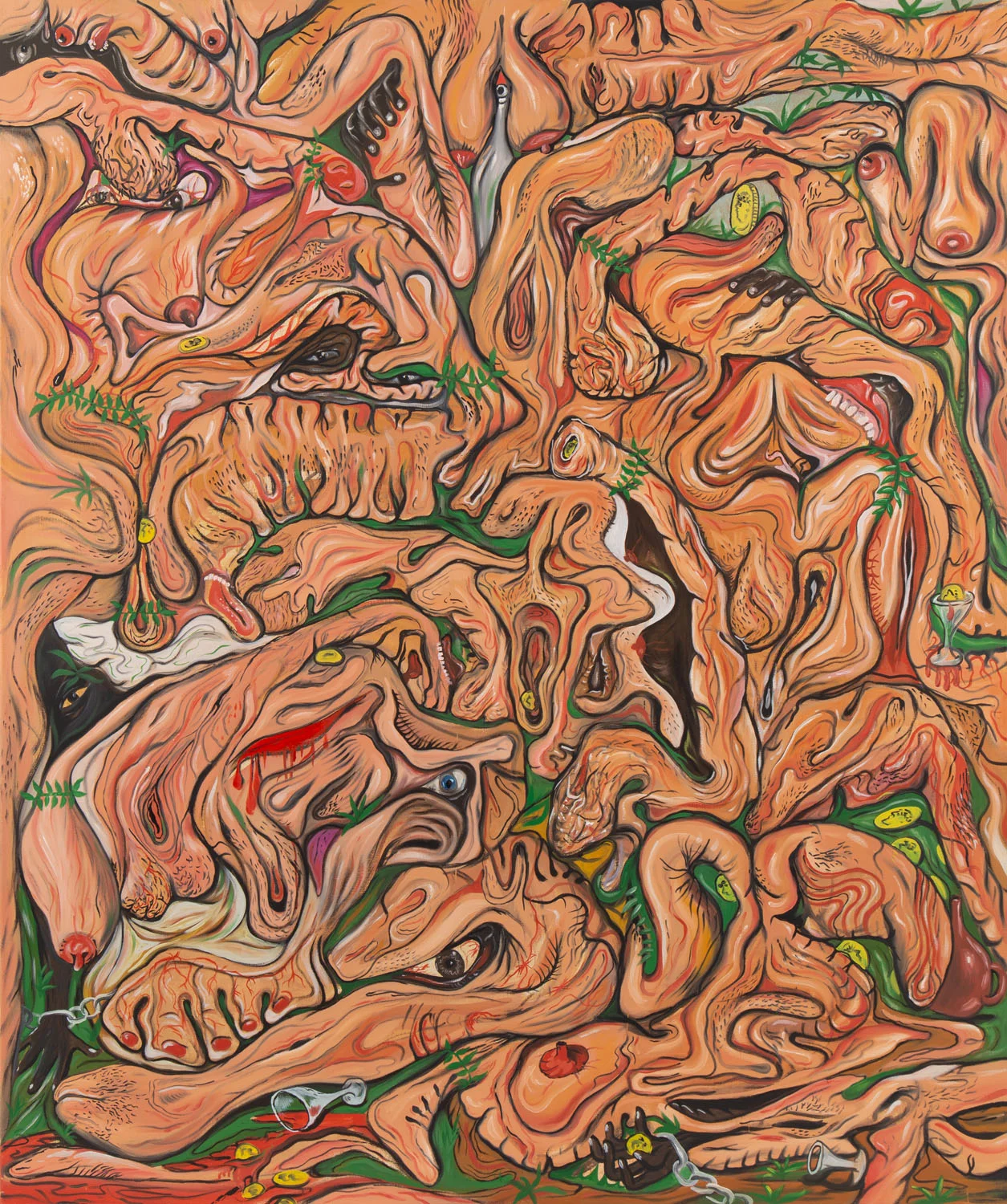
It seems that the artist depicted the accounts of a Roman writer Suetonius, who described the appearance of Caligula, the main character of Ziółkowski's painting, as following, "While his face was naturally forbidding and ugly, he purposely made it even more savage, practicing all kinds of terrible and fearsome expressions before a mirror. (…) He himself realized his mental infirmity, and thought at times of going into retirement and clearing his brain." (Suetonius, The Life of Caligula, cit. per M. Grant, The Lives of the Twelve Caesars Warsaw 1992, p. 104).
The body from Ziółkowski's painting seems to contain all these ugly expressions, which we hide every day by standing tall and smoothing out our wrinkles and folds. Bloodshot eyes, clenched, predatory teeth, battered limbs, saggy, heavy breasts and heavily exposed genital organs are the recurring motifs of his art. The artist leaves no illusions – even if we succeed temporarily, we are only a matter that is subject to the laws of physics and will sooner or later get out of control.
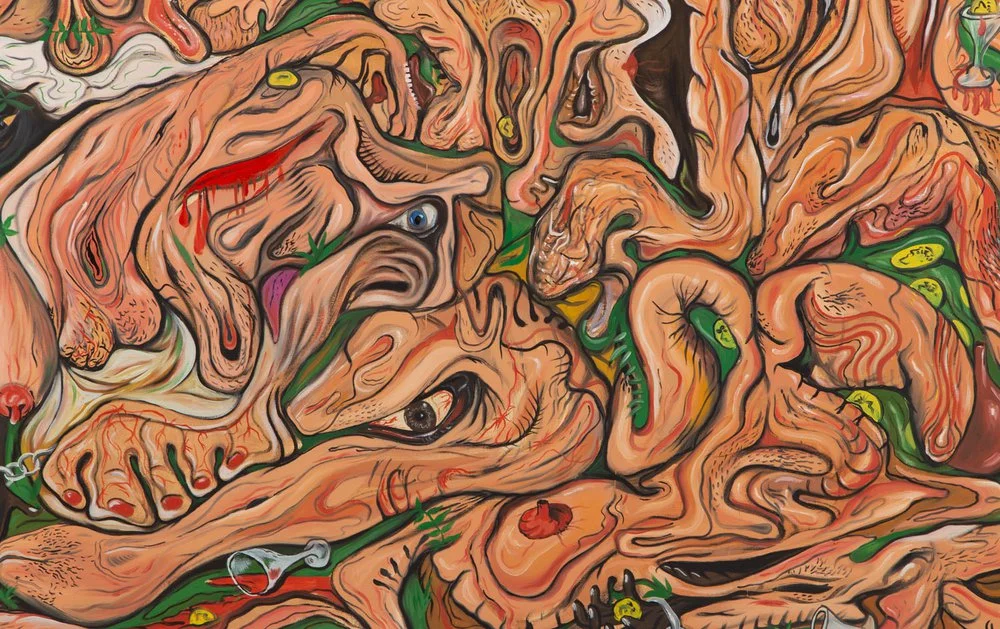
Ziółkowski perceives reality and the entire great history of art as an autonomous sphere, filled with its own motives and codes. In the artist's artworks, they are intertwined with an unrestrained game of imagination, intuition and the unnamed. Ziółkowski's works are marked by a spirit of experimentation and constant search, which reveals itself with the same power in both paintings of still life and in-depth psychological portraits.
Ziółkowski's works are somewhere on the borderline of reality and dream. Balancing gracefully between fiction and madness, they take up, with a remarkable ease, the less and less prevalent thread of great narratives. At the same time, they endear critics and the public with their unpretentiousness. In the artist's works we also find references to the tradition of expressionism, abstraction, surrealism, comics, or drawing conventions, and these are just a few of the most obvious points of reference.