
Surrendering to emotions: Interview with Artur Szolc
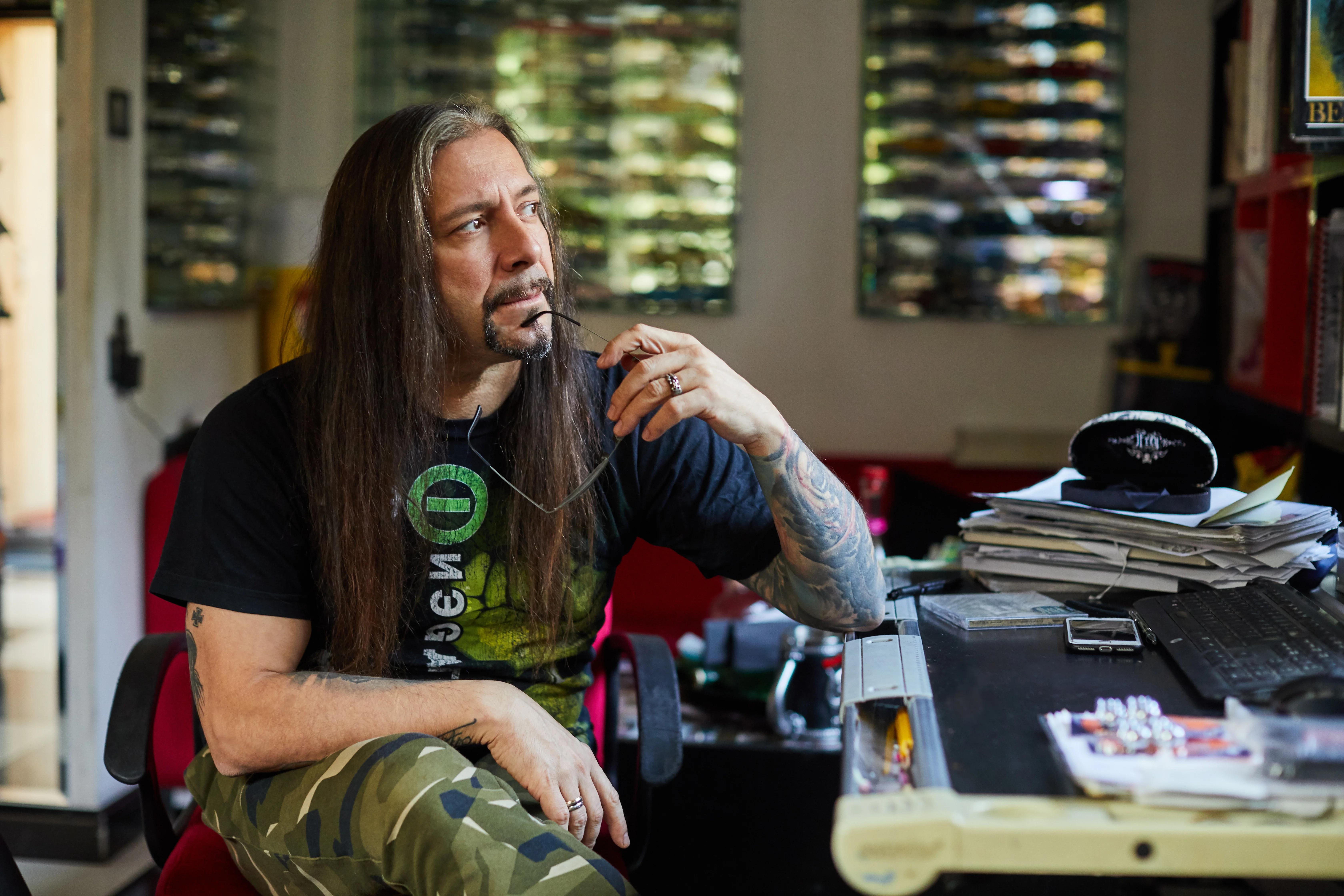
Artur Szolc is one of the most interesting figures associated with Polish surrealism. His painting combines his three passions – art, music, and tattoos. The painter's gloomy compositions make references to underground rock culture as well as his own past. The audience can also relate to them. Artur Szolc told us about his creative process and the inspirations that influenced his art the most.
You quickly rose to a prominent position within the milieu of Polish surrealists. What is magical art to you?
Let us start from the fact that, in my opinion, art should be magical in general, both in reference to imagination and aesthetics, as well as the very meaning of the word. Magical, that is breath-taking, unearthly, and, at the same time, moving and playing to our deepest emotions, inviting us to take part in a journey with its author. The very movement was created a long time ago by painters, who began to process and make paintings inspired by reality and combine them with their unlimited imagination. Depicting the real world became "too little" for them, so their mastery and amazing imagination allowed them to create their own worlds. Currently, magical art is experiencing its second, or maybe third youth. Being surrounded by so many incredible painters and artists, I am personally just trying to find my place in the current scene. My paintings are so distinguishable that I'm sure they'll find their place.
Using my inspiration, role models, hard work, sensitivity, courage, uncompromising nature, and lack of boundaries when it comes to themes, I want to reach an audience of similar sensitivity, taste, and expectations of art. Without a doubt, I want my paintings to evoke feelings-even negative ones. For an artist, there's nothing worse than indifference.
What makes art so fascinating to you? Do you remember your first painting?
From a young age, I have been fascinated by art. I have always liked to create "something from nothing". This irresistible desire to create things I can't buy, this need to capture a moment, catch a split second, this excitement before starting work, then sculpt the moment, surrendering to the feeling when one action inspires the next. It can't be substituted. Every artist, in my opinion, knows the emotion I'm referring to, and one of the objectives is to make the audience immerse in this world. However, one has to love themselves in order to love what they're doing. Then, nothing can prevent you from creating art that is absolutely compatible with you. There's a reason they say artists are in love with themselves. It's normal, at least in my understanding of the art world. Otherwise, we wouldn't be sharing with the world what we have to offer.
The process of my fascination and adventure with art took place quite naturally: starting with my childhood and creating images using iconic "Floppy Bear crayons", through painting the walls in my room inspired by favorite music album covers, painting shirts, and ending with creating paintings, composing music, releasing albums, and writing poems. It took place when I was in primary and secondary school. Only around 2001 did I produce the first significant painting in line with my vision. It was for my wife; she still has it today. As an exception, it is an oil painting, whereas I continue to use acrylic paint exclusively. Perhaps it is because I used acrylics to paint on fabrics and have explored all their secrets.
What story does your painting tell? What emotions do you want to arouse in your audience?
My paintings serve as chronicles and a record of what has moved me at a particular time, presenting the things I cannot accept and that I need to purge myself of. It may also be a subject that has impacted me so much that I have to share it with the world and even force the audience to think and reflect on it. For me, this process is very purifying. It allows me to be a typical, chatty, happy guy in a typical relationship with people. These topics are not generally light, simple, or enjoyable. Such emotions I keep inside myself (laughs).
I don't paint a lot. Each painting undergoes a process of verification and deep study. I want each of the works to be different, so I try not to stick to one theme and motif or use the same props. Therefore, each painting is a different story, a different composition, a different color range, different contrasts, and surfaces. In my paintings, I put a lot of emphasis on contrasts because, along with light and shadow, they are the foundation of good art.
I find it impossible to imagine painting as much as Zdzisław Beksiński did, a dozen or several dozen crosses, cathedrals, or vaguely similar figures. I have the utmost respect for his painting, but I also recognize that his motivations were different from mine and that he had a need to do it. I understand why someone would want to paint things like pierrots, card houses, trains, or sailing ships flying in the air. It may be their need or a fetish, but I'm not into it.
Who is the greatest inspiration for your painting? What do you appreciate about contemporary artists (and other creators)?
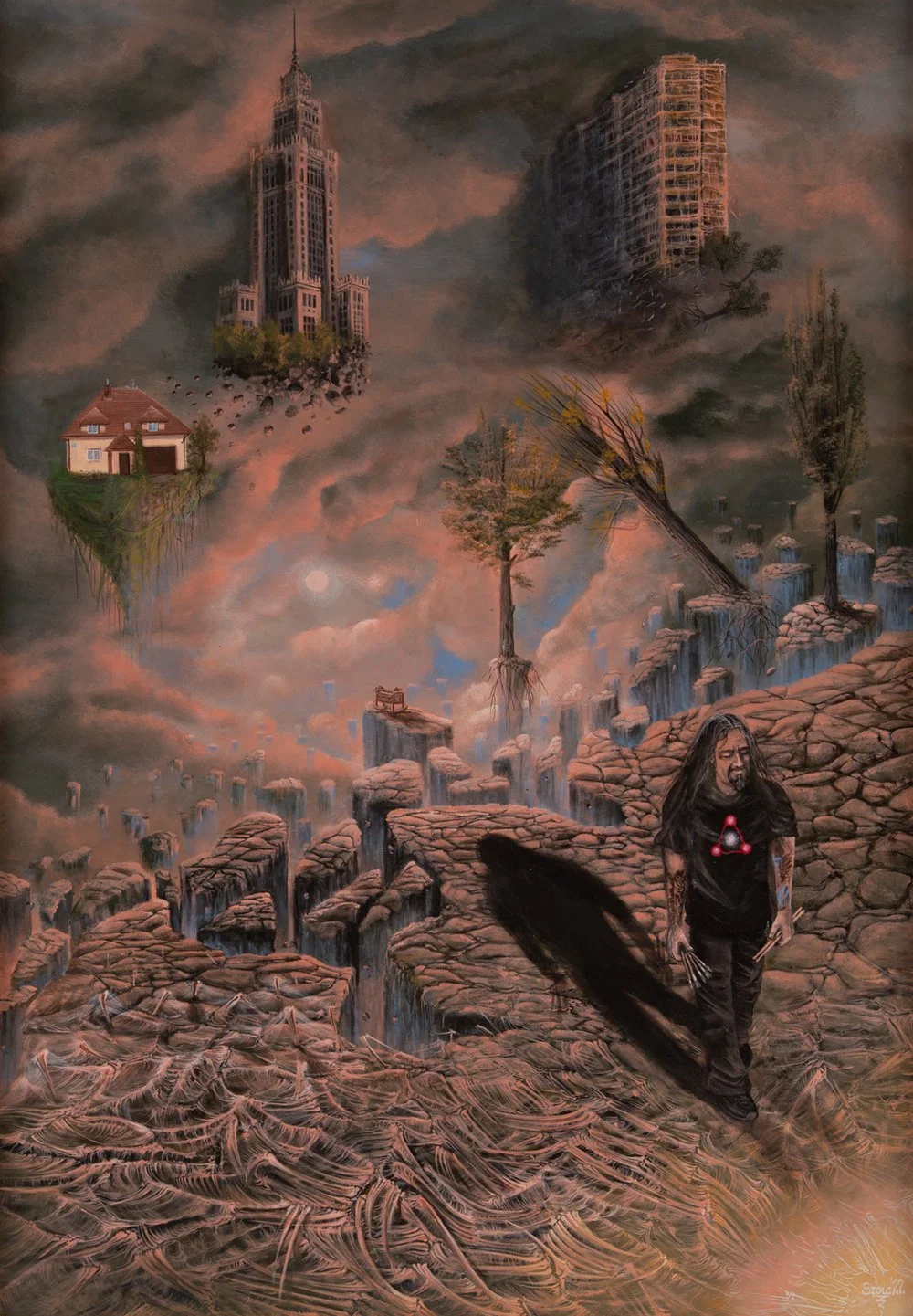
Like every painter, I have my favorite artists, and I am always happy to pay tribute to them. The three most important are Salvador Dali, Hans Ruedi Giger, and Zdzisław Beksiński. Then there are Hieronim Bosch, Arnold Bocklin, Odd Nerdrum, and Frank Frazetta, as well as Artur Grottger, Franciszek Starowieyski, and Witkacy. It's interesting that there are a lot of great tattoo artists out there whose work has influenced mine and who are deserving of attention. They are artists who are masters at using both brushes and pastels as well as tattoo machines. In this case, I will mention Paul BOOTH, GuyAitchinson, and Robert Hernandez. They know all about color, composition, and light, and many artists and painters could learn from them, just as I do with pride and pleasure. But Grzegorz "Bazyl" Baziak, who passed away unexpectedly last year, was my mentor and most significant teacher for many years. I painted "The Flight" in his honor. "Bazyl", like the above-mentioned tattoo artists, mostly created tattoos using the "freehand" method, that is, he made the sketch with a marker directly on the skin. I use this technique to this day. It enables precision when matching the composition to the human body's three-dimensional shape while accounting for all surface curvatures and refractions.
In addition to painting, you also deal with the art of tattooing. How do these two areas come together (or not?)?
As a tattoo artist, I have the honor to work with a "living canvas". Given the elevated nature of the relationship between the creator and the recipient, it is a truly remarkable honor. A tattoo is their closest point of contact, connection, and relationship. When a work is created in consultation with the recipient, many barriers, such as "it's impossible" or "it's not done that way," can be dismantled. Due to the lack of restrictions and the fact that tattoo recipients are typically laymen, they can quite freely come up with very spontaneous ideas. They share their visions, which I am happy to use and from which I gain knowledge. Additionally, after a moment of reflection and raising to a higher level of concentration, it is frequently possible to accomplish something that initially seemed impossible. It is a bit like looking for a way out of a maze or finding a key to a closed door in a computer game. These experiences have given me the ability to "gain strength" in my painting and approach the composition similarly.
Working with a living person unquestionably elevates me as an artist because it gives me the chance to look at the work through the recipient's eyes, an opportunity that no painter who is accustomed to canvas has. This is a unique advantage of tattoo artists-as long as they can appropriately use this gift. It is not a secret that I draw a lot of inspiration from my work as a tattoo artist, applying this knowledge to painting and vice versa. Without a doubt, the patience, accuracy, smoothness, composition, and attention to detail in my paintings are inspired by tattoos. Also, one profession complements the other and vice versa. Thanks to tattoos, you can develop your skills as a good colorist and shadow sculptor. Being able to combine my experiences from the two different areas of art, introduce them to one another, and thereby enhance my techniques, is a wonderful feeling. After all, we learn all our lives, so if someone thinks they know everything, they don't really know anything.
You're also a musician. What role does music play in your art?
Music plays an absolutely crucial role in my adventure with art. Since I play the drums, I can easily add rhythm and repeatability to the bone and biomechanical elements in my paintings (laughs). But seriously, I believe that music was a major factor in my decision to pursue art. Starting from the analysis of the album covers, ending with repainting them while listening to the albums: two types of art absorbed me completely. I still purchase CDs because, to me, a CD with a visual cover qualifies as a full-value publishing product.
Besides the technical fundamentals of color and detail (manual retouching) that I learned in the College of Printing, I am a fully self-taught artist who was created by art and out of love for it. There is no opportunism or calculation; instead, there is a beautiful ignorance and passion that allows me to move freely and do as I please. If I knew so many things that I should know, well, that are worth knowing, I wouldn't have done what I did. In addition, I had masters in both music and tattoo design: "Bazyl" in drawing, and Marek Surzyn in drums. I am still achieving smaller and bigger successes in music. I record albums that are released. I'm not an unpublished musician. I even made covers for a few of my albums. Recently, the album "Are You There" by keyboardist Riverside Michał Lapaj, on which I recorded all the drums and percussion instruments, received a nomination for the Fryderyk Chopin Award. My own initiative, however, is "Music Inspired By," of which I am most proud. Three albums have already been made available: Tarot, Zodiac, and Alchemy. "Music Inspired By Slavs" will be released this autumn. The album's title alludes to Slavic culture traveling in four directions around the globe. This is arguably the most intriguing and mature of my albums.