
Summer in the city and the painterly perspectives of Magdalena Jędrzejczyk
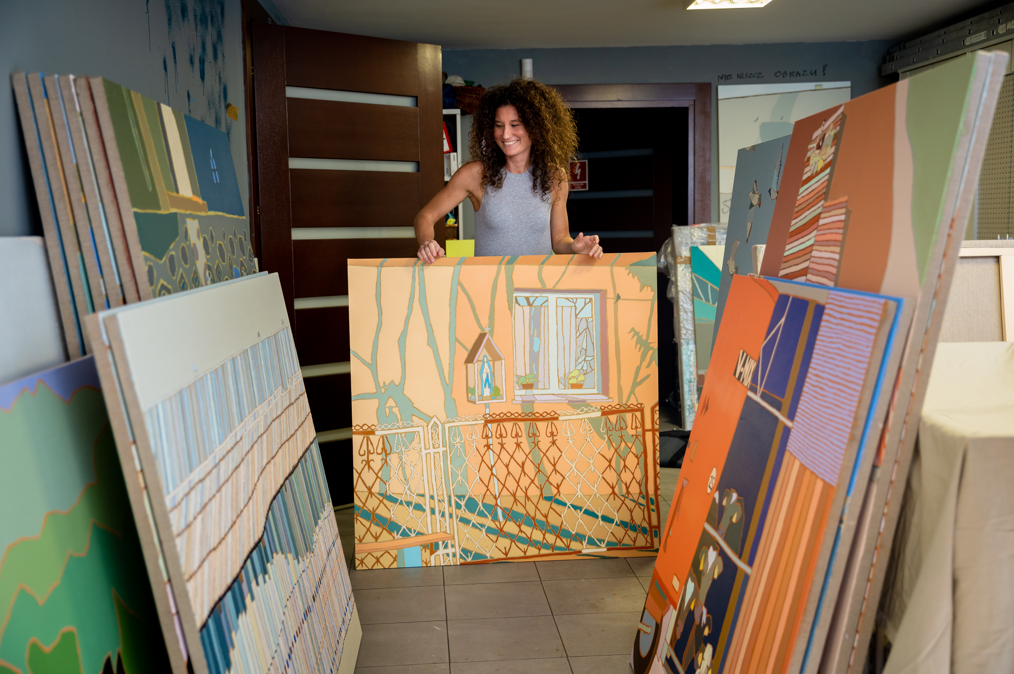
Magdalena Jędrzejczyk is a versatile artist with a masterfully honed technique and an extraordinary awareness of her own creativity. She graduated from the Painting Department of the Warsaw Academy of Fine Arts (ASP). Her diploma was awarded with distinction and presented among the best works of graduates during the "Coming Out" exhibition in 2014. In 2021, the artist also obtained her PhD at her alma mater.
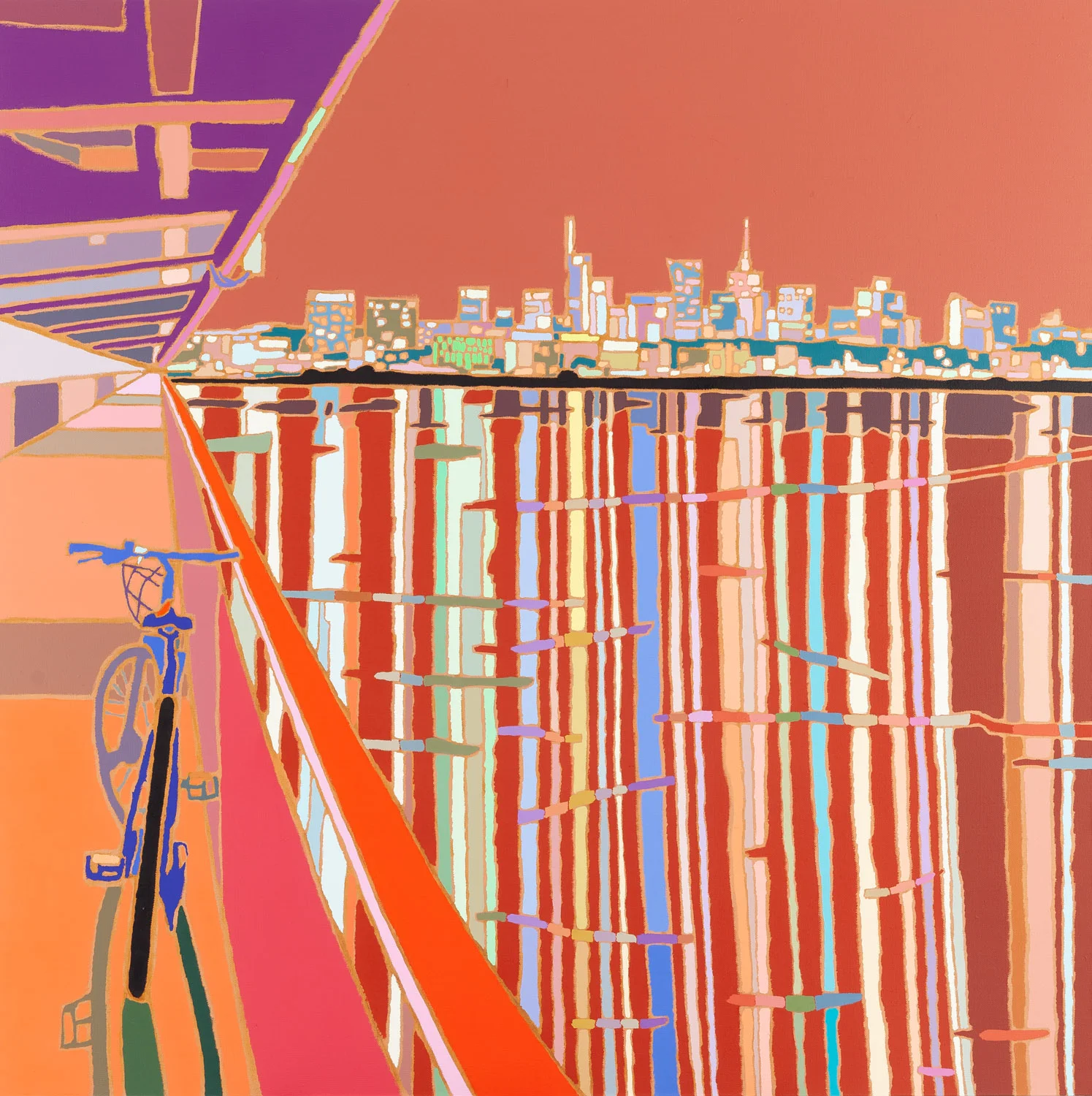
Since her university years, she has consistently focused on figurative painting, addressing the themes of the perverse idyll of the countryside and the everyday life of Warsaw in her works. The observed reality serves as a mere pretext for abstract arrangements of forms and rhythms in her art. Her compositions vibrate with saturated, pure colors, carefully selected by the artist to create harmonious and energetic color combinations. She discusses these and other secrets of her art in this extensive interview. Please read on to find out more.
Paulina Brol: When did you first know you would become an artist?
Magdalena Jędrzejczyk: At the age of 13, I decided to give up playing the piano in favor of painting. I dreamed of creating, but I couldn't compose musical pieces. After completing the Primary School of Music, I focused on painting, knowing that I wanted to become a painter. Later, during high school, in addition to getting ready for the final exams, I intensively prepared for the entrance exams at the Academy of Fine Arts, and I was accepted on my first attempt.
PB: Is painting the only art form in which you express yourself?
MJ: In the past, I also engaged in mural painting and drawing, but currently, I focus on oil painting. Painting on canvas provides so many possibilities for expression and is so rich that I simply don't feel the need to look elsewhere. In the past, I thought about designing stage sets because I love theater. I once even sewed a coat from fabric for which I designed the pattern myself, but I didn't have enough patience to pursue a career in fashion. I don't consider small graphic projects to be art, but I do sometimes create them.
PB: What do you want to convey through your paintings?
MJ: It seems to me that the main idea I want to convey is that beauty can be found in everything that surrounds us. Ordinary, everyday life can be a source of excitement and joy. You just need to be attentive and maintain a certain sensitivity within yourself. In general, for a painter to create, they must constantly be amazed and nurture a childlike sensitivity to the world. The most important aspects of my painting are light and color, which build up space and give it rhythm. I am constantly searching for the boundary between abstraction and figuration, balancing somewhere in between. It's about the magic we give to reality through painting. The universality of the message is important to me. It always makes me happy when the viewer has their own individual and unique interpretation of the painting.
PB: So far, your main themes have been the countryside and Warsaw. Why have you chosen so?
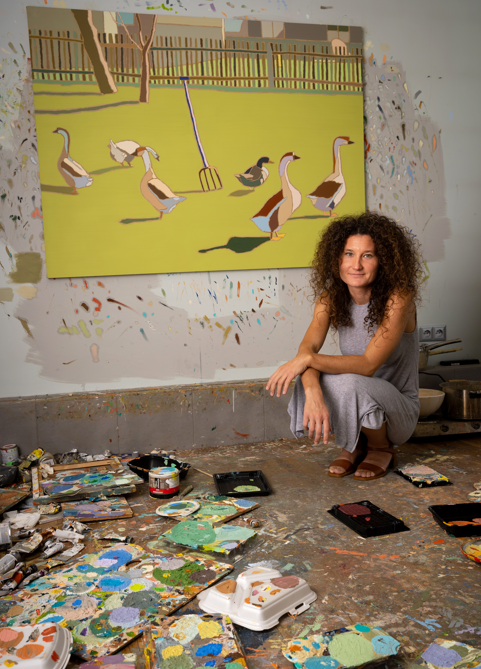
MJ: It happened very naturally and spontaneously. As a child, I spent a lot of time in the countryside and have many memories from those years. My grandmother lives in the countryside, and for several years, I even had a studio there. I spent a significant part of my studies in the countryside. My professor agreed that I could bring my landscapes and other observations of the countryside to painting reviews. Painting a model in the studio of the Painting Department wasn't very appealing to me. Therefore, my diploma in painting was related to the countryside ("Eternit" was the title), and my PhD thesis was also an extension of those observations ("Abstract Observationalism" was the title). I was born in Warsaw, but my "Warsaw" explorations really began when I moved to Powiśle and started raising my child on my own. Long walks with a stroller, and later regular bike rides to the other part of the city where I have my studio, became a source of new ideas and inspiration. I suspect that if I still lived in Spain, I would still be tackling Spanish themes. I gather ideas for paintings wherever I am currently staying. You could say that I am always at work because I never stop observing and I also collect materials by taking a lot of photos.
PB: Your paintings are of a high technical quality. Could you reveal something about your extraordinary technique?
MJ: The quality of the painting support and preparing the primer myself are very important. I paint on linen supports that I have been ordering from a trusted manufacturer for many years. I prime the canvases using the traditional method. For this purpose, I mix chalk, zinc white, and pigment, then add warm gelatin and linseed oil varnish. I obtain a semi-glossy ground, apply two layers, and the color depends on the previously added pigment. I don't use any medium (such as turpentine or linseed oil) while painting; I paint solely with oil paint. I achieve a matte surface and paint flat and thinly.
PB: Is there something without which you couldn't start painting?
MJ: Something must enchant and interest me in terms of color and composition. That specific piece of reality must be unique, like a puzzle or mystery. Usually, I take photos when that happens, often a large number of them. Sometimes, an idea forms in my mind, and to bring it to life, I need to compile many photos from completely different situations and places. I don't paint directly from the photo from start to finish. There is a moment that I particularly enjoy when I no longer need the photo, and I engage in abstract arrangements of colors and forms. Apart from that, I paint in silence, often after intense physical exercise; my one-way trip to the studio is 13 km. Sports greatly stimulate creativity and also contribute to better concentration.
PB: I assume you approach your work in stages. What do they look like?
MJ: The first stage is an oil sketch on the canvas using a brush. I usually use sienna for this because it dries quickly, within one day, or a maximum of two. Once this sienna sketch on the canvas is dry, I begin the actual work. I don't know why, but I usually start painting from the top. I apply a specific color to the canvas when I'm certain of it after mixing it on the palette for a while. I never mix colors on the canvas; I don't like senseless smudging. If, for some reason, the applied color turns out to be wrong, I scrape it off with a palette knife or wipe it off with a damp baby wipe before applying a new one. There is essentially no third stage unless I start correcting the painting once most of the sections have dried. However, such situations occur extremely rarely; I don't like to correct paintings.
PB: Is there a favorite place or symbol that you incorporate into your compositions?
MJ: It seems to change over time. I have periods when I intensely explore specific places or sports disciplines... but they pass. Sometimes, I return to certain motifs after several years. I don't like monotony; I want to continually develop and search. What must always be present in the painting is light, space, and color; without them, there is no painting. I try to focus on that. The topics come on their own; they are born very spontaneously in my case. They are largely a pretext for purely formal searches, abstract juxtapositions of forms and rhythms.
PB: What are your biggest artistic dreams?
MJ: My biggest dream is to be able to continously create and make other people happy with my painting. I feel the greatest satisfaction when my image evokes joy in another person. I want to stimulate positive feelings with my painting and make people optimistic. A solo exhibition in one of the National Museums would, of course, be a nice element in my creative path, but I believe that this is not a prerequisite for artistic fulfillment. I believe that what is most beautiful in my work is continuous development, it is the most attractive in this profession.