
Splendor of Polish Kilim Carpets
The long tradition of Polish weaving had made fabric an art form and elevated it to the rank of a national asset. Fabric had been present in Polish houses for centuries, it was popular both in manor houses of nobility, burghers' tenements, as well as peasant cottages. It played an important role in decorating interiors and Polish weaving stood out against the background of European decorative fabric. Kilim carpets had become representative of Polish art, being a symbol of native tradition, appreciated and awarded at the most important national and international exhibitions on numerous occasions.
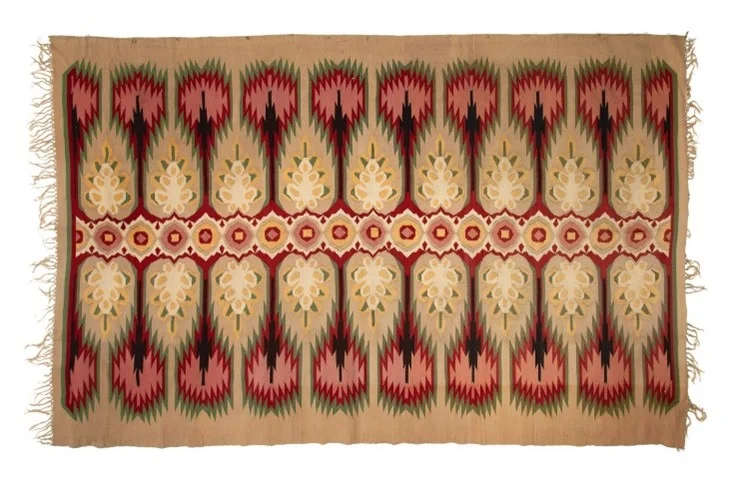
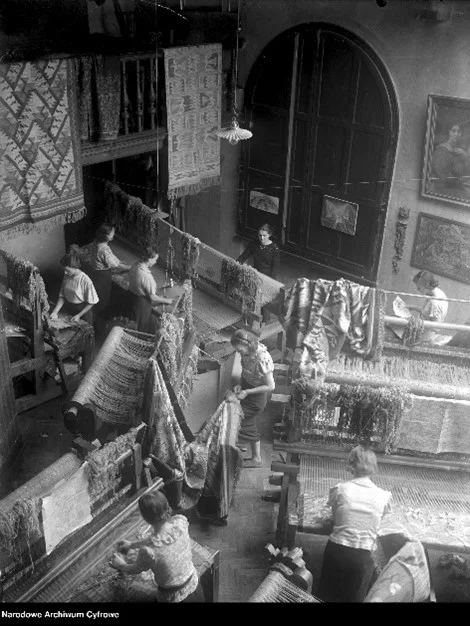
Until the beginning of the 20th century, the weaving of kilims was mainly carried out in home studios, and the techniques of fabric production would be passed down from generation to generation, "In our rich, colorful, noble past, the lavish native fabrics, especially kilims, constituted an essential background for our life in military camps, palaces, manor houses, in Kyiv, or during religious celebrations". (Catalog of National Exhibition of Old and Contemporary Kilims, Lviv 1913, p. 3). In Polish houses, kilim carpets served as everyday objects, however, they remained to be luxury goods. These fabrics were most often used as wall decorations, as well bedding, covering desks, tables, or coffins during funerals. There had been cases of wrapping the dead in them. They were described in the catalog of the Polish National Exhibition of Old and Contemporary Kilims in Lviv from 1913, "For Polish peasants, kilim carpets were luxury goods, highly valued and respected. They were often included in bride dowries, given to daughters by the wealthiest parents. In addition, kilims were often donated to Catholic and Orthodox churches, where they would lay at altar steps. New kilims would be stored neatly in chests and taken out only for special occasions, e.g. funerals. Old, worn-out Kilims served as items of everyday use, for instance as bedcovers."
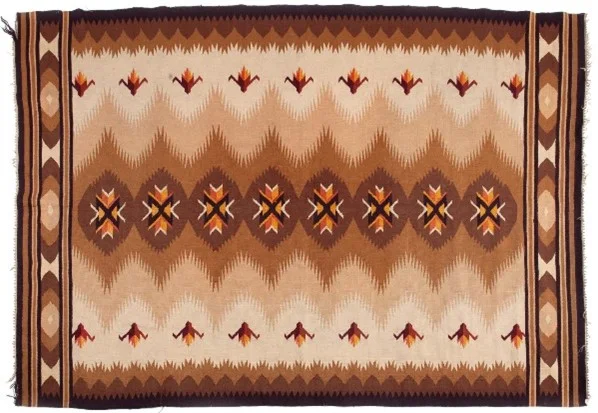
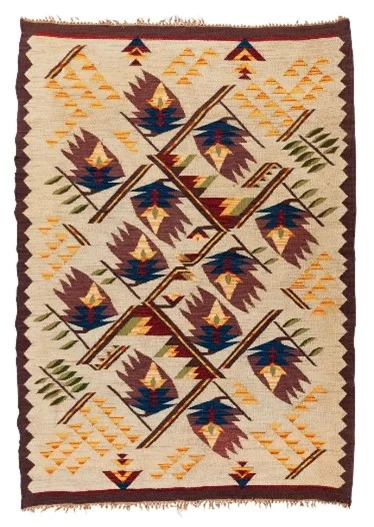
It was not until the 20th century that Kilim carpets gained artistic value. Modernist and Young Poland's searches for the national Polish style were of particular benefit to reinventing kilim carpets. They gave the possibility of intertwining tradition and modernity, which was remarkably popular at that time. In the interwar period, kilims became one of the most important sectors of the Polish art industry, which had been already noticed by contemporary critics, "The production of kilims, like no other sector in the artistic industry, saw such a progress in ennobling the material, techniques, and ornamentation." (Rzeczy Piękne, R. 8, No. 4, p. 129.). Kilims, thanks to their long tradition, became a symbol of Polish individuality, especially in view of Poland regaining its independence. Kilims started presenting ornaments imitating folk motifs, arranged in symmetrical patterns, "The artists tried to draw inspiration from the elements of tradition that, in their view, testified to the national character of a work. Their kilim carpets were full of stylized common flowers, ornaments inspired by folk embroidery, painted chests, cut-outs, Easter eggs, highlander handicraft. Eventually, they started reaching the most popular themes of this period, such as peacocks or roses, which were remarkably popular among all artistic genres. On the other hand, the artists brought their own inventions to compositions and color patterns, they designed their carpets in a painterly manner, freely, in the spirits of Art Nouveau decorativeness." (Irena Huml, Współczesna tkanina polska, Warszawa 1989, p. 9)
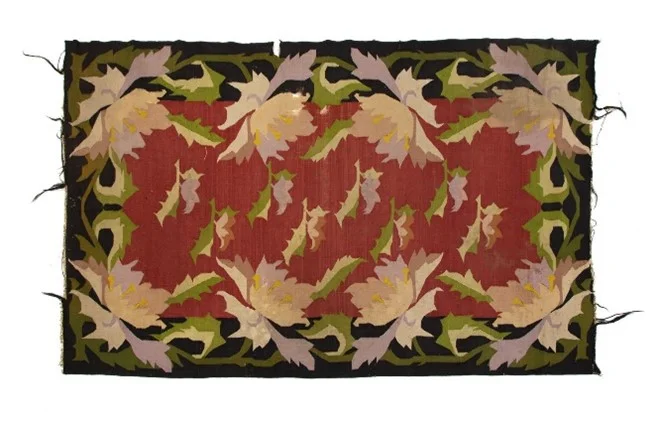
Rhythmical and geometrical patterns were one of the most popular motifs in the interwar period, which reveals art déco's fondness of symmetry. One may also notice that the symmetrical folk patterns and saturated, harmonized colors drew inspiration from the rich tradition of folk art. Striving for making craft equally appreciated as painting or sculpture, the artists made fabrics into works of art, representing Poland e.g. at the International Exhibition of Modern Decorative and Industrial Arts in Paris in 1925. The style of contemporary kilims perfectly reflected the character of Polish art déco, which distinguished itself against the background of other European fabrics, "We are not fully aware that Poland excels in the production of artistic kilims. In 1925, at the International Exhibition of Modern Decorative and Industrial Arts in Paris, Polish kilims competed for primacy with the Swedish kilims by "Föreningen Handarbetets Vänner", which is a huge progress. It makes us believe in the glorious future of the Polish kilims in the international arena." (Naprzód, No. 56, 9.03.1929)
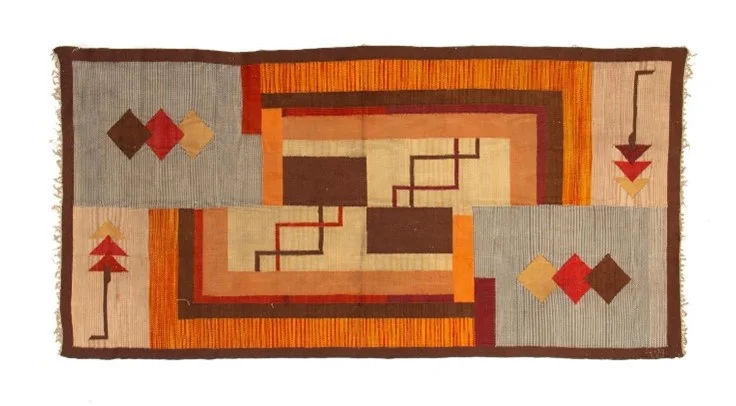
Kilims were not only works of art, but also utility objects. The fabrics were presented at exhibitions in Poland and Europe and at the same time constituted an important element of decoration in houses or highland chambers. As a result, they targeted the moderately affluent part of society. In 1928, decorative fabrics were praised as following, "Kilims are beautiful decorations of walls, floors, and home equipment. They can be used in various ways, e.g. as bedspreads for ottoman couches, bedcovers, tablecloths, etc. (…) The versatility of kilims does not spoil the harmony of houses. On the contrary, their opulence gives the apartments a nice, warm, and cheerful atmosphere." (Stefan Kacprowski, Kilimy i wełnianki, Towarzystwo Wydawnicze Bluszcz, 1928, p. 1).