
Searching for beauty – artists' journeys to distant lands
"Searching for beauty" – that's how Bronisława Rychter-Janowska described her European peregrination undertaken between 1912-14, with Italy as her main destination. She was not the only artist who embarked on distant journeys in search of inspiration for her works. Painters eagerly traveled to other, especially, far-flung and exotic countries that stimulated their imagination and artistic flair, often exerting a significant influence on the development of their work.
As we had the opportunity to present in the exhibition "Mela Muter. On the Road," journeys continually provide artists with inspiration for creating art and offer them new painting subjects. The upcoming "Art Outlet. 19th Century and Modern Art" auction features a significant group of paintings inspired by trips to Southern Europe and artistic depictions of the Orient, created by artists like Feliks Michał Wygrzywalski, Bronisława Rychter-Janowska, Włodzimierz Terlikowski, and Aleksander Laszenko.
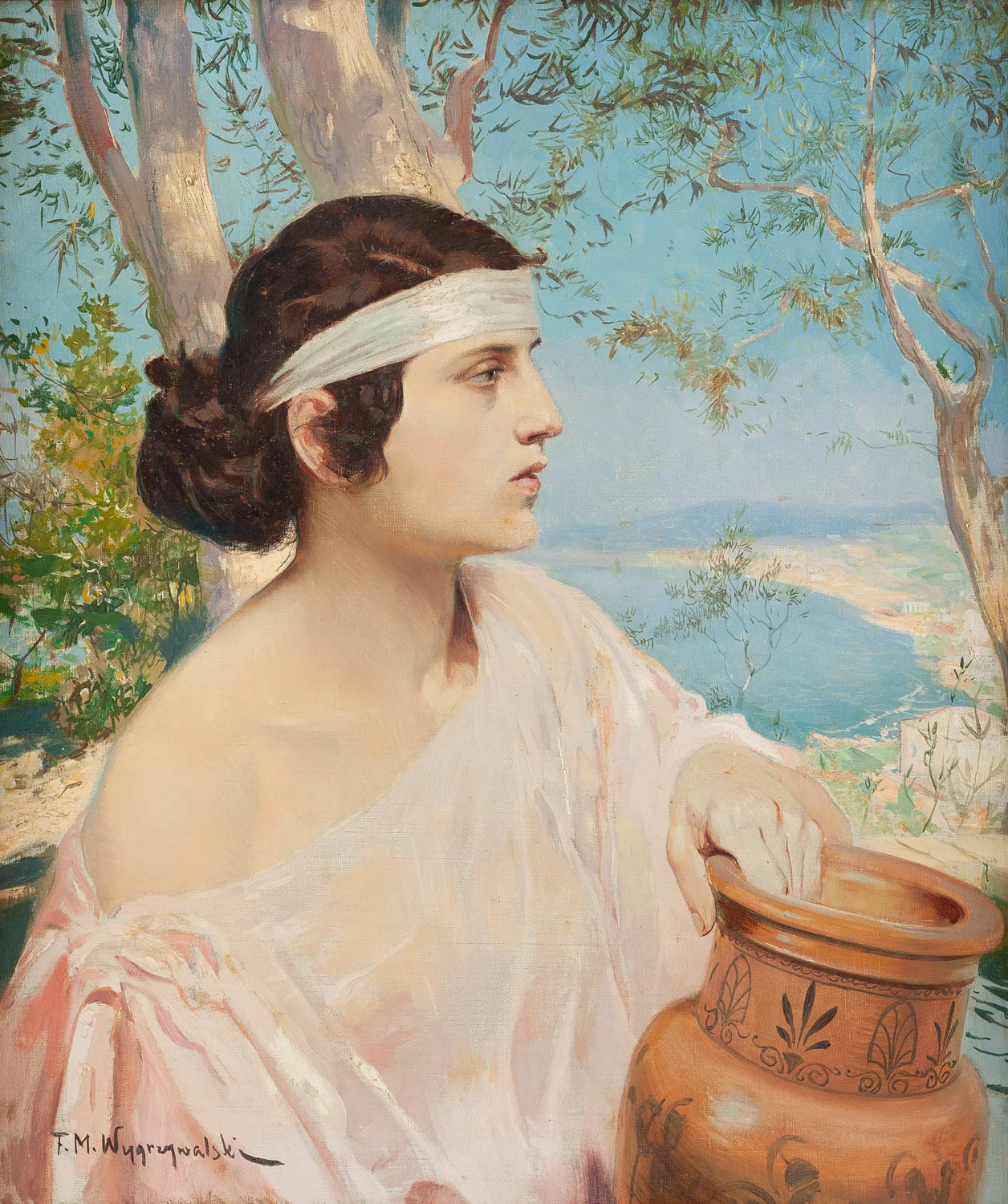
One of the most popular travel destinations was Italy. Considering its centuries-old artistic heritage, architectural monuments, and galleries filled with excellent works by old masters, it's not surprising that artists chose this direction. Additionally, the picturesque coastline, southern sun, long warm days provided ideal conditions for studying landscapes. One of the artists who decided not only to visit but also to reside longer in Italy was Feliks Michał Wygrzywalski. After studying in Munich and Paris, the painter arrived in Rome in 1900. In the Eternal City, he found a source of "great art." He was captivated by the southern landscape bathed in sunlight, the blue-sapphire sea, the passionate temperament of the local people, their customs, and the impressive ancient heritage of the country. His life partner became Rosa Sammassa, of Italian descent, whom he met during his studies in Munich. In Rome, the painter passionately visited galleries and copied the works of old masters. Undoubtedly, the ancient marble sculptures, antique vases, and remains of temples also made a significant impression on him. The painting presented in the catalog, Roman Woman Against the Backdrop of Vesuvius, encapsulates the artist's interest in classical antiquity, the southern beauty of Italian women, and the seascape. In the idealized image of the woman, the painter reminds us of the beauty and power of the ancient Empire.
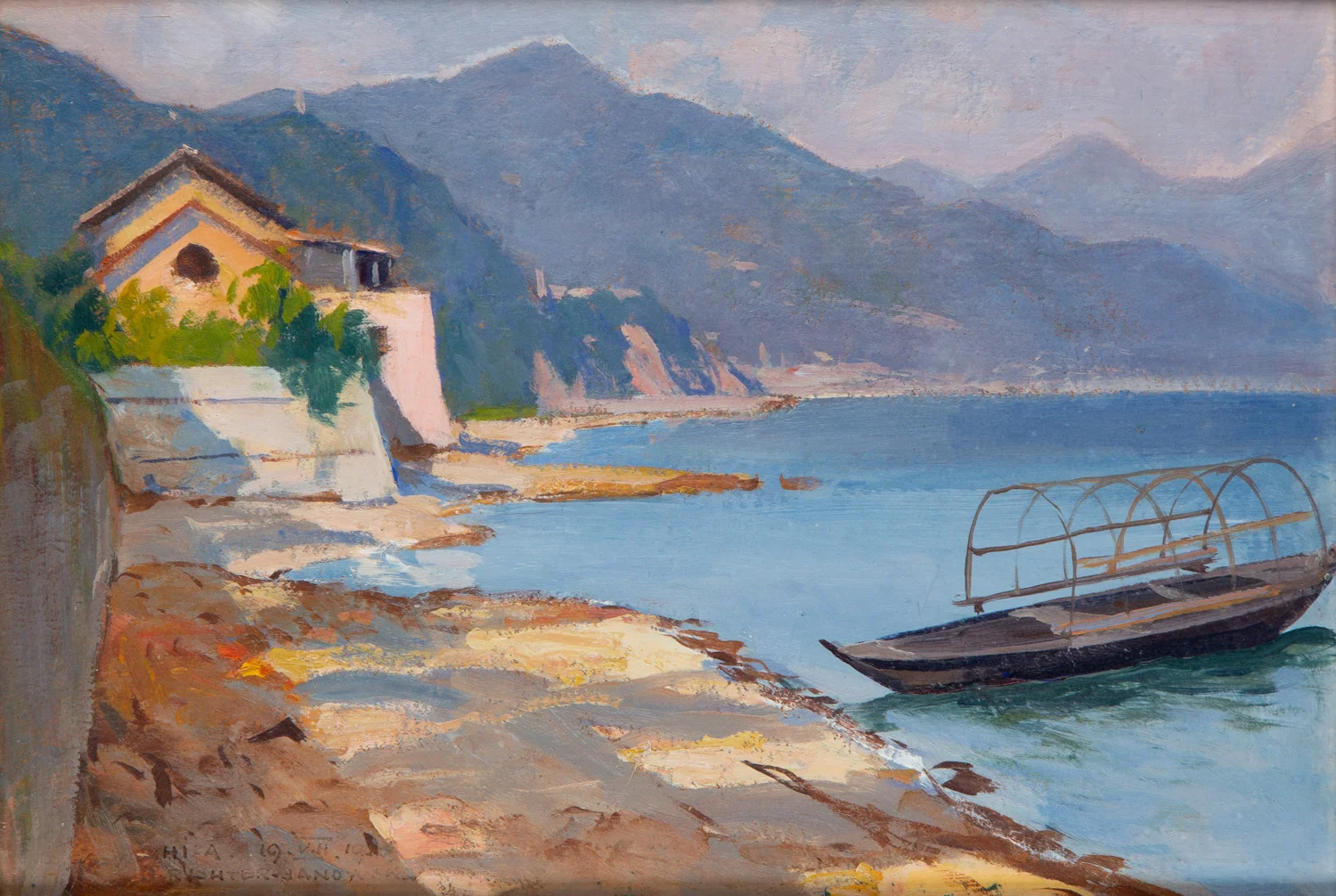
Artists sometimes also traveled to Italy for studies. This was the case for Bronisława Rychter-Janowska, who arrived in Italy in 1904 after her time at the Munich Academy, to continue her studies in Florence and Rome. She returned to Italy multiple times: in 1912-14, 1919, and 1924. In addition to the cities where she studied, she also visited Naples, Venice, Padua, Florence, Genoa, and even Sicily. These journeys introduced representations of ancient temple ruins, church interiors, Venetian lagoons, maritime landscapes, and coasts into her work, as seen in the presented painting from Ghifa. She painted directly from nature, allowing her to capture the pivotal moments. The artist sent her works from Italy to Polish exhibitions. She also organized her own Italian exhibition in the spring of 1913 at the Excelsior Hotel in Rome. The exhibited paintings received warm reception from the critics. Most of them were sold, and one titled Return from Church was gifted to Pope Pius X.
In addition to Southern Europe, artists were also drawn to the Mediterranean Sea: to Egypt, the Maghreb countries, and the Levant. Orientalism, or the interest and inspiration drawn from the culture of the broadly understood East, was one of the leading trends in European art in the 19th century. It was connected to political events that took place at the end of the 18th century and the first decades of the 19th century, primarily the colonial expansion of European powers in the East, as well as the ongoing "Eastern Question" that manifested in the Balkan conflicts. On the other hand, the affinity for exoticism and the extraordinary was intertwined with the spirit of the Romantic era. In Polish art of the 19th century, Oriental themes were explored by artists like Aleksander Orłowski, January Suchodolski, Tadeusz Ajdukiewicz, and Alfred Wierusz-Kowalski. The fascination with North African and Middle Eastern countries didn't wane at the turn of the century and during the first half of the 20th century; rather, it persisted. Depictions of Saharan oases, portraits of local populations, and idyllic scenes of couples under the southern sun continued to be present in the works of artists like Stanisław Chlebowski, Adam Styka, Aleksander Laszenko, and Włodzimierz Terlikowski.
One of the Polish orientalists was Aleksander Laszenko, born in 1883 near Kharkiv. He traveled extensively with his father across Europe, the Middle East, and North Africa from a young age. He studied painting at the Imperial Academy of Arts in St. Petersburg while also attending the Konstantinov Artillery School for Officers. He combined his military career with his artistic one, and he continued his passion for travel. He also had an interest in archaeology. It is probable that he visited the tomb of Tutankhamun in 1922, capturing scenes from its walls in sketches and canvases. Laszenko made multiple trips for plein air painting in Egypt, capturing desert landscapes with monumental ancient architecture in the background, often with solitary Bedouins on camels. He was also interested in portraiture and meticulously depicted the attire of the local populace, indicating his ethnographic knowledge of the residents. He also created oriental-themed prints using the technique of color woodcut.
The artistic output of Włodzimierz Terlikowski was also influenced by numerous exotic journeys. He traveled to India, Australia, New Zealand, and Northern Africa. These far-reaching journeys were reflected in his depictions of Oriental cities with mosques in the background and portraits of followers of Islam, as seen in the painting featuring a Muslim woman in traditional attire with a veil covering her face. Oriental compositions were also created by Warsaw-based artist Konstanty Szewczenko. His canvases captured Bedouins, genre scenes in desert landscapes, and couples in love. The artist's work showed a strong influence from the works of Adam Styka, particularly in the depictions of smiling couples embracing under the golden light of the setting sun.