
Peasant-Mania in the Krakow Style
Polish folklore fascinated many national artists who worked at the turn of the 19th and 20th centuries. The painters' interest in simple rural life and native traditions found its reflection in depictions of folk dances, wedding ceremonies, folk rituals like Sobótka (Kupala Night), funeral ceremonies, and portraits of rural people. The beauty of young women from Krakow, Łowicz, highlanders, and Huculs were immortalized by artists like Wyczółkowski, Sichulski, Jarocki, Pautsch, Kędzierski, Axentowicz, Wyspiański, and Weiss. For them, the category of youth represented the vitality of the Polish people. This phenomenon in Polish culture was so extensive and significant that it later received the name "peasant-mania."
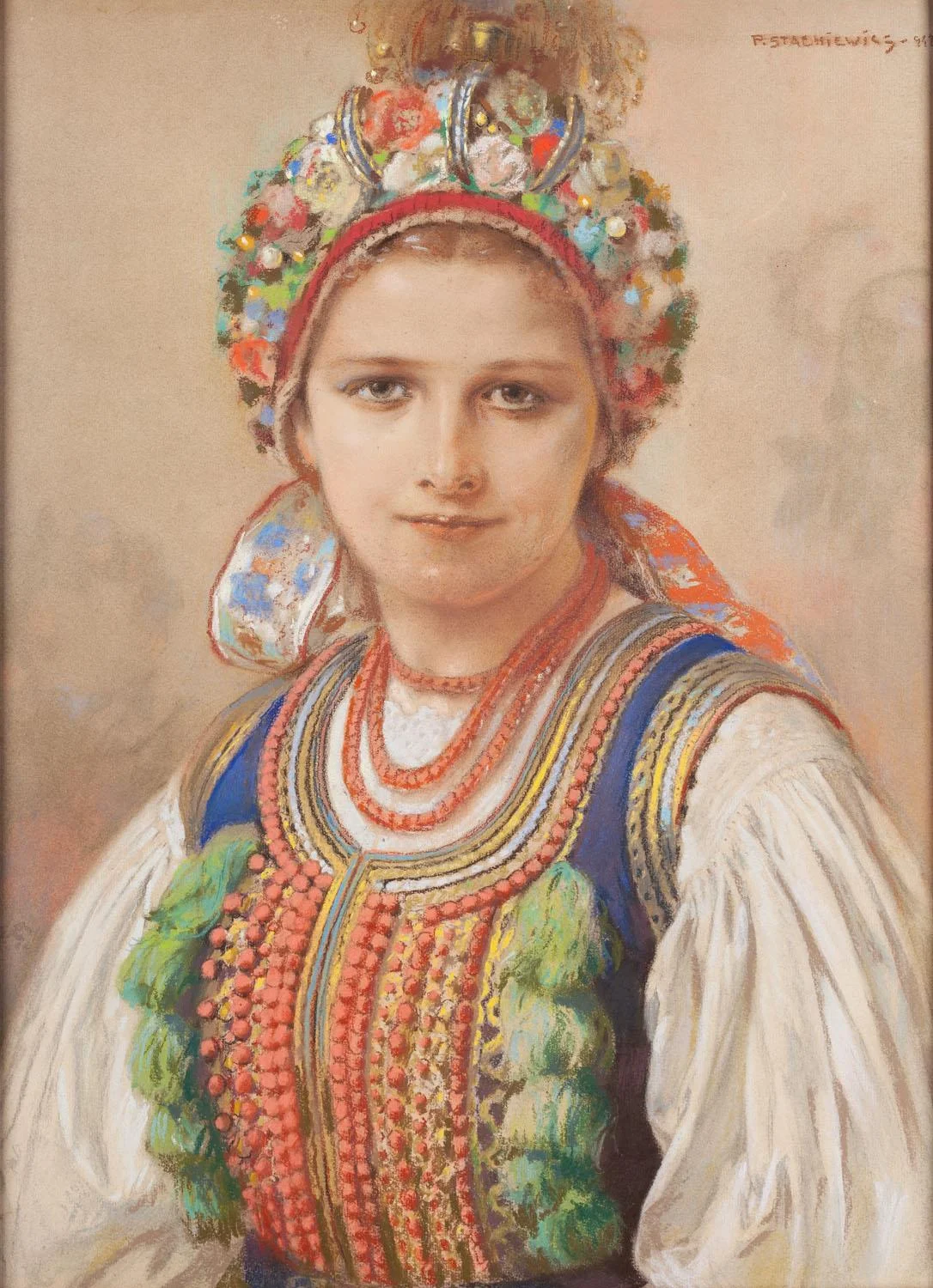
Representatives of the intellectual and artistic elite, in an effort to break the stagnation and cultural crisis caused by urban life, returned to nature, to the countryside, to gain vital energy and stimulate their artistic inspiration. They often married women from peasant communities, as was the case with the painter Włodzimierz Tetmajer and Anna Mikołajczykówna, or her sisters, Jadwiga and the poet Lucjan Rydel. The latter became prototypes for the young couple in Stanisław Wyspiański's play "The Wedding." The character of the Bride from the drama inspired artists to paint the image of a young peasant girl in traditional Krakowian attire. One such artwork is offered at the auction by Piotr Stachiewicz. This Krakowian painter received artistic education at the School of Fine Arts under Jan Matejko, Władysław Łuszczkiewicz, and Florian Cynk from 1877 to 1883, and then honed his talent at the Academy of Munich until 1885. After completing his education, he returned to Krakow, where, alongside religious and mythological scenes, he immortalized the folk traditions of Lesser Poland (Małopolska). The artist was known for sensual portraits of women, idealized odalisques in turbans, and Krakowian women created using pastel technique. Often, Zofia Paluchowa from Dłubnia, known as "Beautiful Zośka," posed as a rural girl in folk costume for him. This beautiful girl was a model for many artists, including Wojciech Kossak and Wincenty Wodzinowski. In the presented artwork, the artist portrayed the girl in a festive, splendid dress adorned with a magnificent wreath decorated with colorful flowers and embroidered ribbons flowing down her back. The Bride's white shirt is adorned with a multicolored corset embroidered with beads, braid, and buttons. Above it, on her neck, rest three strings of carmine coral beads.
Piotr Stachiewicz's "Cracovian Woman" will be auctioned on July 25th at the Art Outlet auction. Auction of Collection , where prices for all works starts at 1000 PLN/220 EUR, offers attractive prices for paintings by Wojciech Kossak, Feliks Michał Wygrzywalski, Włodzimierz Terlikowski, Władysław Szerner Junior, and others.