
Rafał Malczewski's painting for the Na Skarpie villa
Displayed at the exhibition, Rafał Malczewski's double-sided painting connects Zakopane with the capital city. It was created in the 1930s for Jadwiga Elżbieta Pniewska, wife of Bohdan Pniewski, for their Na Skarpie villa in Warsaw. The villa gained fame as an icon of modernist architecture and the life's work of its owner, who was also the designer. Bohdan Pniewski, one of the most famous architects of Warsaw in the previous century, designed it for his own use in 1936-1937. The building, in the form of a simple, heavy block, was transformed from a classical garden pavilion designed by Bogumił Zug, which later served as the presumed headquarters of a Masonic lodge.
Its earlier history is reminded by the preserved classical portico from the garden side, consisting of Doric half-columns. The architect added viewing terraces on the higher floors and also included an additional floor. On the Na Skarpie Ave side, the elevation with small window openings and the embedded main entrance, covered with sandstone slabs, resembles a defensive structure. The crowning touch of the project was the inscription carved on a smooth slab, a mysterious Latin inscription meaning: "The trailing one rebuilt the temple of the Masons and dwelt in it."
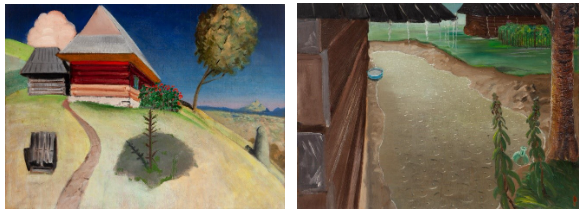
Not only was the concept of the villa's external structure meticulously thought out, but also its interior. Stone walls were covered with lime mortar, and the floors were laid with dark and light marble, in addition to sandstone veneers juxtaposed with plastered wall sections and oak flooring. One of the surprising solutions was, for example, the lining of the ceiling of the study with built-in, original folk troughs. It seems that Malczewski's painting depicting mountain huts fit perfectly into this austere decor. According to family legend, the work was intended to serve as a partition between the spouses' bedrooms, hence its composition is two-sided. Who got the sunny view and who got the gloomy, rainy day? Unfortunately, it is impossible to find out anymore. Both sides of the work encapsulate all the most characteristic features of Rafał Malczewski's work: experiments with form, that is, composition of plans, variety of perspectives, synthesis of shapes, as well as bold color combinations. The theme of the painting refers to numerous landscapes by the painter, presenting a poetic, provincial world of small and trivial things, in which people played insignificant roles. It was mainly nature and the magnetism of the mountains that inspired the artist. However, the painter did not directly transfer the external world onto canvas or plywood but transformed it into a painterly concept, which became a second reality, governed by its own laws, constituting a parallel, coherent, and purified world. This specific realism of Malczewski's was extremely intriguing to Witkiewicz:
"Malczewski's paintings, despite their overall realism (that is, the reflection of a certain reality) and the lack of all the virtues of purely artistic qualities (that is, composition and harmony of colors and the grasp of form, serving to highlight its constructiveness), are not a transformation or transposition of the nature in which we live, but rather the result, the creation of a completely different world, having externally only a distant resemblance to the arrangement in which we are stuck like in a prison"
(Stanisław Ignacy Witkiewicz, Exhibition of Rafał Malczewski in Zakopane, quoted in: Stanisław Ignacy Witkiewicz o czystej formie i inne pisma o sztuce, ed. J. Degler, Warsaw 2003, p. 122).