
PABLO PICASSO "JE TRAVAILLE"
The first among painters-engravers
Pablo Picasso may be considered an archetypal peintere-gravure, "painter-engraver". Peintre-graveur is a term probably invented and certainly popularized by a great Viennese scholar of the old master print, Adam Bartsch (1757-1821). Bartsch was the author of a great catalog of old master print, published in Vienna in twenty-one volumes (1803-21). The catalog was titled "Le Peintre Graveur". The term peintre-graveur comes from French and refers to "painter-engraver". Originally, it was used to distinguish between printmakers who dealt with graphics with the primary purpose of producing art, those who made their works from the scratch - designed the composition and created the drawing on the matrix - and those who essentially copied in a print medium a composition made in a different medium to produce what had been known for numerous years as a "reproductive print". In addition, engravers, unlike painters-engravers, primarily created non-artistic works in print form, such as maps or illustrations for books.
Over time, the term painter-engraver broadened, including also artists whose main occupation was painting and engraving. Naturally, many creators dealt with the two fields, but only a small group concentrated on them and interchangeably created compositions on canvases and on matrices. These two spheres of artists' activity often influenced and complemented each other, being comprised in the artistic series made of both impressions and paintings. The group of contemporary peintre-graveur certainly includes Joan Miró, Pierre Soulages, Hans Hartung, and Robert Rauschenberg, for whom graphics was not only a measure to enhance sales of their works but also constituted an independent and full-fledged mean of artistic expression. For Pablo Picasso, graphics also became one of the primary means of creative expression, equally important to his works on canvases.
"I don't paint, sculpt, or print - I work!"
Indeed, graphics was extremely important to Picasso. Suffice it to say that he created around one thousand and three hundred graphic designs from the beginning of his life until 1968. His extraordinary enthusiasm, ability to concentrate, as well as a certain ideological affinity, are best reflected in his words, stating that he is not a painter, sculptor, or graphic artist, but a working man of art. It was not through art but through work, often conducted at night, that Picasso fulfilled himself to the greatest of his capacity, as he claimed. In a few cases, making graphics drove Picasso to a creative frenzy. In 1934, in just four days, he created as many as eleven out of the subsequent one hundred compositions commissioned by famous art dealer and patron Ambroise Vollard (the compositions are known as “La Suite Vollard"). In 1957, in just a few hours, he made as many as twenty-six aquatints for the Tauromaquia series. (Georges Bloch, Pablo Picasso, Catalogue of the Printed Graphic Work 1904-1967, Berne, Editions Kornfeld et Klipstein, 1968, p. 12.)
Pablo Picasso's works on graphics developed gradually, and each stage was dominated by one type of graphic technique. Initially, it was chalcography, various variants of etching, and drypoint that fascinated the young artist the most. He became interested in these techniques during his stay in the Paris studios of Eugène Delâtre, Louis Fort, and, above all, Roger Lacourière, who made Picasso familiar with numerous new methods of making impressions. Later, the artist himself became the owner of a printing press, on which he made numerous works and thus explored the secrets of graphics.
In 1919-1930 he dealt with lithography from time to time. The first peak in the development of his graphic skills took place when Picasso created a series of prints for art dealer Vollard. During the war, the artist created mainly book illustrations. In 1945 Picasso started working on a great lithographic work at Fernand Mourlot's atelier and the intensity of his work suggests that the artists may have wanted to catch up with the field of graphics. Growing mastery in this medium, combined with Picasso's remarkably prolific brilliancy, allowed the artist to quickly discover new fields of lithography. During this period, he sporadically made etchings. Instead, Picasso focused on large-format aquatints, which, similarly to lithographs and all of his later works, were published by the Louise Leris Gallery.
When Picasso moved to the south of France, his lithographic activity encountered difficulties of a practical nature - the artist did not have direct access to a printing press. For this reason, Picasso turned to linocut and made a series of posters in this technique, on which he worked in the years 1959-1963. At that time, he also renewed contacts with the aforementioned Jacques Frélaut. In the meantime, Frélaut took over the Atelier Lacourière and went to Cannes, where he prepared ceramics for the etching process. Picasso and Frélaut worked in the basement of Villa Californie. In 1963 Piero and Aldo Crommelynck brought a hand printing press from Paris to Mougins, where the artist settled down and worked until his death. Hundreds of copperplate engravings, printed thanks to the help of the Crommelynck family, came from the late period of the artist's life, that is 1968-1971.
Pochoir on the wall, in the portfolio, and in the album
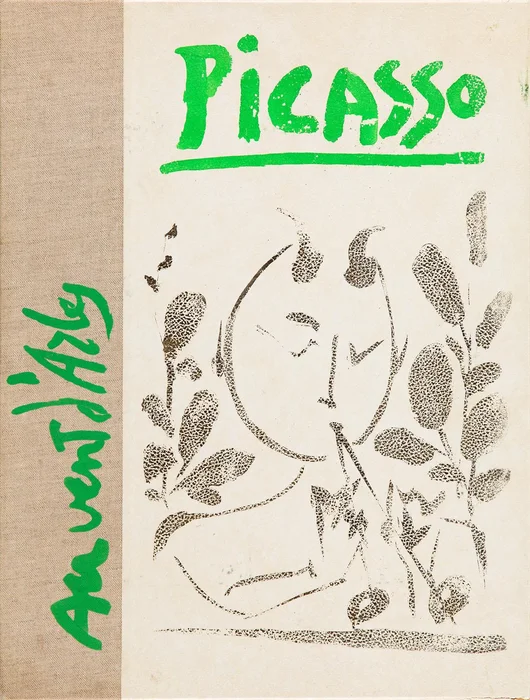
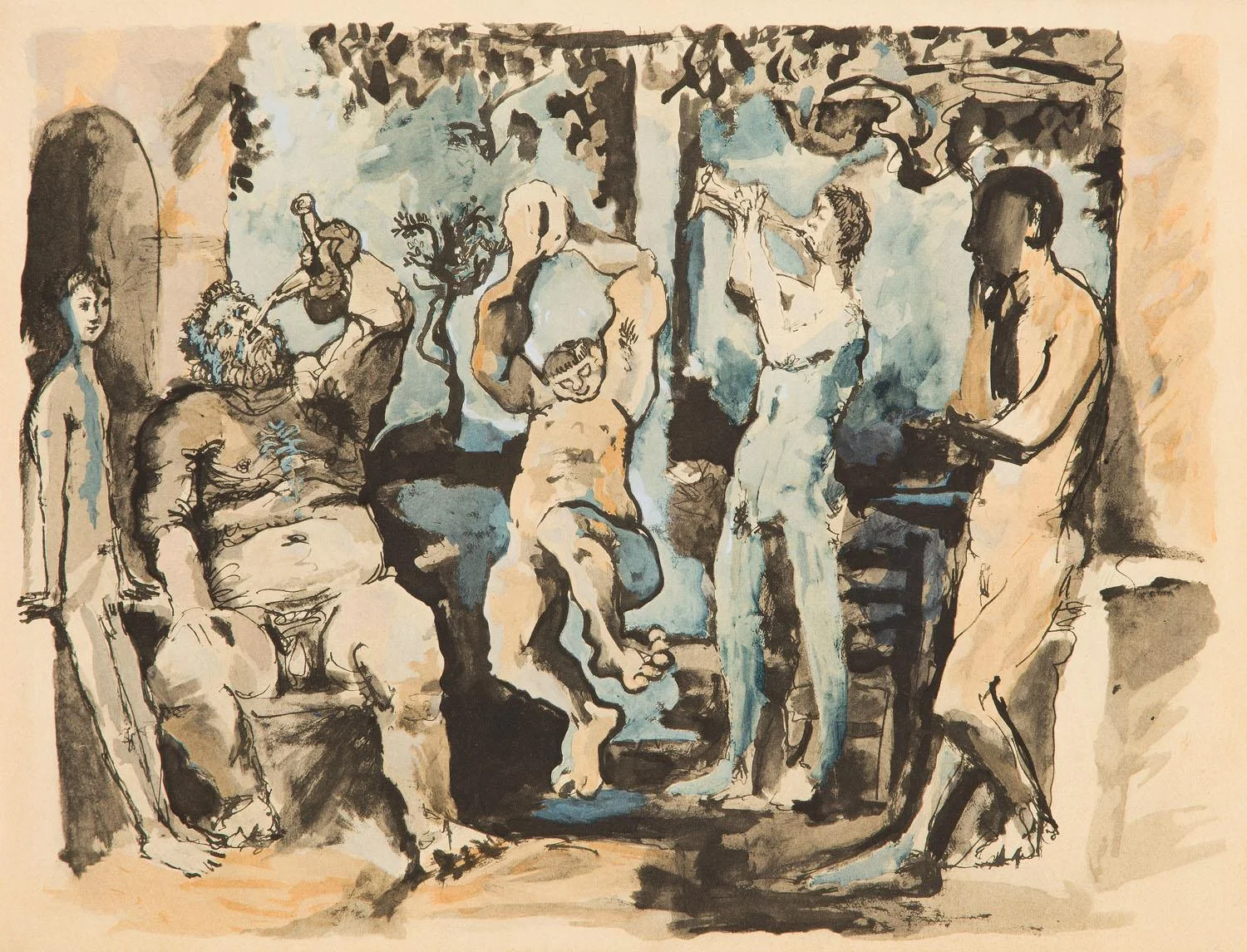
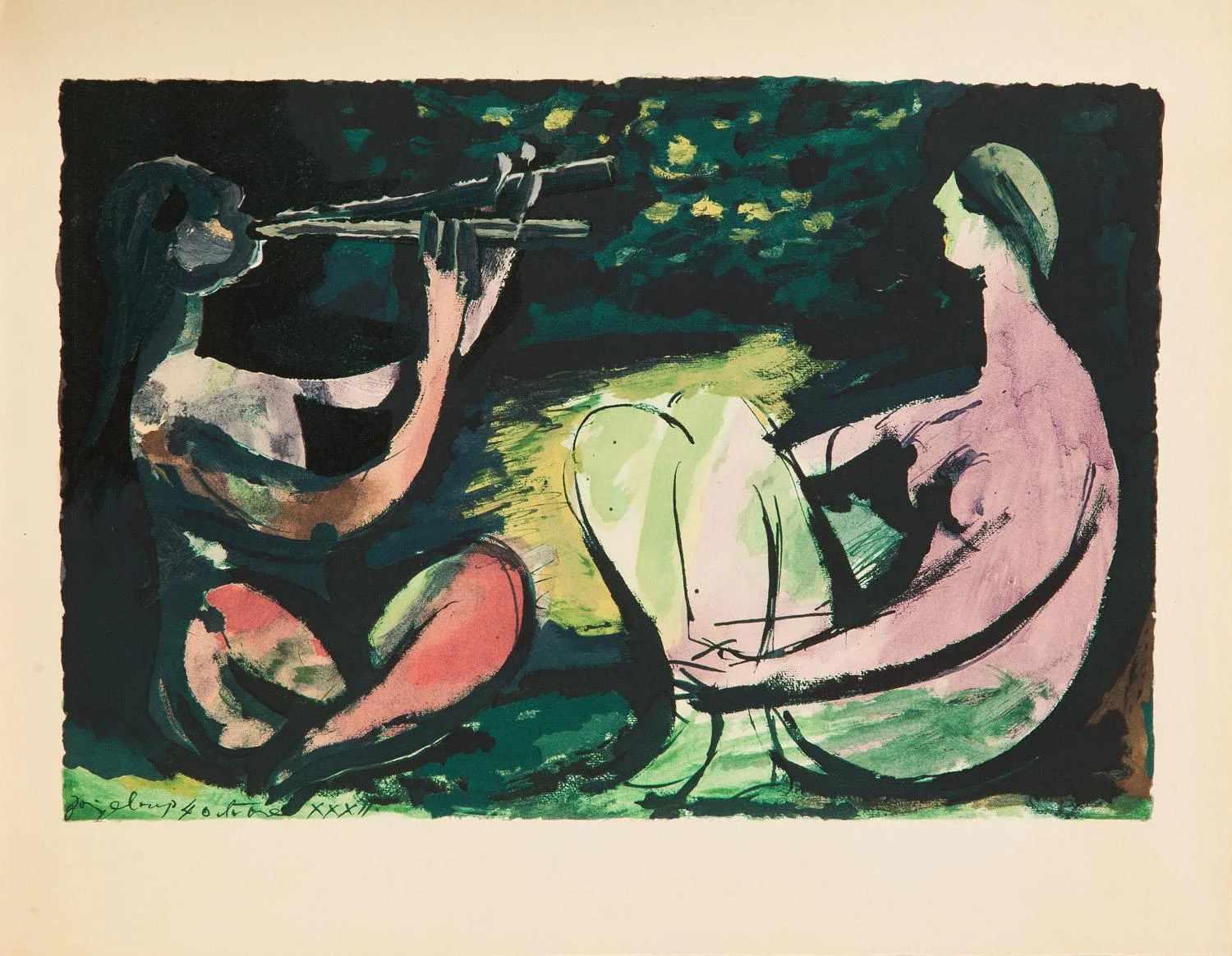
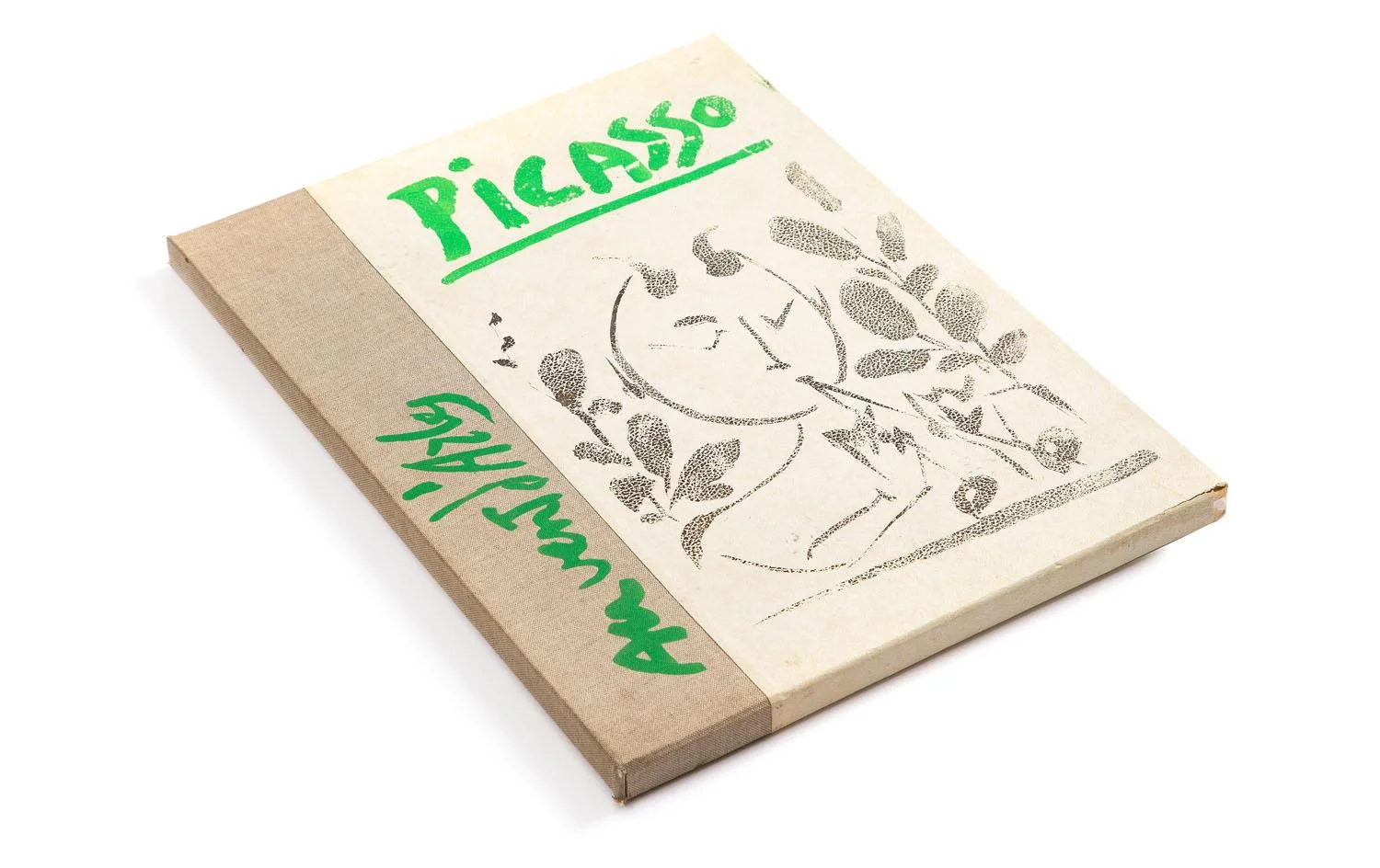
The presented portfolio of graphics comes from 1967 and was published by Au Vent d 'Arles éditeur in a limited number of five hundred copies. The portfolio does not have a hand signature of the artist (only the first few dozen was signed in such a way), however, it has a signature from a template. The portfolio contains as many as fifteen boards that present both pre-war and post-war works by Picasso. We may find there such pieces as Jeune Faune, femme et enfant from 1936, "Minotaure" from 1933, "Bacchanale" from 1955, or "Portrait de Espagnole".
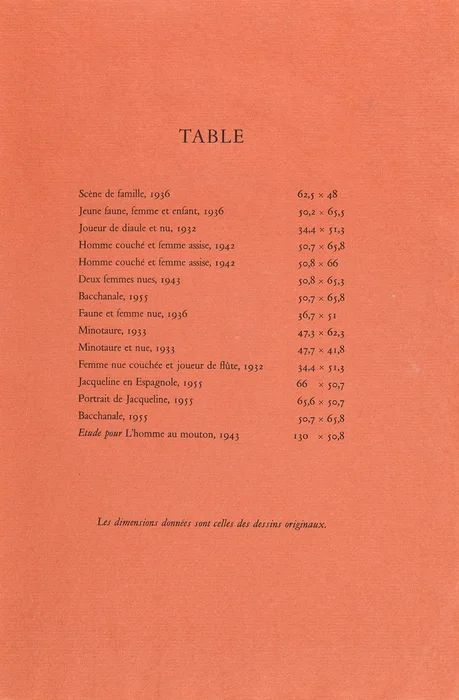
The last graphic in the portfolio is particularly noteworthy, measuring over one hundred and thirty centimeters in height. It was titled "Etude pour L'homme au mouton" and comes from 1943. This work consists of two connected sheets of paper. The prototype for this graphic was a watercolor study prepared during the artist's work on the sculpture "L'homme au mouton", which Picasso made in tribute to artist Max Jacob.
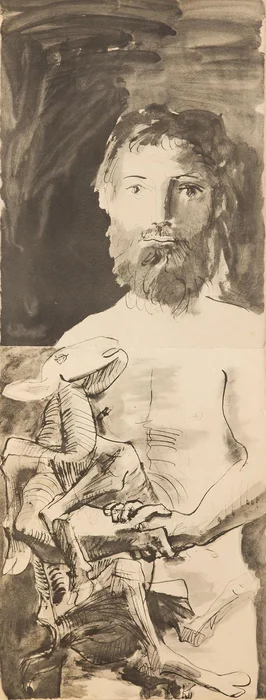
The works were made in the Jacomet Pochoir technique, that is with the use of stencil. Many prominent artists of the 20th century, such as Van Dongen or Matisse, chose this method to copy their favorite works of art. Pablo Picasso used the pochoir technique more than two hundred times, both at the beginning and the end of his career.
Pochoir is a graphic technique used to copy works of art, but interestingly, both the method and the effect of the impression making differ significantly from etching, wood carving, or lithography. In the Pochoir technique, the print is obtained with the use of various types of paints, from water-based paints, gouaches, to pastels and gold or silver foil applied by hand to sheets of paper. The colors are applied to the paper with the help of stencils, also known as templates. These negatives are made of ultra-thin metal foil or sometimes of other hydrophobic materials.
Subsequently, they are arranged in a certain order and placed on paper. Later, the paints are applied with various brushes, sponges, and swabs. The process takes place until the result matches the original artwork as much as possible. Sometimes it took between forty and a hundred stencils to make one pochoir. It was a very expensive and labor-intensive method, in fact too expensive for modern times and therefore completely forgotten. Fortunately, thousands of beautiful pochoirs have been preserved in the collections of museums and collectors.
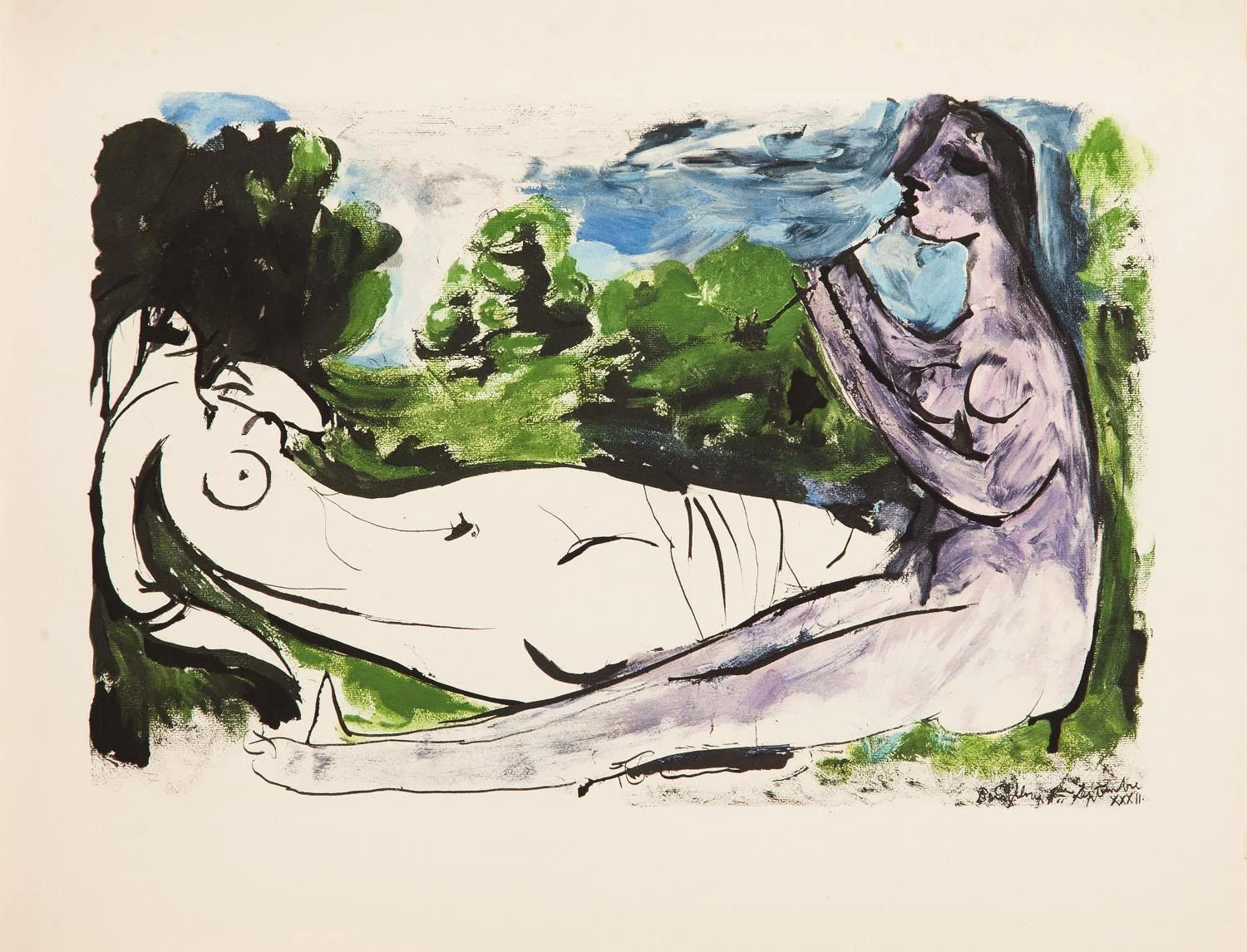
Each pochoir is a unique and exceptional work of art, and, most importantly, each series consists of several slightly different copies. Differences are often difficult to see at first glance due to the layering of colors. Compared to other reproduction techniques, it is the realism of shades that constitutes the most distinctive feature of pochoirs. The colors are much clearer than, for example, those obtained via lithography or screen printing, as the paint is applied with a brush in a three-dimensional way, it is not just two-dimensionally "glued" onto the surface of the paper.