
Olga Wolniak. The Poet of Femininity
Olga Wolniak, born in Burma, graduated in painting from the Academy of Fine Arts in Warsaw. She began her artistic explorations by creating paintings reminiscent of collages. This technique, particularly characteristic of her work in the 1980s and 1990s, allowed her to create large-format portraits painted with acrylics on glued newspaper papers. The most common subjects of her paintings were artists, friends, and acquaintances, whose photographs Wolniak repainted in a big close-up. The themes she addressed brought her artistic work closer to socialist realism, drawing the viewer's attention to social issues.
It was precisely this well-established artistic foundation that enabled Wolniak to develop a discourse on women's equality and their culturally assigned roles in her later works. A distinctive feature of her later creations are canvases adorned with motifs of Eastern fabrics-carpets, rugs, and kilims, as well as lacework. Consequently, the painterly sign became the subject of anthropological exploration for the artist, with her inspiration drawn from artistic handicraft and textiles in various forms.
The paintings inspired by Eastern carpets were presented at an solo exhibition at the Zachęta National Gallery of Art in Warsaw in 2000. In this series of works, by transferring Oriental patterns onto canvas, Wolniak addressed the theme of the role and significance of women, whose invisible hands produce these furnishings. The artist elevated the labor of women to the highest rank of painting. In the repeated motifs of carpets, Wolniak reflected on their significance. Simultaneously, the depicted carpets embody the presence of cultures that form an unnoticed part of Polish everyday life. The familiarity of the shapes and patterns presented on them is meticulously conveyed by the artist through the choice of appropriate textures fixed with layers of paint.
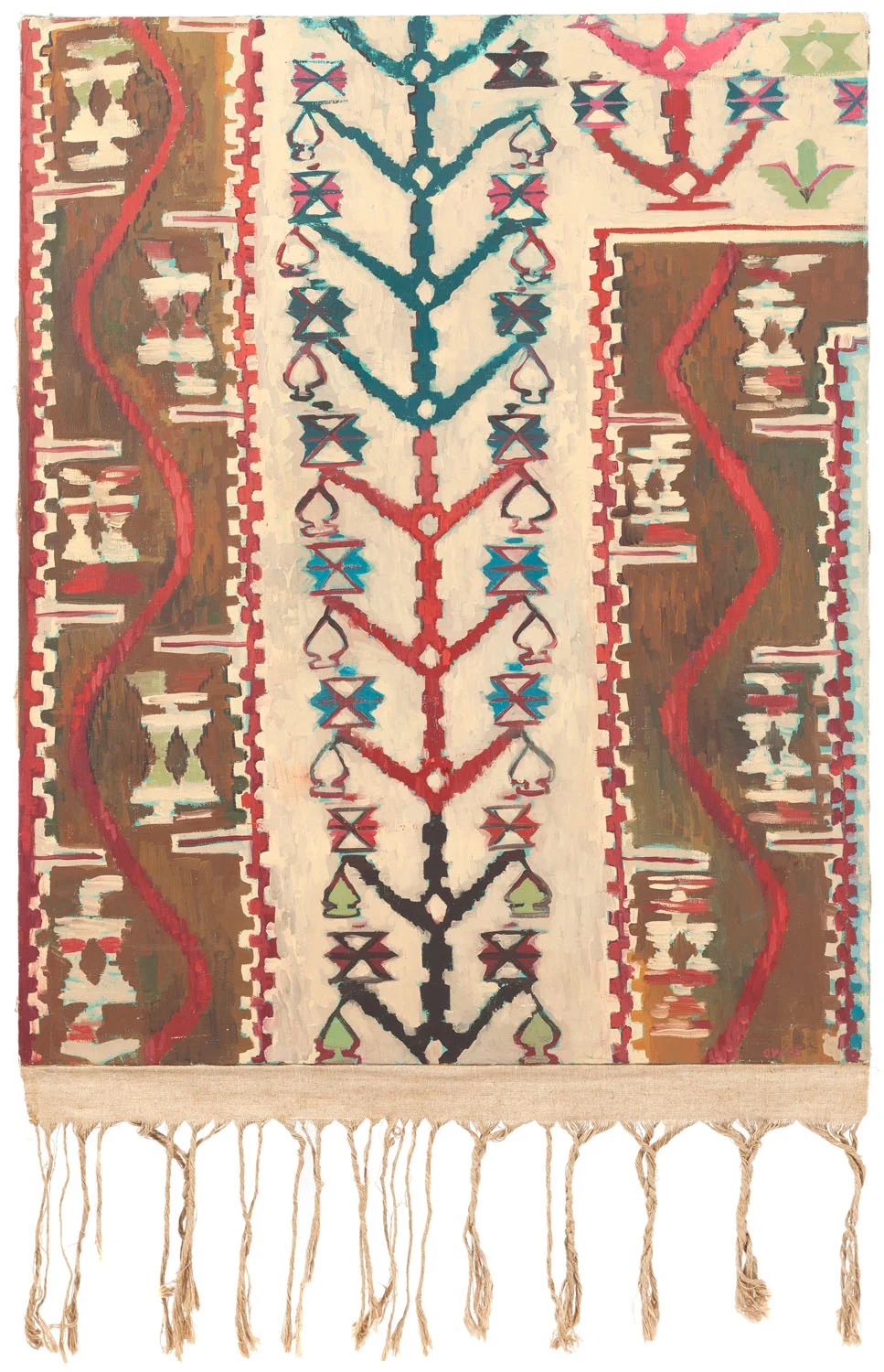
Color, emotions, and meanings serve as the focal points of Olga Wolniak's artistic expression. Her works, rich in colors and ornamentation, are reduced to the painterly sign-a medium for anthropological and cultural exploration. As noted by Magdalena Durda-Dmitruk:
"Upon closer inspection, these colorful, geometrically ordered, almost abstract compositions not only serve aesthetic delight but also reveal the mysterious content of archetypal symbols and signs, becoming a reflection on universal truths. The painted threads and patterns are incredibly sensual; they also seem to emanate inner light and energy of a subtle, feminine touch. They represent a kind of contemporary icons inviting deeper contemplation and reflection"
- Magdalena Durda-Dmitruk, introduction to the exhibition catalog "Oczy Wschodu", source: http://www.aps.edu.pl/media/3429237/olga.pdf.
Wolniak also engages in public space projects, creating wall paintings and murals in collaboration with studios such as Bogusławscy i Partnerzy, JEMS Architekci, and architect A. Wyszyński. From 1995 to 2004, she co-created the "Otwarte Pracownie" project in Warsaw's Praga district. Her works can be found in museum collections, including the Royal Castle, the Zachęta National Gallery of Art in Warsaw, the Collection of the ING Polish Art Foundation, the Collection of Art of PKO Bank Polski, the Ilana Goor Museum in Jaffa (Israel), as well as in private collections.