
Mroczne historie Zdzisława Beksińskiego
"Like a classic representative of my zodiac sign, I lived primarily in the world of my own imagination. After all, I wasn't a diplomat surrounded by intriguing events, nor a traveler with plenty of tales to tell, such as a shared dinner with Mao Tse-tung or a shared lover with Che Guevara. I even had only one wife. My entire life consisted of standing at the easel or sitting at the table, working while listening to music."
- Zdzisław Beksiński.
Pisces are known for their unique and complex personalities. Their dual nature (symbolized by two fish swimming in opposite directions) often makes them full of contradictions. Pisces are most afraid of leaving their comfort zone. Uncertainty about life or new people can significantly hold them back. The best way for Pisces to manage stress is through mindfulness, helping them feel in control and at peace. While this description should be taken with a grain of salt, Beksiński was, in many ways, the archetypal Pisces. His rich imagination (reflected in his paintings) and legendary aversion to travel or even attending his own exhibitions are the best evidence of this.
Zodiac Pisces are famous for their tendency to lose themselves in their thoughts. In Beksiński's studio in Warsaw, there was reportedly a sign that read, "Everything's gone to hell," with the note "from collected thoughts" beneath it. However, as the artist himself claimed, he had only ever collected that one thought. This was Beksiński-full of contradictions. Despite his vast knowledge of the world, he never traveled, with his furthest trip being to the Czech Tatras, and even that, he claimed, happened by accident. Painting was his whole life. He could lock himself in his studio for long hours, perfecting every detail of his work. He was always searching-for answers to difficult questions or new forms of expression. This is especially evident when examining the progression of his work. For example, in the late 1950s and early 1960s, he drew on the poetry of Rainer Maria Rilke and existential themes. After 1964, he broke away from the avant-garde movements of the time, devoting himself almost entirely to a kind of painting that bordered on dark fantasy and surrealism, mixed with his own visions. During this time, he also created sculptures in plaster and metal. From the late 1960s to the early 1970s, his work featured motifs from the Far East. By the mid-1970s, he focused almost exclusively on oil painting. His work from the 1980s intertwines Baroque and 19th-century motifs with strong erotic undertones. These works were often described as "dream photography." In the 1990s, he began incorporating computer graphics based on his collection of photographs into his work.
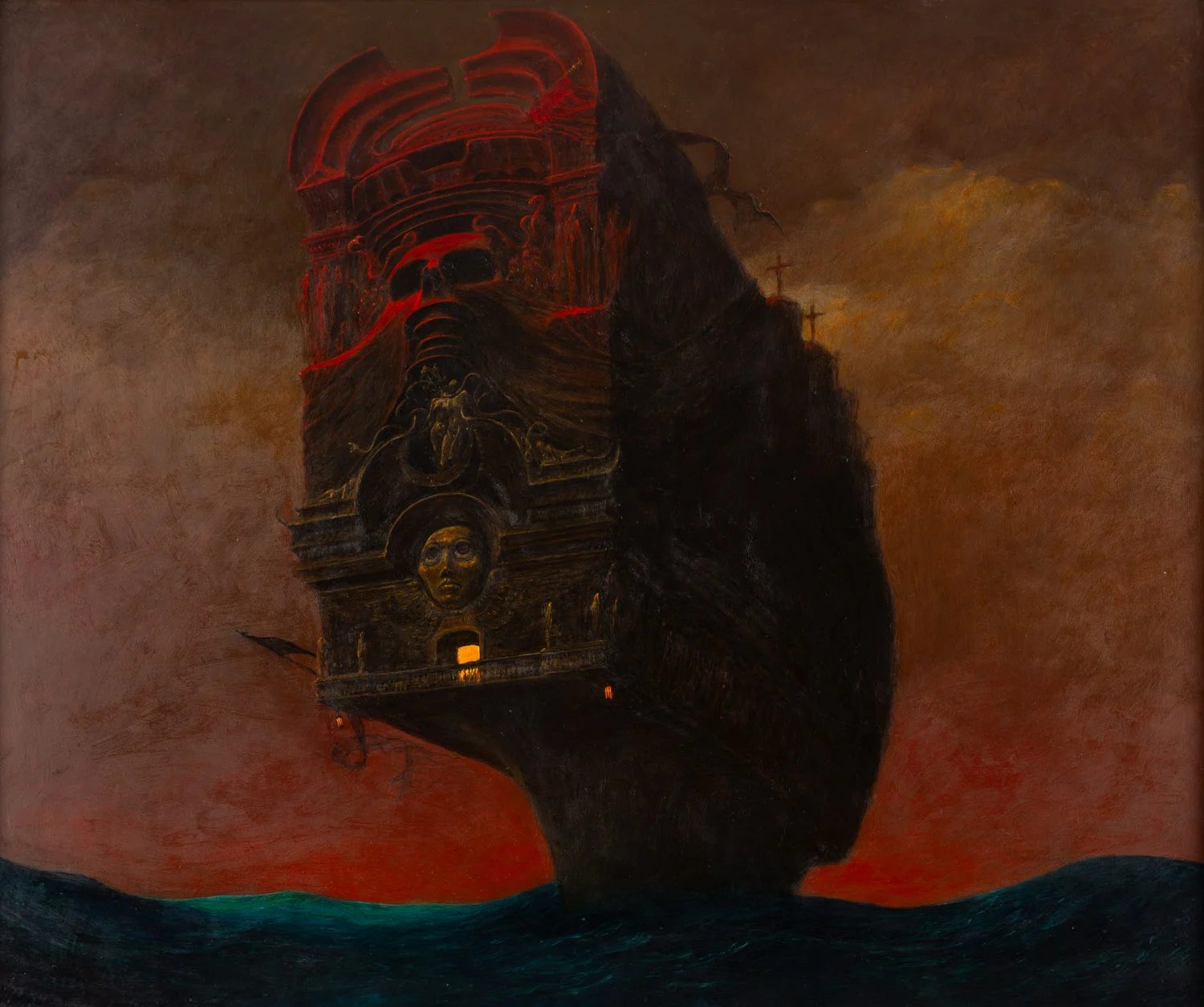
The presented painting dates back to 1972 and was exhibited as early as 1973. In an article titled A Poem About Waiting from the magazine “Literatura," the following was written: " 'Waiting' – that's how Beksiński described the titles of his recently exhibited paintings at the Contemporary Gallery. And I think that with this one word, he created a key both to the displayed works and to his entire body of painting." (Wojciech Skrodzki, Poemat o oczekiwaniu, Jerzy Putrament, Warsaw 1973, p. 4). Beyond the palpable atmosphere of anticipation in the painting, it features a calm, symmetrical composition. In the center of the canvas is a ship levitating over a turbulent sea, moving toward a burning sky. Beksiński's painting brings to mind Richard Wagner's opera The Flying Dutchman. Premiering in Dresden in 1843, the opera told the tale of a ship wandering the seas and bringing misfortune to sailors. The titular Flying Dutchman is the captain of these cursed sailors. Although it is uncertain whether this opera served as inspiration for Beksiński, considering his love for art and dark tales, it is highly probable. When observing the painting, the viewer's eye is drawn to a small entrance to the ship. Inside, there is a vivid orange light that contrasts with the rest of the ship, which is painted in dark tones. Above the entrance is a wooden bas-relief that seems to gaze at an enormous skull towering above it. The entire scene is shrouded in cobwebs, giving the impression of a ghost ship. This could be a subtle allegory about human life. Notably, the painting was created during a period when Beksiński was particularly interested in alchemy, Eastern philosophy, and dream analysis, which, to some extent, is reflected in the works from that time. It's important to remember, though, that any attempt to analyze the master's works is merely speculative. Deciphering the specific symbols or messages in his paintings is no easy task. This is a fundamental characteristic of his entire body of work. As Tadeusz Nyczek wrote:
"Beksiński, who has been painting these strange scenes for twenty years, playing out in his semi-theater, will never be able to rid himself of the viewer who persistently insists on asking questions about their meaning. Beksiński will reply that there is nothing there but visions from the subconscious. And that he wasn't trying to convey any specific message when he painted a decomposing body or a pack of wolves beneath a flying balloon rising into the sky. And that these obsessions are drawn directly from psychoanalysis. Then the viewer will ask the same question again, and the misunderstanding will persist, impossible to quiet, because each side will stubbornly stand by its position."
(Tadeusz Nyczek, Autophychotherapies de Beksinski, [in:] Beksiński. Peintures et dessins. 1987–1991, [ed.] Piotr Dmochowski, AP International, Paris 1991, (author's translation, p. 11).
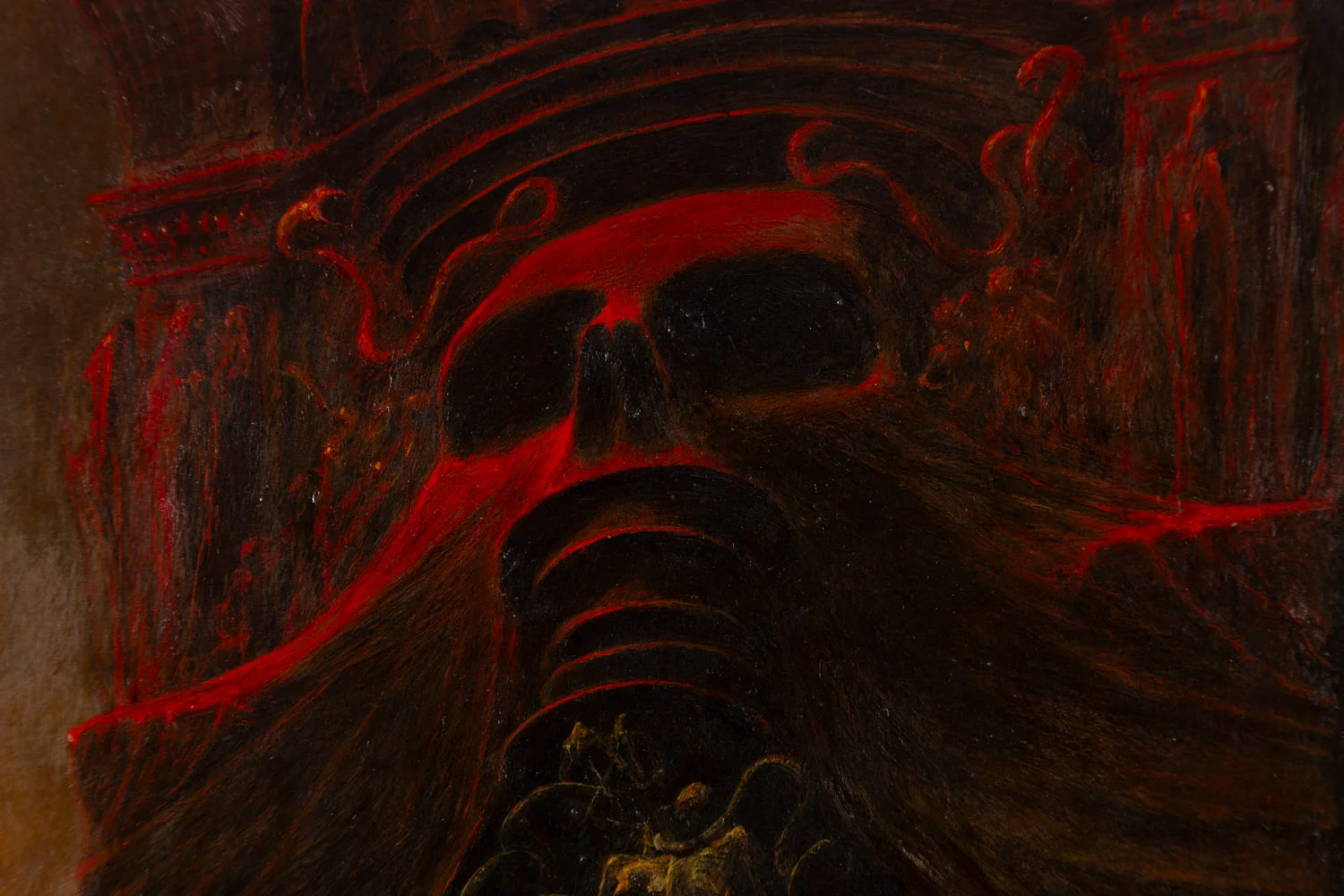
The fantastic, spine-chilling, dark world that the artist created quickly garnered the admiration of many. There was no other painter at the time whose work could be compared to Beksiński's. While most artists of his generation were fascinated by abstract painting, Beksiński painted figuratively. He is even considered a precursor of neo-figuration. With admirable consistency, he portrayed moving scenes, fragments of unresolved stories, and imagined landscapes, richly imbued with themes of death and decay. According to many critics and art historians, including Bożena Kowalska, such works were a method of releasing negative visions, a way for him to maintain mental balance after an unhappy childhood. By painting his favorite motifs (such as crosses, which are also present in this work), Beksiński seemed to find some relief.