
Modern Design: The work of Irena Żmudzińska, Maria Chomentowska, and Hanna Lachert
Kornelia Starczewska
"We aspire to a beautiful, splendid future, but we cannot yet discern its shape; imagine the form and framework of the life we are moving towards,"
- Jerzy Hryniewiecki, Kształt przyszłości, "Projekt", 1956, no 1, p. 9.
The 1950s and 1960s were a golden period for post-war Polish design. The language of abstraction penetrated from painting into design. Furniture took on asymmetrical forms like figures from Picasso's paintings; they were sometimes as curvaceous as Henry Moore's sculptures and intriguing in an unconventional way. The aspirations of a new generation were reflected in the designs of Irena Żmudzińska, Maria Chomentowska, and Hanna Lachert. Each designer represented their own vision of modernity. Lachert created designs with flowing shapes, following in the footsteps of the Eames family. Chomentowska explored the possibilities of bent plywood, while Żmudzińska's designs show traces of Scandinavian influence. Industrial designers sought their own paths of development, navigating between different trends. "Organic style in Poland was not opposed to functionalism. On the contrary, its creators emphasized the ergonomics of forms derived from nature," notes Anna Frąckiewicz (Anna Frąckiewicz, Kształt przyszłości, czyli styl lat 50. i 60. [in]: exhibition catalog "Chcemy być nowocześni. Polski design 1955-1968 z kolekcji Muzeum Narodowego w Warszawie," Warsaw 2011, p. 24). In the map of modernist design, the lead was taken by often experimental projects, which have gained cult status in the 21st century and are sought after by collectors.
Right after the war, Hanna Lachert studied under Jan Kurzątkowski at the Academy of Fine Arts in Warsaw. After completing her education, she collaborated with the Institute of Industrial Design and, in the late 1950s, became associated with the Central Cooperative for Folk and Artistic Handicrafts ("Cepelia") and collaborated with its subsidiary, the "Ład" cooperative in Warsaw. The author of the monograph dedicated to Hanna Lachert describes the designer as a distinct and contrasting personality.
"A girl from a good home of landowners, the daughter of a lady, with a tendency to break the rules, a little rogue. Incredibly hardworking but always found time for skiing trips (...) A designer who, according to the principles instilled by the professors of the Warsaw Academy of Fine Arts, placed ergonomics first, even though her designs consistently captivate with their beauty,"
- Katarzyna Jasiołek, Hanna Lachert. Wygoda ważniejsza niż piękno, p. 7.
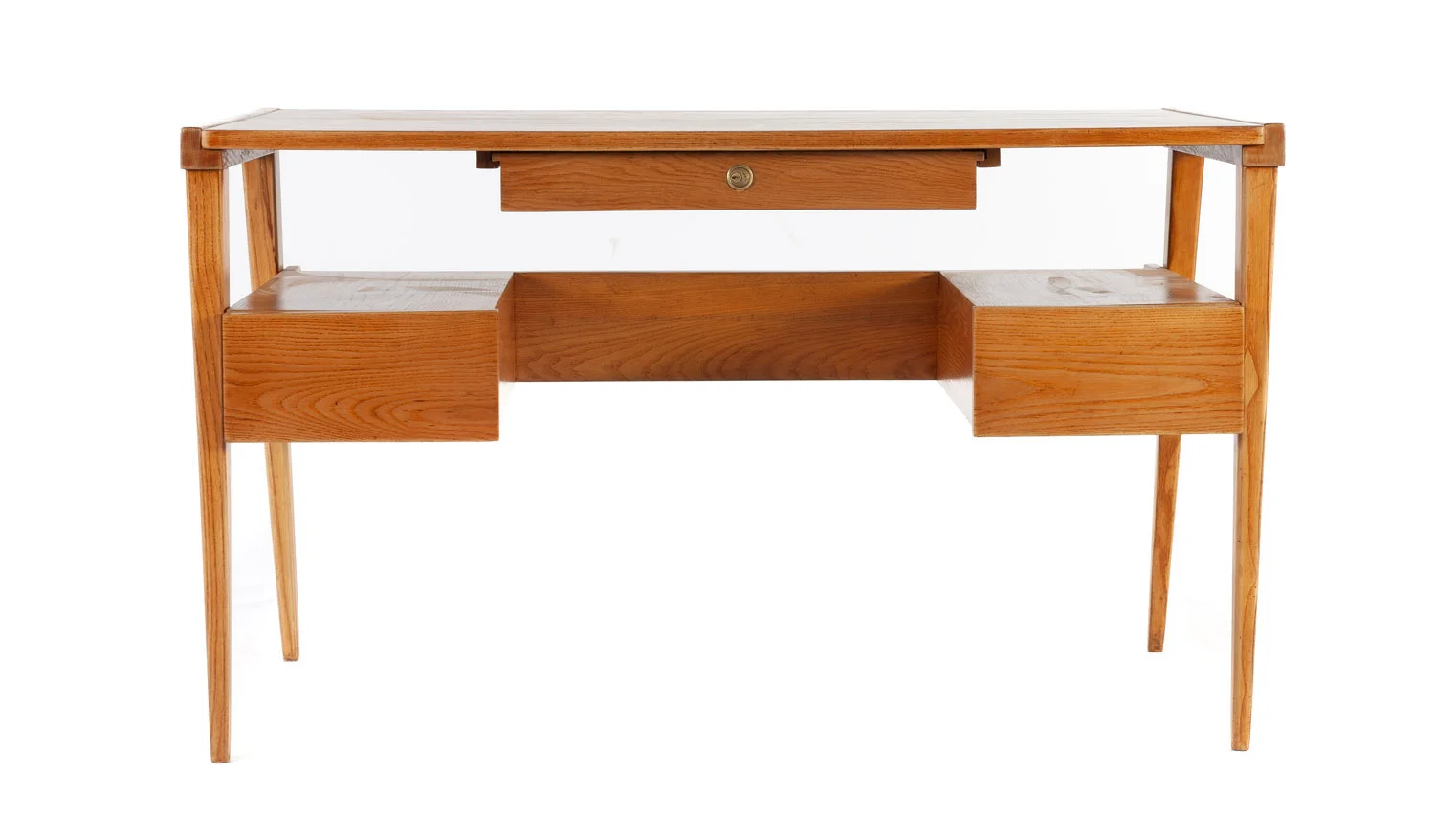
The presented double-sided desk was designed by Lachert for the "Ład" cooperative. The piece owes its lightness to slender legs and proper proportions. Beyond its beautiful form, Lachert also emphasized usability. Just as versatile as wall units and wall beds, the table can serve various functions. In one unassuming design, Lachert combined a shelf and a secretary desk. She simplified structural elements into geometric forms and removed ornamentation, reflecting her unceasing inspiration from the Bauhaus school. Not forgetting about comfort, she turned the long under-desk drawer into a safe, incorporating a lock opened with a key into the design.
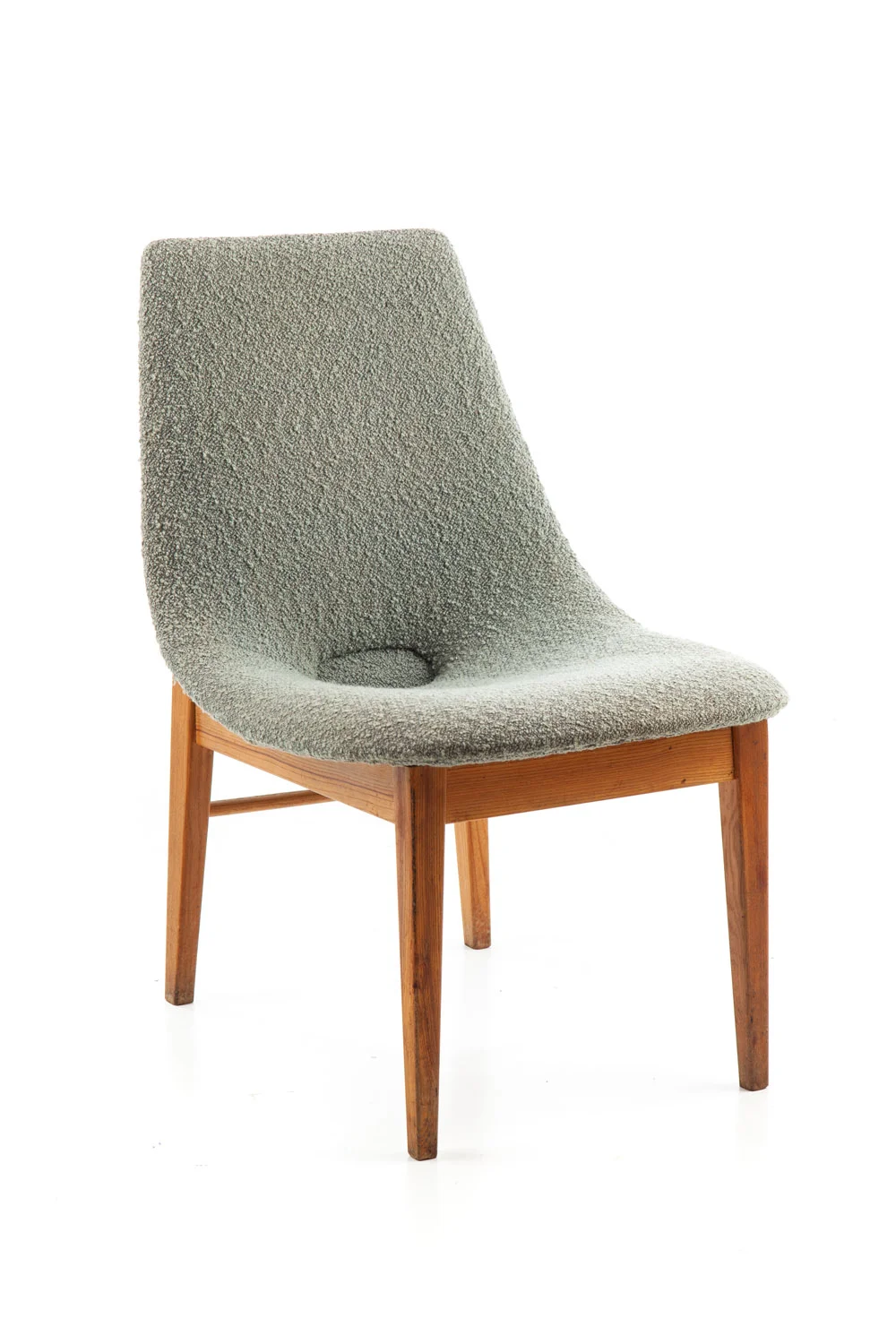
For the "Ład" cooperative, Lachert also designed the "Muszelka" (Little Shell) presented at the auction, whose organic form combined with the soft upholstery is synonymous with comfort and a high level of artistic quality, in line with the "Ład" ideals.
"The 'Ład' cooperative aimed to continue the good traditions of Polish craftsmanship not by imitating its forms but by adopting its principles: functional purposefulness, honest display of construction, and material characteristics (...) 'Ład' objects, made using craft methods and produced in small quantities, are quite expensive and are distributed mainly among the cultural elite,"
"Jak urządzić mieszkanie. Wydanie drugie", Warszawa 1960, p. 8.
"Muszelka" represents an extension of pre-war traditions and an attempt to find an appropriate formula expressed in the language of industrial design.
Maria Chomentowska offers an equally innovative take on functionalism in her designs. After her studies, Chomentowska joined the Institute of Industrial Design (IWP), marking the beginning of the so-called "IWP furniture style." Anna Maga, in the magazine "2+3D," wrote about the specifics of her work:
"Maria Chomentowska's works are interesting, often innovative in terms of construction, sometimes searching-they do not shy away from various styles, but never exceed certain boundaries of simplicity and unpretentiousness; they do not indulge in so-called designerism"
- Anna Maga, "2+3D. Kwartalnik Projektowy", no 47/2013.
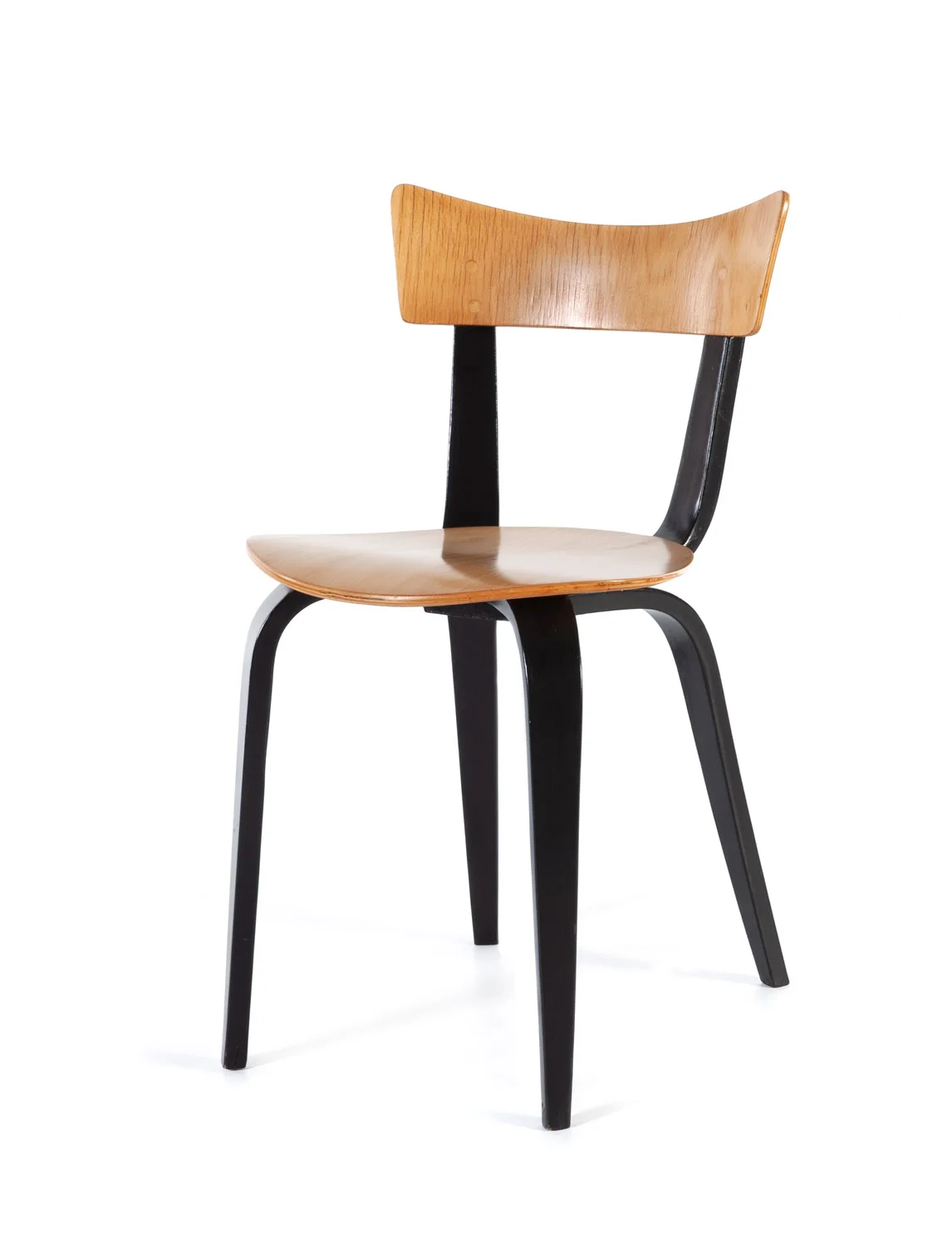
The presented "Pająk" (Spider) type 288 is a project by Chomentowska from 1956 that currently enjoys the status of an icon of post-war design. The chair was created on behalf of the Institute of Industrial Design as part of research into the use of plywood and other non-standard materials in industrial design. Chomentowska's experiments with bent plywood also resulted in the "Płucka" chair from the same period, made from spoilage. In parallel with plywood, Teresa Kruszewska worked on similar projects, and her iconic "Muszelka" chair was born from the same need for experimentation. Plywood served as a cheaper alternative to solid wood and guaranteed greater plasticity, allowing for forms close to nature. Krystyna Łuczak-Surówka sees the exploration of medium boundaries by Chomentowska and Kruszewska as a stage in the evolution of Polish design.
"Organic forms in Polish furniture design evolved from experiments with plywood and wicker to plastics. The designs of Jan Kurzątkowski, a pioneer in Poland in using the flexibility of plywood and highlighting the plastic properties of this material, and then the young generation, including Teresa Kruszewska and Maria Chomentowska, are examples of the search for organic shapes in the formation of seats mounted on simple carpentry structures,"
– says the researcher (Krystyna Łuczak Surówka, "Nowoczesne formy z tworzyw sztucznych" [in]: "Wizje nowoczesności. Lata 50. i 60. – wzornictwo, estetyka, styl życia," materials from the session "Lata 50. i 60. w Polsce i na świecie: estetyka, wizje nowoczesności, styl życia," National Museum in Warsaw, April 15, 2011, pp. 75-76).
The design of chair "Pająk" type 288, by Maria Chomentowska, was put into mass production and manufactured in the Bentwood Furniture Factory in Radomsko. Historical specimens that have survived to this day are rare on the market and are acquired for, among others, state collections. Chomentowska's "Pająk" is part of the collection of the National Museum in Warsaw and was displayed in one of the most important exhibitions of post-war design–"We Want to Be Modern: Polish Design 1955-1968" (Chcemy być nowocześni. Polski design 1955-1968 z kolekcji Muzeum Narodowego w Warszawie, [ed.] Anna Demska, Anna Frąckiewicz, Anna Maga, Warsaw 2011, p. 75).
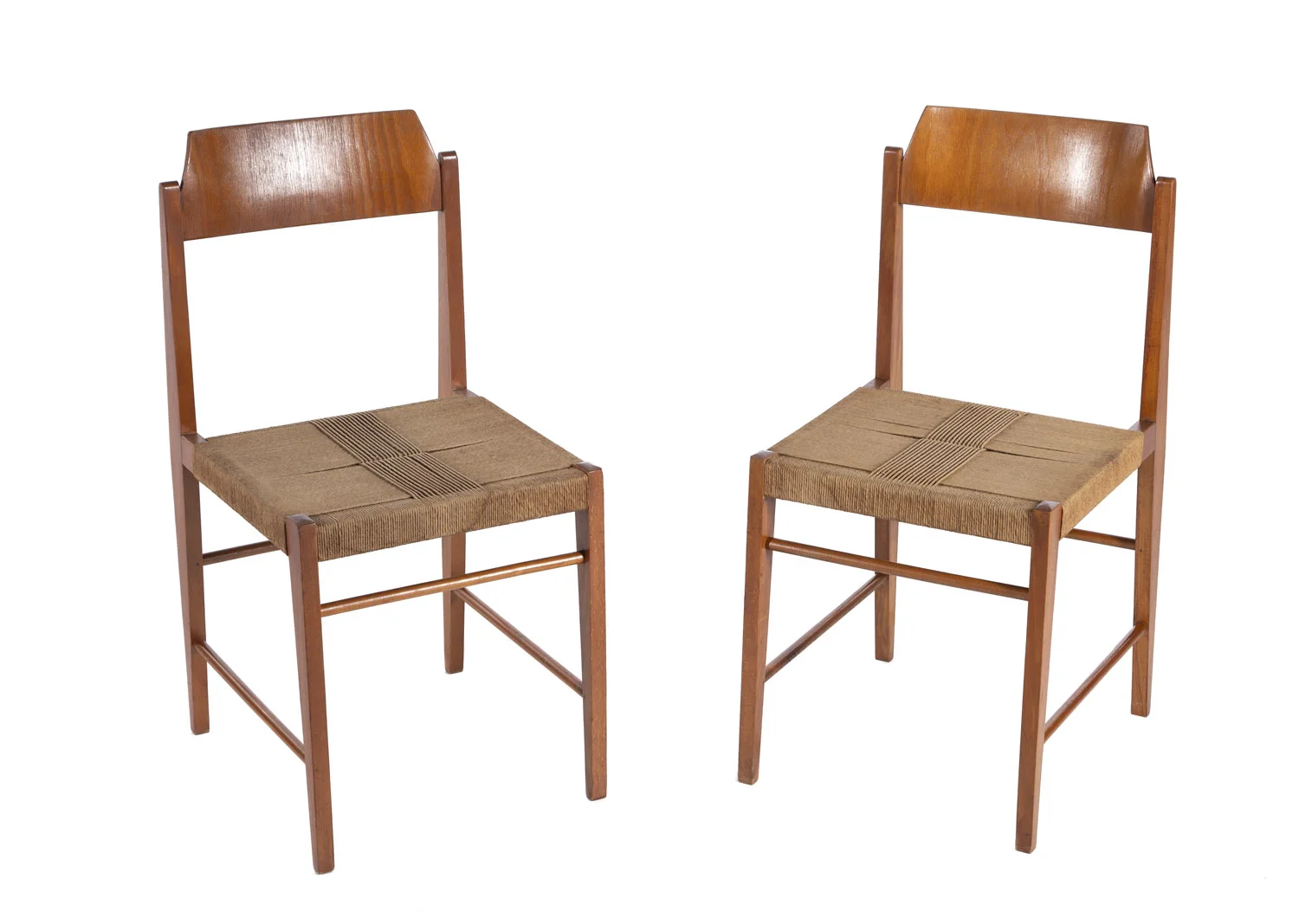
Irena Żmudzińska, a few years older than Chomentowska, like Hanna Lachert and Maria Chomentowska, was associated with the Institute of Industrial Design. She collaborated with the "Ład" cooperative and took part in important post-war exhibitions, including the 1st Polish National Exhibition of Interior Architecture and Decorative Art in 1952, held at Zachęta. Żmudzińska's chair, type 200-185, is a creative adaptation of Scandinavian solutions. The woven seat and the frame correspond to the designs of the Danish duo Peter Hvidt and Orla Mølgaard-Nielsen. Simultaneously, the geometric shape of the backrest indicates individual explorations of utility forms. Żmudzińska's work bridged the gap between historical and modern furniture, sometimes serving as a critical reception of global trends, as in the case of the type 100-185 chair.
The modern designs of Hanna Lachert, Maria Chomentowska, and Irena Żmudzińska allow us to grasp the aspirations of the post-war generation. Modernist furniture harmonized with the new reality and showcased the "desire for a beautiful and splendid future."