
Maria Anto - Painter of Unimaginable Worlds
Maria Anto made her debut in the early 1960s, at a time when an experiment related to non-geometric abstraction and gesture painting, imported from the West into People's Poland, was already established in the artistic environment.
On the other hand, it was a time when the manifestations of conceptual art that was to come in the second half of the decade did not yet exist in the art circulation. Not belonging to either one or the other tendency, Maria Anto entered the institutional world of art as a representative of a tendency which was then on the sidelines of avant-garde trends, which does not mean, however, that it was a "sentence" on the artist. Contrary to the prevailing currents, Maria Anto managed (quite quickly) to appear in the world of art, although she always remained somewhat independent - on the sidelines of groups and painting trends.
The artist graduated from the Academy of Fine Arts in Warsaw in 1960, and already in 1963 represented Poland at the São Paulo Biennale. Participation in this prestigious event must have been an unquestionable distinction for the young artist. In 1966, Zachęta organized a monographic exhibition for the painter (6 years after her graduation). Therefore, Maria Anto quickly appeared in the community. As one of the relatively few, she had the opportunity as a citizen of the People's Republic of Poland to be represented by a foreign gallery, which was also associated with (a relative) financial success. Nevertheless, she remained forgotten for some time after her death. Wider posthumous recognition brought her a monographic exhibition, organized in Warsaw in 2017.
The style of Maria Anto included, above all, elements of unprofessional (then called "naive" art) and the so-called magic realism. The artist successfully combined both tendencies, creating a characteristic language of painting that distinguished her from the artistic milieu in which she functioned. Anto remained faithful to her aesthetic choices throughout her lifetime.
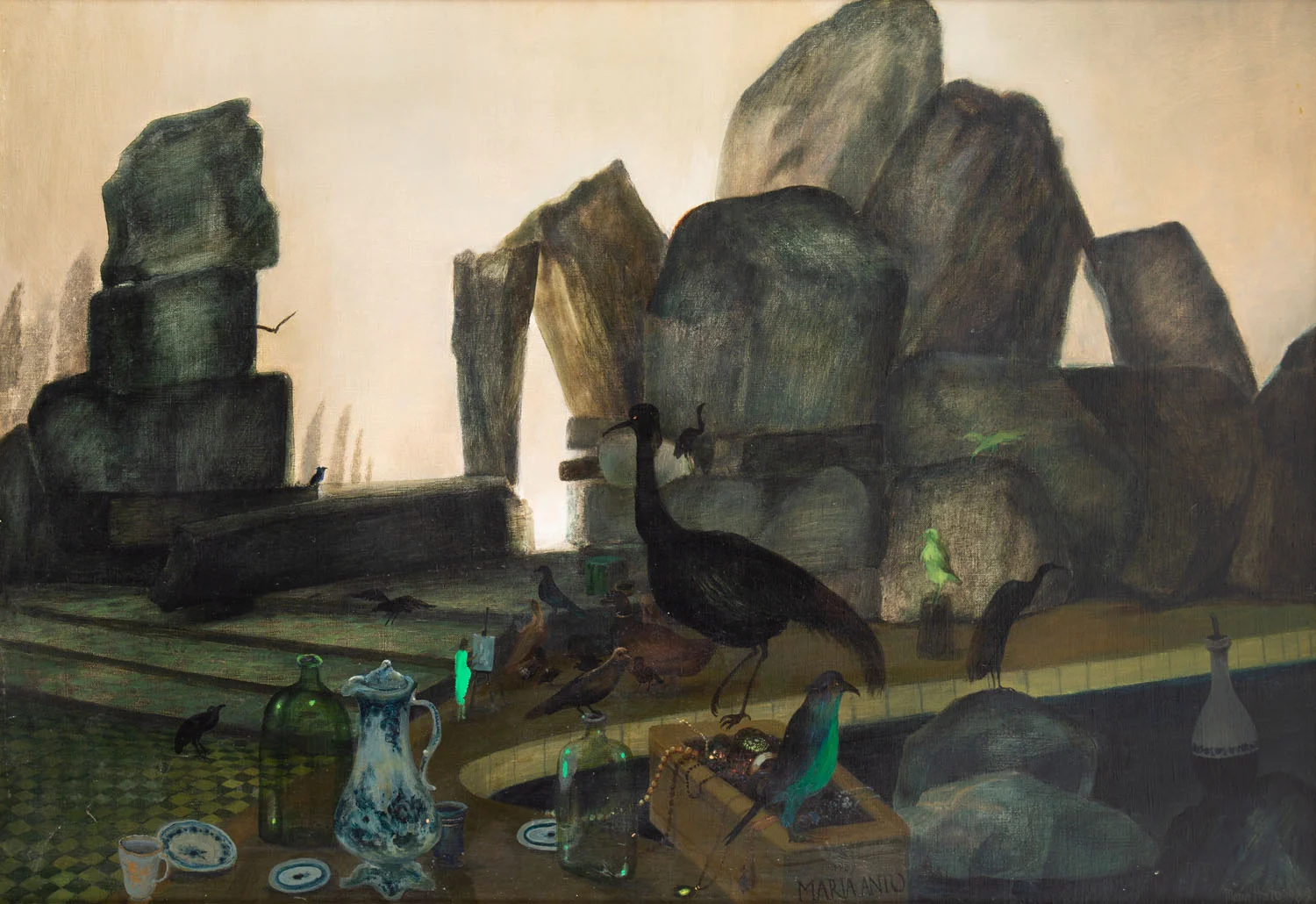
The canvas from 1989 remains a unique presentation - it is a self-portrait of the artist. Thus, it stands out from the painter's work as an image that shows herself. It is also an image that goes beyond the self-portrait convention. Although the self-portrait is usually expected to show the face of the author, the presented image does it only in a rudimentary way. So there is a paradox here. The artist declares to show herself, but introduces herself to viewers with her back turned. Her face, usually expected in a self-portrait, is not visible. In addition, it is a small figure, distinguished only by the bright, iridescent color of the outfit. The artist's figure is lost among the animals and objects gathered around her. The human was diminished in this performance. The world of fauna and inanimate objects definitely controls it. As it can be assumed, they are a product of Anto's imagination - similar characters inhabit other paintings of this artist. It seems, then, that the painter appeared among the fruits of her own fantasy. Here it consists in giving a special rank to these non-human companions. They dominate her, small and inconspicuous in this performance. One gets the impression that the convention of the self-portrait here is that the painter depicts herself as a creator of unreal worlds. We see her standing in front of the easel. After all, she creates a self-portrait - thus she shows herself as a painter of a fanciful performance, as a creator of an astonishing environment. Thus, she symbolically shows her face, although literally she does not. She remains turned, does not present herself to the audience, breaking the convention of portraying.