
‚I’ve never worked for so long with such tension and through so much resistance"
"In my paintings, the titles are, most of all, ironic-funny, grotesque, rooted in Galicia, incomprehensible, provincial, and generally amusing to the average person. But I always repeat, till it gets boring, that if anyone today wants to say something genuinely serious, they immediately lose. No one believes in this type of endeavor today. There must always be a wink or some sort of indication that it is, in fact, a joke. My artistic formation is a surrealist one."
Tadeusz Brzozowski
During his stay at Lake Tahoe, Tadeusz Brzozowski created numerous paintings and art objects. This trip to the United States marked a pivotal moment in his career, during which he produced a record number of works. Typically conservative with canvases and hesitant toward mass production, in America, he abandoned his previous reservations and fully unleashed his creativity. He worked daily, following a set routine, painting canvases and creating ink drawings. This series of paper works greatly differs from his other pieces. Drawing, as the most personal form of artistic expression, allows us today to trace Brzozowski's emotions almost in real-time during his stay with the Kunczynski family. These works are also a testament to the enthusiasm and energy he sought to convey to his potential American audience through his canvases and ink on paper. The drawings, when compared to the letters addressed to his wife Barbara Gawdzik-Brzozowska, form a kind of diary that Brzozowski left from his time in the USA. It's challenging to assess the true commentary nature of the works. Still, in their titles and style, one can sense the excitement and tension that accompanied him while staying with the Kunczynskis. The linework in his American-period drawings is sharp, the compositions flatter and more schematic. In his 1971 works, there are few of the characteristic somatic “garlands" that hang from spindly limbs. Instead, these compositions feature many fierce lines, both sharp and precise. The titles, too, are distinctly more direct: "Laufer nęka", "Łka kat", "Kurdupel szczudła lekce sobie waży" These are just a few examples from Brzozowski's electrifying set of drawings created in the modest basement studio at the Kunczynskis 'home.
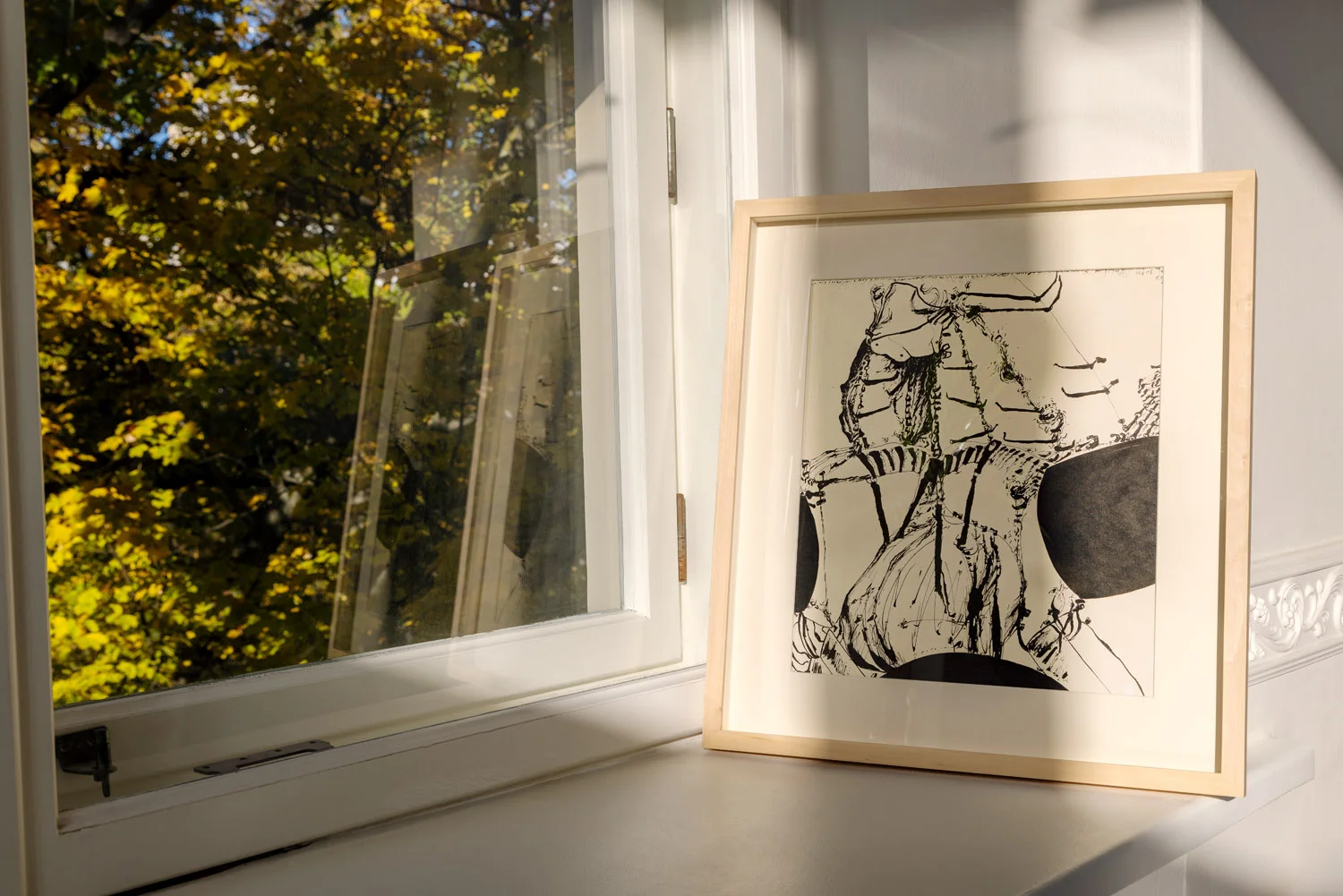
His American-period drawings distinctly stand out within his entire body of work in this medium. His earliest pieces, from the late 1930s and early 1940s, were made with pencil or crayon and mostly consisted of portraits drawn with a touch of humor and irony, giving them a caricature-like style.
In the 1950s and 1960s, Brzozowski developed a series of drawings that he refined over the years, mainly depicting figures-both male and female nudes-created with ink and pen. These works are traditional in form and expression, emphasizing realism, as Brzozowski used fine lines to capture the outline of a spine under taut skin or the indentations of his models 'hips. This series is a detailed and atmospheric study of the human form, not directly utilized in his paintings but unmistakably connected to his later works. The careful rendering of shapes, distinct outlines, and strong contrasts all foreshadow his future artistic style.
In the mid-1950s, he created one of his most famous series, "Ballet" (1954–1955), now primarily known through reproductions. This series focused on grotesque "dancer" characters undergoing progressive disintegration. These figures, marked by distortion, brought both euphoria and pain into the artist's work. This was also when his drawings began to feature humorous, often grotesque titles. Over time, the boundaries between figuration and abstraction blurred, creating new territories that stimulated viewers 'imaginations.
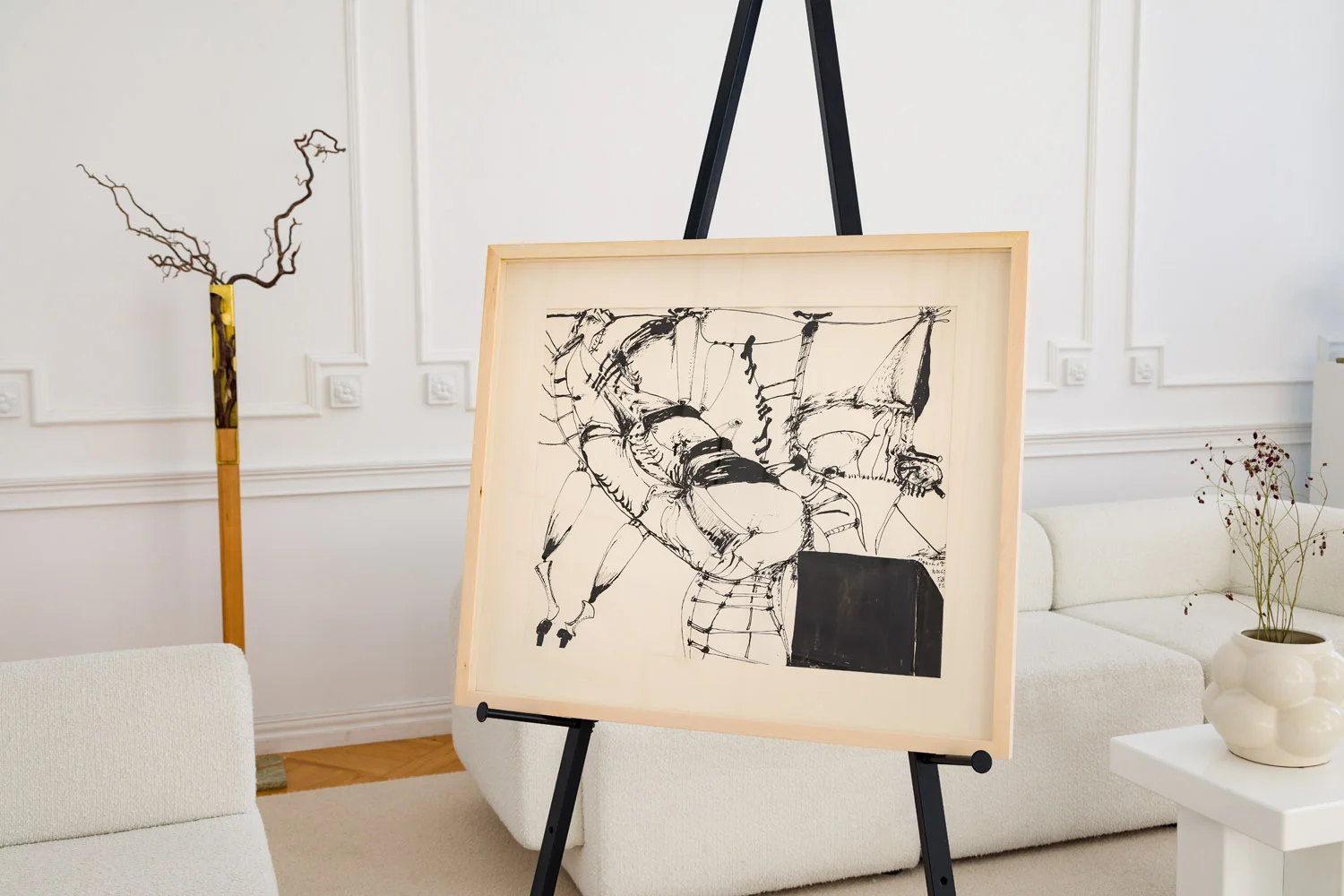
In the late 1950s, Brzozowski's drawn figures began to resemble insects. Like a researcher, he keenly highlighted anatomical similarities between the human and natural worlds. Kafkaesque human-insects gained abdomens or other insect-like features. The most characteristic element in these compositions on paper are the thin, quasi-limbs, whose dense network forms a framework for each drawing. Interestingly, these ink-drawn limbs rarely appear in his paintings, making his ink works a parallel world, communicating through a unique language of meanings that are difficult to interpret.
In the 1960s and 1970s, the compositions he created on paper and canvas became increasingly abstract. Still, even among lines and shapes, one can glimpse outlines of tissues, hair, or veins. The separation of figuration from abstraction never fully occurred in Brzozowski's work. The resulting compositions serve as a field where these two tendencies intersect and interact. Human figures were given complex, elaborate bodies, akin to insect-characters, with fragmented forms and shells. The deformation seems endless. Bodies are dismantled, leaving behind anatomical fragments, individual puzzle pieces that can be recognized through the titles, offering a sophisticated visual game.
Brzozowski's ink works from the 1970s are rare examples of his ink creations. Although his drawings often extended themes explored in his paintings, they were made sporadically. The majority were created in the first year of martial law in Poland. Over one hundred ink and watercolor pieces were created during this period. His son, Wawrzyniec Brzozowski, attributed his father's sudden productivity to a mere lack of linen canvases, which were essential for his artistic process. Similarly, he insisted on only the highest quality paints. Fortunately, the artist obtained a significant supply of high-quality Scheller and Whatman paper, saving his work during this challenging period. His works from the 1980s differ from his earlier drawings. Notably, Brzozowski increasingly incorporated color, bringing his paper compositions closer to his paintings. Additionally, with the use of watercolors, his compositions gained a more three-dimensional feel, resembling an abstract image created by an electron microscope.
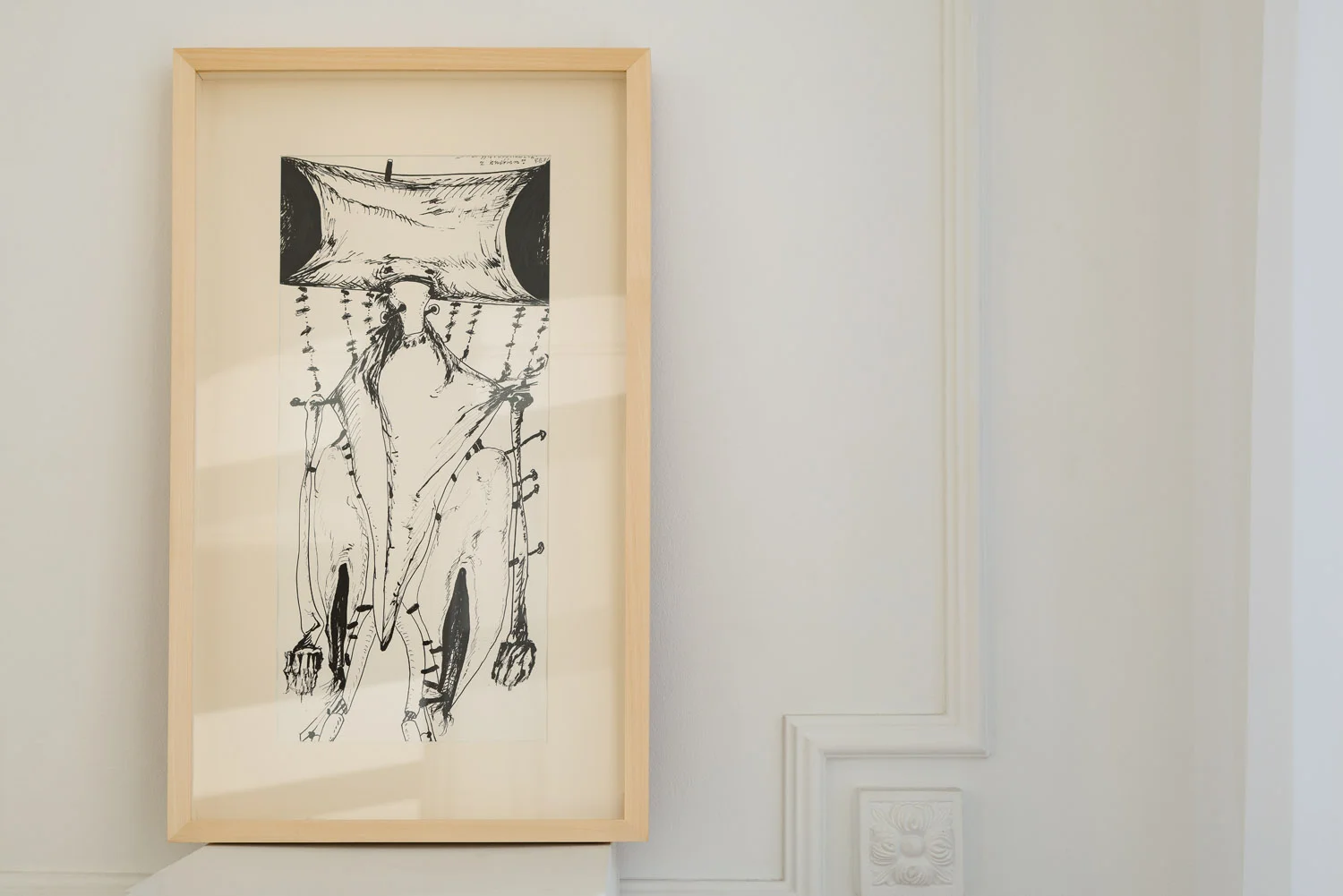
Figurative abstraction leaves viewers with ample room for interpretation and questioning. The largest question marks appear when realizing that Brzozowski actually creates an anthropomorphized world, where seemingly chaotic strokes and shadows form drama characters. It is challenging to pinpoint the roles of individual actors, though their titles often offer clues: "Koniuch", "Kurdupel", "Grabarz" that translate to "Stable Boy," "Dwarf," and "Gravedigger.". These figures are drawn from a bygone world. They come from different social classes and display a sense of theatricality. We encounter both "upper-class" representatives like the "Prima Donna" and more folk or carnival-like characters like the aforementioned "Dwarf," "Gravedigger," or "Stable Boy." These individuals remain undefined, shrouded in mystery and vagueness. Despite their differences, they share one thing: they inhabit the same world, and their fates intertwine. Their situations are no different, and indeed, both groups are captured in compromising and contradictory roles. It's unseemly for the "Prima Donna" to tempt or for the "Executioner" to weep. The embarrassment portrayed in the drawings is universal and spares no one. All characters, regardless of origin, remain defenseless in these situations-disease, suffering, and bodily limitations touch everyone alike.
In Tadeusz Brzozowski's drawings, we also find a humanistic message, showing us all as equal, particularly in the face of suffering and life's hardships. This suggests compassion and empathy. As Mieczysław Szewczuk noted: "Mieczysław Porębski distinguished two complementary layers of meaning in Brzozowski's paintings: eschatological, dealing with ultimate questions and existential boundaries, and the ludic, satisfying the need for catharsis through carnival-like profanation of ritual. The presence of these two layers creates a vision of existence with remarkable strength and depth. Comparing his painting and drawing, monumental canvases charged with color contrast with the modest, more personal drawings, where the artist's jest, joke, and mockery are more apparent."