
Franciszek Starowieyski. Intelligent snob in outline
In addition to his unique achievements, Franciszek Starowieyski left behind an extraordinary story. He never painted for himself; the recipient was always the most important in the creative process. Thanks to this, the memory of him is constantly alive, filled with a wealth of anecdotes, and art remains up-to-date.
Already as a child, he created the "Whores, Machines with Two Modes and a Crank" (in Polish: "Kurwy, maszyny na dwa tryby i korbę"), then "Pussymeter" (in Polish "Pizdomierz"), and with the end of the war in 1945, he decided to become a great engineer and inventor. In the first half of the 1950s, during his studies, he adopted the pseudonym Jan Byk (Jan the Taurus). He used the name of his family coat of arms, Biberstein, and the signature F. v B. S. (Franciszek von Biberstein Starowieyski) in his works. He wanted to live 300 years earlier, remaining in a strong connection with the legacy of Baroque artists, which he fully realized by antedating his works by 300 years (from 1970). As his wife Teresa recalled, "He named his son Belzebub, loved dirty jokes, and women."
"In an apartment full of souvenirs, drawings, paintings, photos, and old objects with collector's value, one gets the impression that Franciszek Starowieyski will come down from the top floor where he worked any moment and say, 'Now, Tereska, give us a piece of your strudel,' and he will turn to me, 'My wife cooks wonderfully.' That's how it was a few years ago when he invited me to his place on Bernardyńska. Later, I saw him two more times at Reszel Castle in Masuria, where we went to see his friend Adam Myjak, then the rector of the Academy of Fine Arts, and drank champagne with strawberries,"
- said Krystyna Pytlakowska in an interview with Teresa Starowieyska (source: https://viva.pl/ludzie/wywiady-vivy/wywiad-z-zona-franciszka-starowieyskiego-teresa-23444-r3/).

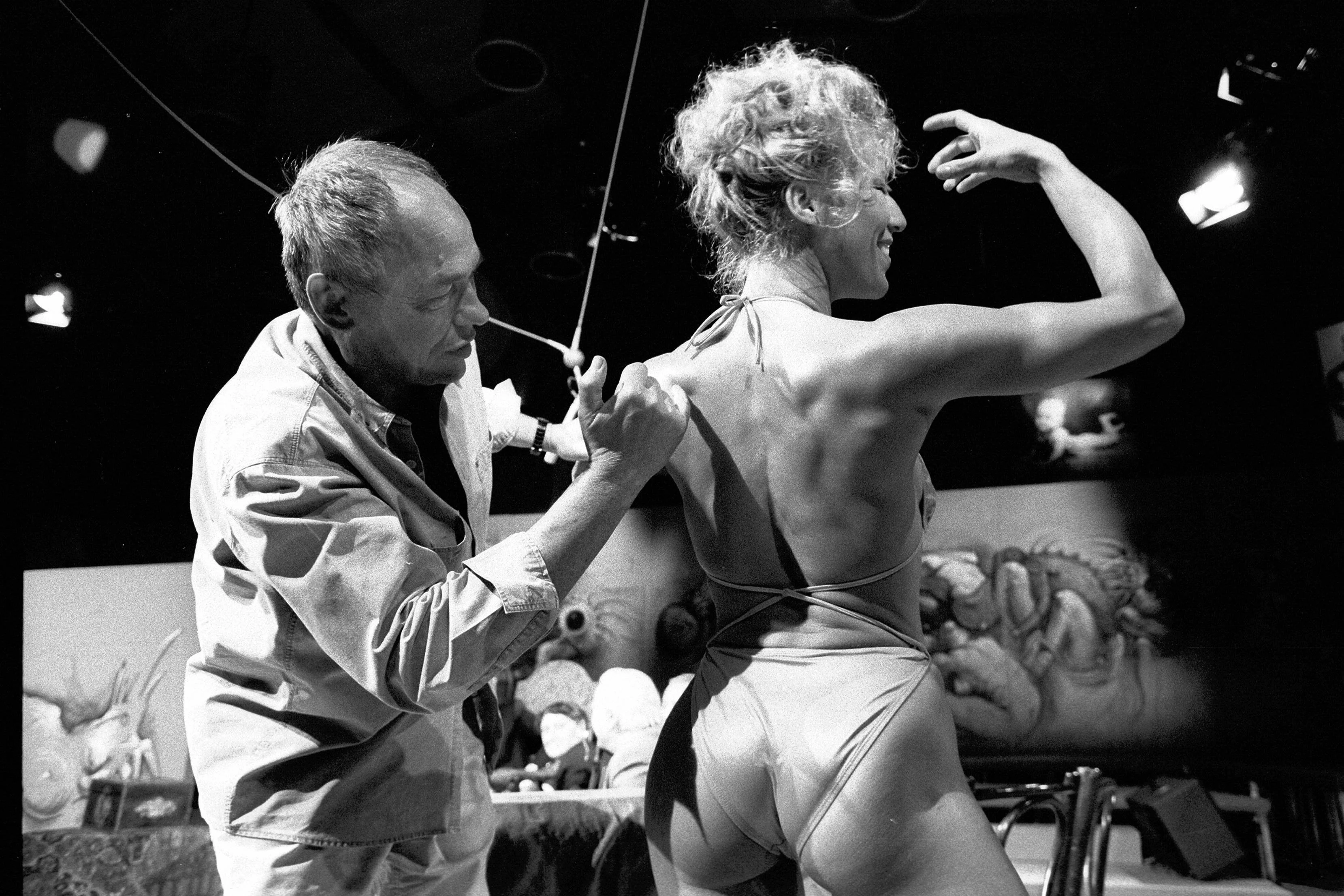
The artist gained special popularity in 1971, when Andrzej Papuziński made the film "Bykowi chwała" ("Glory to Taurus"), dedicating it to Starowieyski's art. In the same period, he received, among others, an award at the International Art Biennale in Sao Paulo, Brazil, and the Cannes Film Festival (in the field of film posters). In 1985, he created a poster for his own exhibition at MOMA in New York, which was also the first solo exhibition of a Polish artist there. However, his greatest recognition came from the so-called Drawing Theatres, which he carried out from 1980. In close to 30 sessions, Starowieyski created large-format paintings using his own technique of charcoal and pastels in front of an engaged audience. The main role during their creation was played by the mood and creative aura - the presence of nude models, accompanied by music and literary text, was mandatory. As Alin Avila pointed out:
The essence of the matter is hidden in nudity, not in the pretense of the present - that was Franciszek Starowieyski's conviction. When he drew the body, it was primarily an act of searching for abstraction, which one could guess existed beneath the costume of the line"
- Alin Avila. Pożoga, niedole i radości 1993 [in:] Franciszek Starowieyski (1930-2009). Przyjaźnie Paryskie 1683-1693. Collection A and N. Avila, State Art Gallery in Sopot, 2014, p. 43.
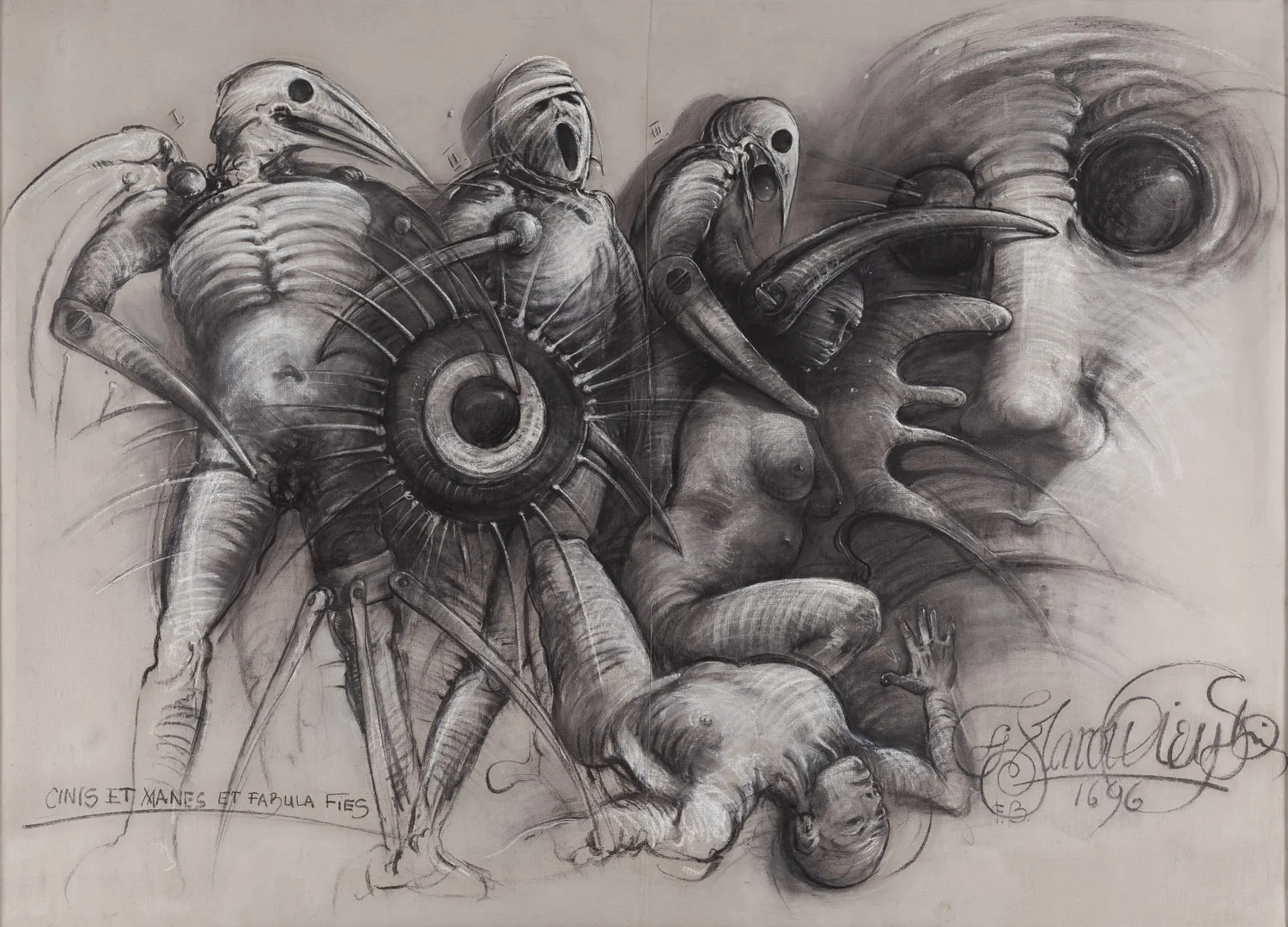
In 1999, as a summary of his work, Starowieyski listed that he had created 2000 paintings and drawings, 50 theater and opera scenographies, and 300 posters. In all of his creations, drawing was the most important aspect, which he placed on the same level as large artistic interventions. Hence, his numerous sketches, often supplemented with many comments and calculations, provide an extraordinary story about his imagination, sources of inspiration, and are material evidence of Franciszek Starowieyski's thoroughly developed and sophisticated genius.
"Franciszek Biberstein-Starowieyski was a true, authentic aristocrat, in his peculiar way attached to family traditions and respecting them. But he was a personality that shattered all canons, norms, and limitations, an extraordinary personality with an unbridled temperament and unpredictability. He was incomparable in creating incredible yet captivating and colorful fictions and myths, and was the most surprising and controversial in discussions and views on art, and not only, among all the artists I had the opportunity to meet and befriend"
- Bożena Kowalska, introduction to the exhibition catalog "Bykowi chwała! 100 plakatów Franciszka Starowieyskiego z kolekcji Janusza Pławskiego wyborze Bożeny Kowalskiej," Mazovian Center for Contemporary Art "Elektrownia," Radom 2009,p.7-8.