
Fijałkowski - Printmaking means focus
In 2022, we celebrated the 100th birthday anniversary of Stanisław Fijałkowski, who was one of the most important Polish post-war artists. Fijałkowski's rich oeuvre included paintings and prints, and the very artist often regarded his works in both of these techniques as equally relevant. Such an elevation of printmaking, very typical of the entire community of Łódź artists, allowed for the development of a printmaking language that is recognizable all over the world. It is characterized by tranquility and a modest form, whilst its content is abundant in metaphysical messages.
Danuta Wróblewska paid particular attention to the ascetic and contemplative nature of Fijałkowski's prints:
"Horizontal, vertical, diagonal. Modesty, clarity, focus. This is true for a well-built house, a tree drawing, or an unbreakable grid of sounds. Peace and nodes of tension interrupting it-as in a well-conducted melody. Like many other accomplishments before it, this art asserts that when one uses fewer creative means, a more certain outcome is achieved. "
- Danuta Wróblewska, Zatoka spokoju [in:] Stanisław Fijałkowski, Galeria Ego, ed. Poznań 2003, p. 7.
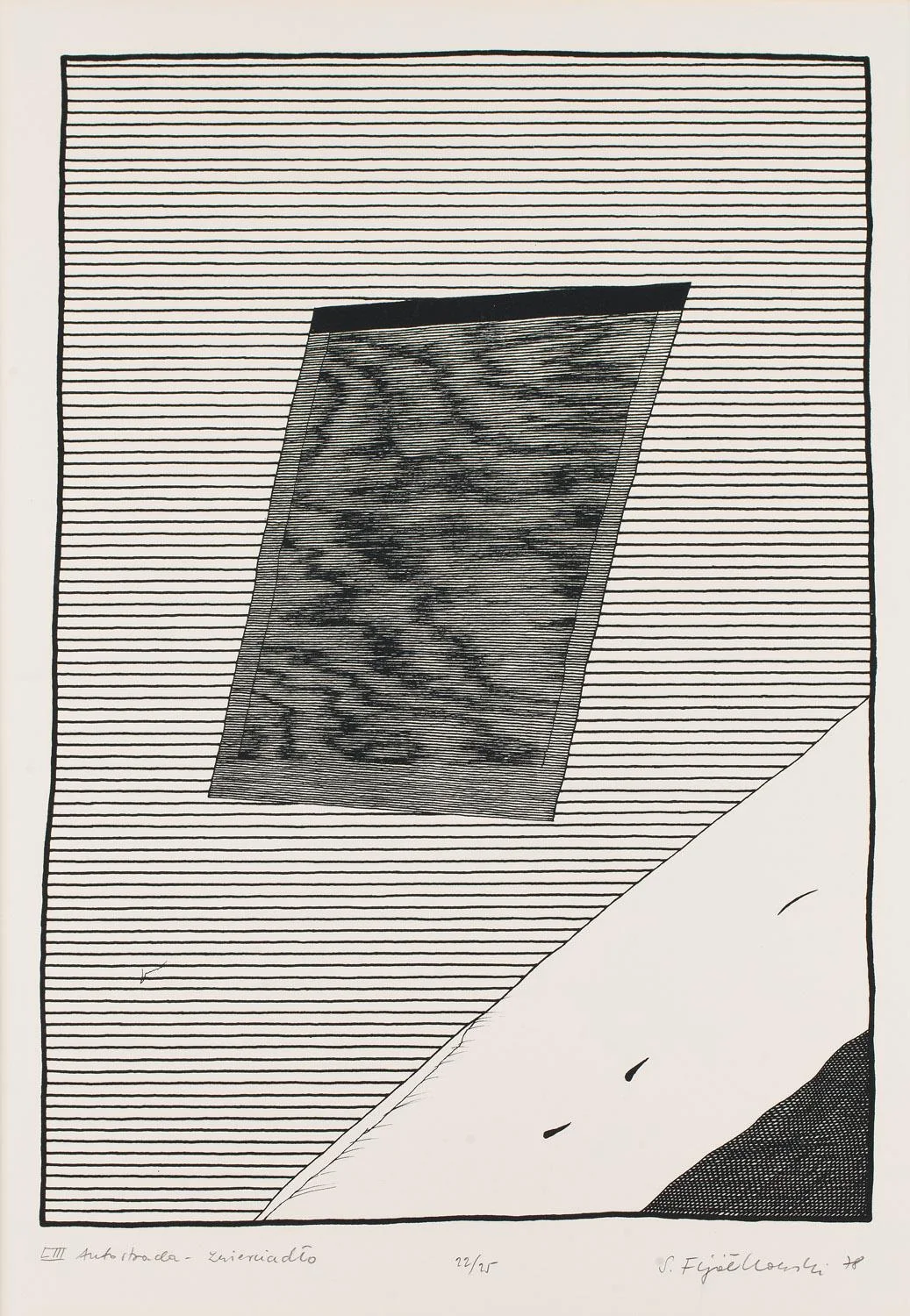
Printmaking played a very important role in Fijałkowski's creative output, constituting an extension of his painting activity, despite the fact that printmaking was the basis for all his later works. The artist studied painting at the State Higher School of Fine Arts in Łódź but obtained his diploma in printmaking under the supervision of Ludwik Tyrowicz. His diploma presented a layout design for a (fictional) catalog of the collections held by the Art Museum in Łódź. After graduating, Fijałkowski concentrated on painting and did nothing else for ten years. He believed that printmaking was a discipline that "emerged from painting and, in a way, accompanied all the activities of a painter." (Stanisław Fijałkowski – Lata nauki i warsztat. Łódź: Galeria 86, cop. 2002, p. 28.) According to Fijałkowski, painters were the best printmakers, not specialists. In his prints, the author primarily used solutions developed by Dürer and Rembrandt. The real growth in Fijałkowski's printmaking didn't happen until he dedicated himself to experiments with lithographic limestone in 1961. He also made his first linocuts at that time. His main incentive for moving towards printmaking was, presumably, the start of a trade union printmaking studio and permanent regional and nationwide competitions in Łódź.
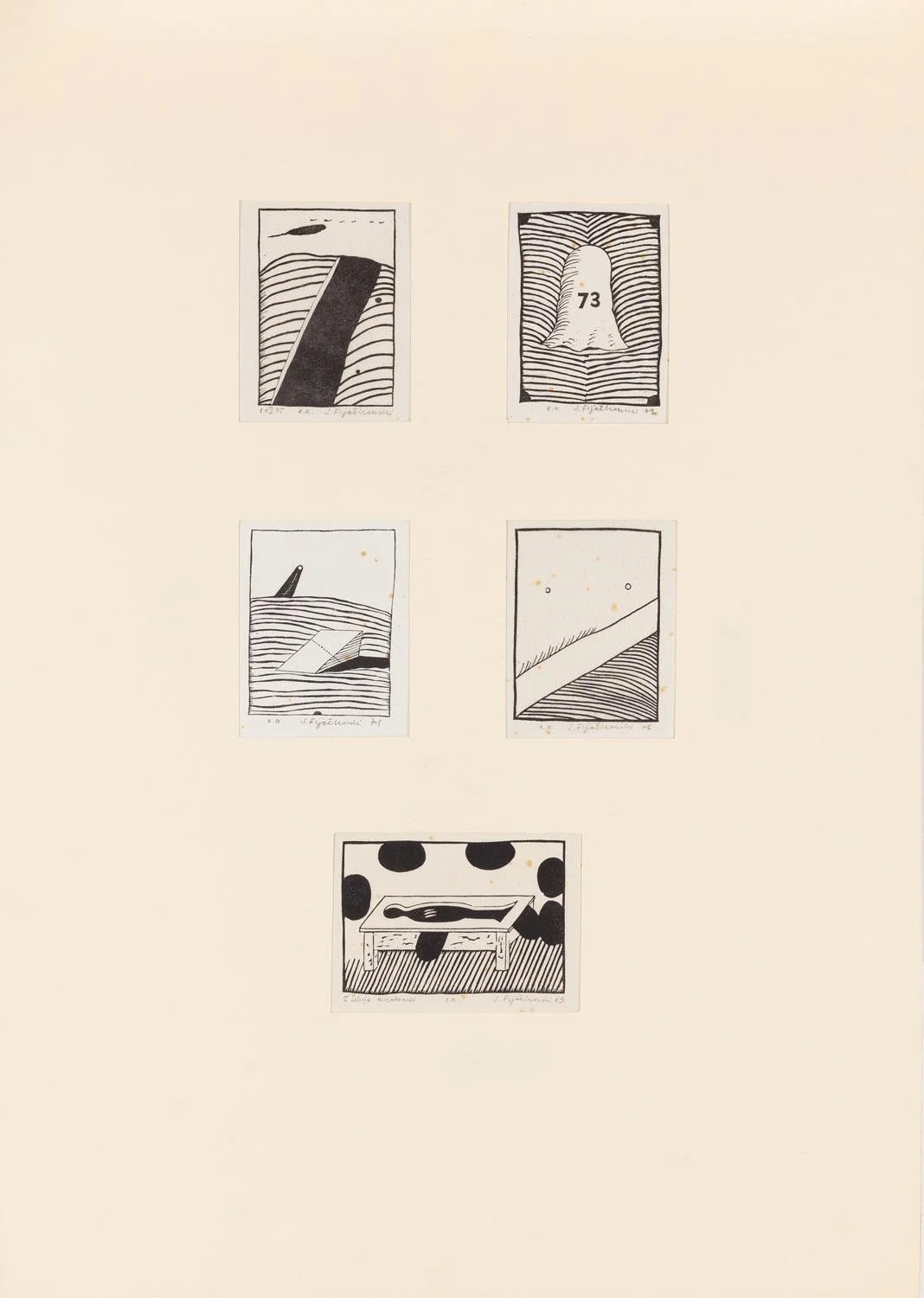
After his first experiments with lithography and linocuts, Fijałkowski decided to devote himself to the latter technique, which wasn't warmly welcomed by the Łódź academic community. His turn toward a schematic and reproductive linocut was perceived as a rebellion against academic traditions. As the artist himself recalled:
"I quickly and very clearly realized that a defined and the simplest form possible, as well as the craftsmanship devoid of mysteries, are the main powers of an artwork, not an abundance of technical possibilities and conspicuously guarded artistic tricks. The technique must be so simple and obvious that it does not arouse any interest (of course, professionals will always be absorbed in technical details); that is when the message becomes important.
- Stanisław Fijałkowski – Lata nauki i warsztat. Łódź: Galeria 86, cop. 2002, p. 28.
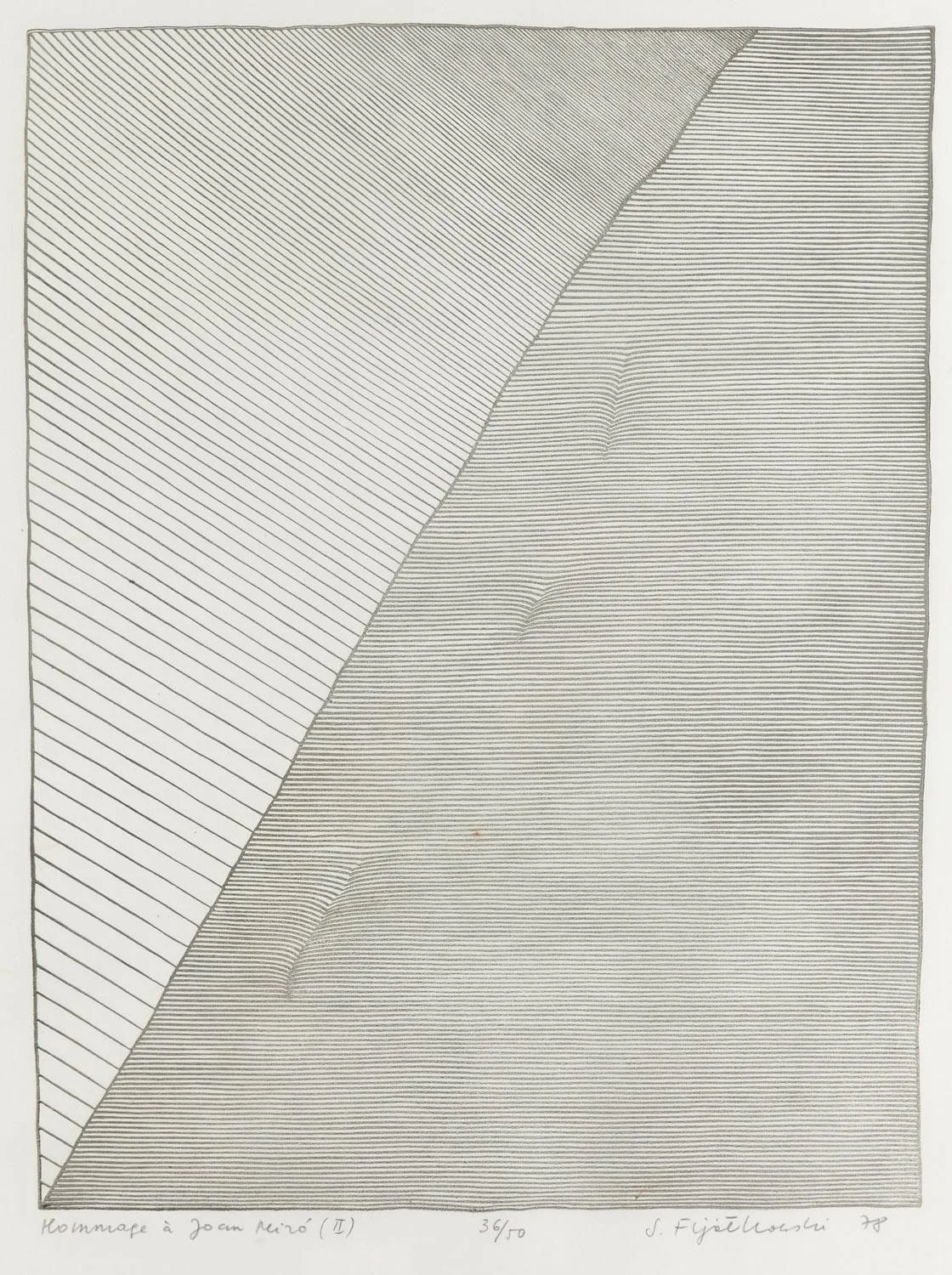
In the latter half of the 1960s, Fijałkowski ostentatiously broke with the cult of tools and technical perfection promoted by academic circles and turned to improvisation and drawing, which became the artist's main means of creative expression. Both prints and paintings from this period were made using schematic sketches, which Fijakołwski enriched with painting or printing motifs. Above all, Fijałkowski did not use the help of a print technician, who would traditionally make the impressions of the projects made by artists. Fijałkowski was virtually always in charge of the printing press, which was key for the final effect. For the artist, the very process of making impressions had a huge impact on the outcome. Years later, Fijałkowski recalled his work with the printing press as follows:
"Indeed, I cut and impressed the finished project myself, looking forward to the new experience and pleasure of making copies. Cutting the sheet has always been a kind of meditation for me, a rare opportunity to calm my ambitions and realize that I'm a skilled craftsman. Looking at the many printed copies, each of which was an original piece, brought joy similar to the biblical multiplication of bread. "
- Stanisław Fijałkowski – Lata nauki i warsztat. Łódź: Galeria 86, cop. 2002, p. 28
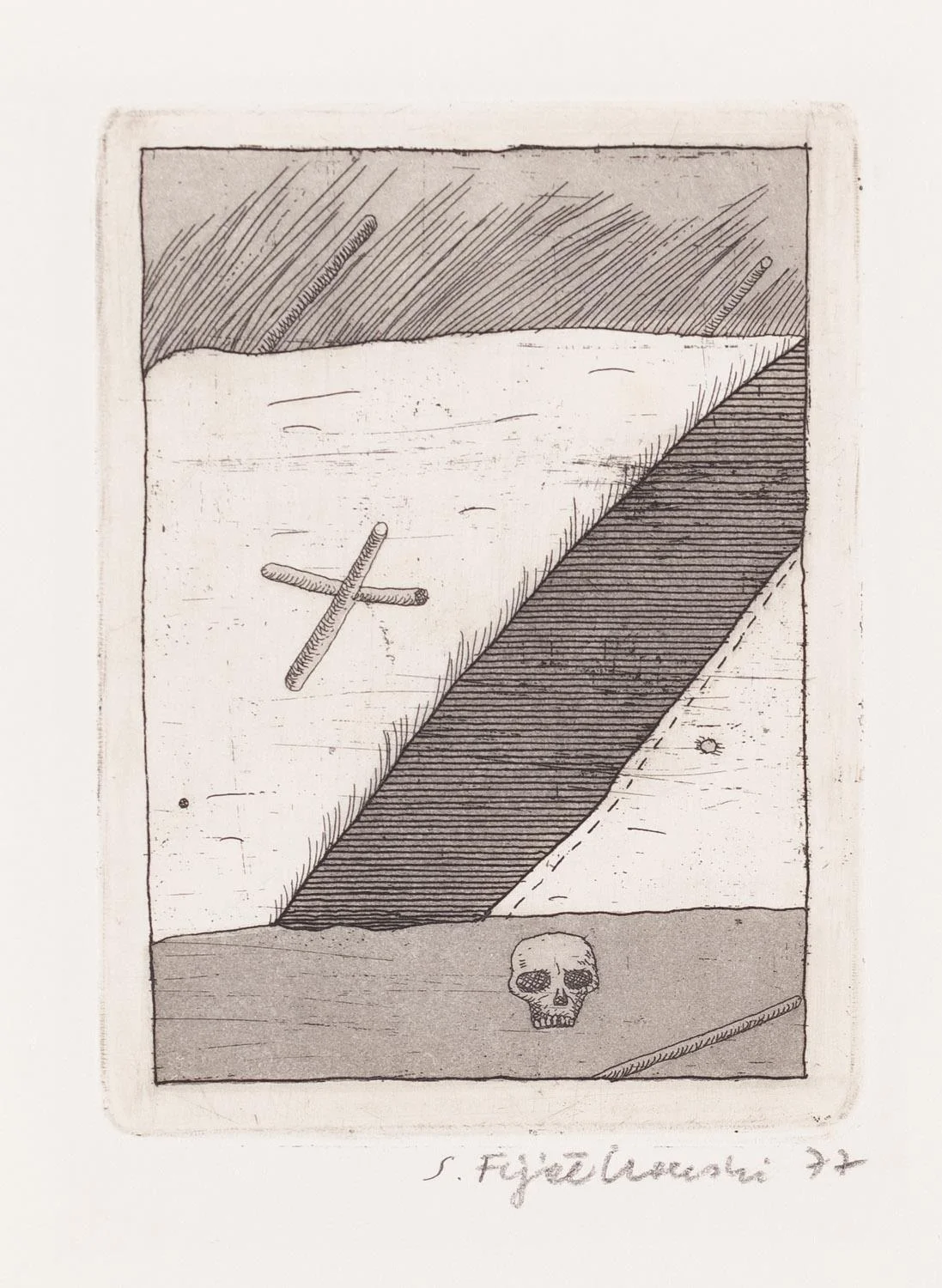
Printmaking was also a very important medium for the rising star of the Polish art scene from a purely pragmatic point of view. Making copies was a much cheaper and more accessible mean of artistic expression, which allowed the author to make a name for himself in the pre-internet era. Furthermore, prints could be given to other people, which facilitated building new relationships with artists and the wide circle of friends that surrounded Fijałkowski. When it came to sharing his works, the form was essential. Prints could be easily rolled up and inexpensively sent by post, also, what's important, abroad. For Stanisław Fijałkowski, the presence of his prints in salons worldwide was particularly pleasing and, in fact, helped build his image as an international artist:
"Sending your works to numerous exhibitions, especially the international ones, which were becoming increasingly popular, soon turned out to be a necessity if one aimed at gaining recognition for his or her art and compete with the best creators. In addition, I take pride in the fact that Polish art is almost the only export product of undisputed quality. The strong position of printmaking became also noticeable thanks to the Polish section of the International Association of Woodcutters XYLON, a very visible presence of Polish woodcutters at international exhibitions and their winning numerous awards, as well as the activities of the Krakow International Print Biennale and the Łódź International Miniature Print Biennale.
- Stanisław Fijałkowski – Lata nauki i warsztat. Łódź: Galeria 86, cop. 2002, p. 28