
Ewa Kuryluk and Horror Vacui
Ewa Kuryluk's drawing with the provocative title "Kosmosex" depicts a couple intertwined in a loving embrace at the center. They are floating in the air, upside down against the backdrop of an abstract, geometric structure. Below them stretches a hilly landscape. The work from the early stage of the artist's career belongs to a group of drawings and graphics she refers to as "Humanlandscapes."
They are characterized by the fluid transition of figures into elements of the landscape, reflecting the artist's desire to give equal weight to all living and non-living elements of the world. She often deformed figures or likened them to animals, as seen in the drawing of a woman with unattractive, hairy legs. In her works, the landscape undergoes anthropomorphism - the hills resembling the curves of the human figure, and the lines covering the fields resembling long, softly falling hair. In "Humanlandscapes," even the smallest element seems to pulsate with life.
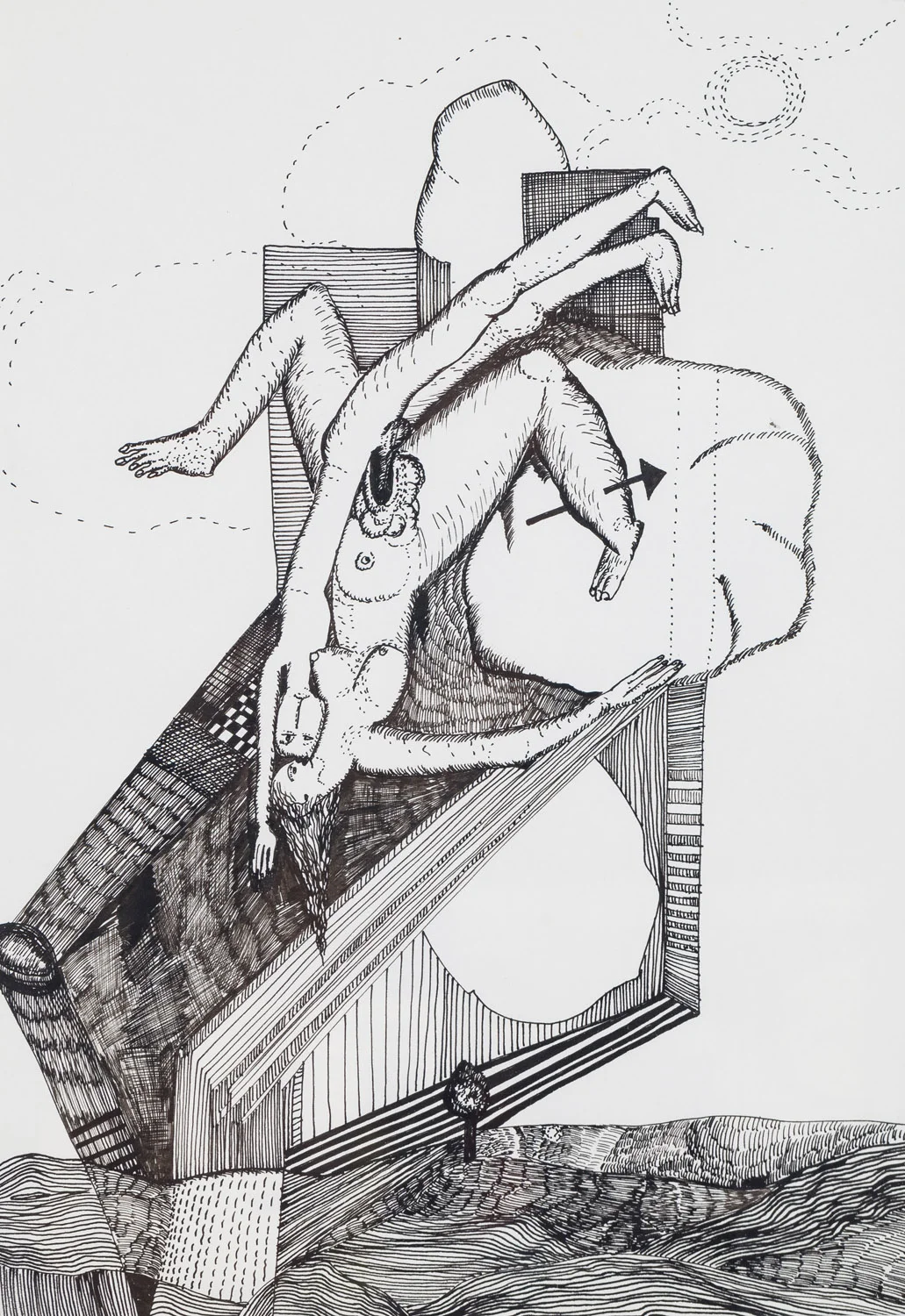
The drawings and graphics from this period are distinguished by their high decorative quality. The artist mentioned that during this time she succumbed to horror vacui, the tendency to densely fill spaces with ornaments. The richness and intensity of the works from the late 1960s and early 1970s sometimes align them with folk art, while at other times with Art Nouveau or works from the Far East.
A peculiar syncretism, combined with a pantheistic view of the world, fits perfectly into the burgeoning hippie movement of the late 1960s. Works such as "Kosmosex" with their openly sexual undertones resonate exceptionally well with the era of flower children and sexual revolution. Kuryluk began exploring erotic themes in art while still a student, and they remain an important thread in her multidimensional creativity to this day.
The seemingly idyllic "Humanlandscapes" hide a shadow, characteristic of post-World War II art, developed with an awareness of the fragility of human life. Upside-down, deprived of stable ground, the figures are unnaturally contorted. Engaged in copulation, they embrace each other, but their faces do not reveal pleasure. Signs of catastrophe are visible in Kuryluk's art, particularly from 1968, stemming from her personal experiences. In December 1967, the artist's father passed away, and in March of the following year, her family experienced a painful bout of anti-Semitic persecution. This led to the deterioration of her mother and brother's health - both suffering from schizophrenia. The artist did not hide that her visual and literary work is autobiographical, and the fate of her loved ones affects the most intimate spheres of her life. She portrayed the world around her through the prism of emotions associated with current events.
The inverted figures in the drawing can be linked to the figure of Icarus, who often appears in "Humanlandscapes," sometimes in the foreground and highlighted in the title, elsewhere hidden in the background. Kuryluk treated the mythological hero as a universal symbol of catastrophe that destroys utopian dreams. At the same time, he embodied her brother Piotr - a miraculous child whose wings were clipped by illness.
In the second half of the 1970s, when Kuryluk, along with Andrzej Bielawski, Andrzej Bieńkowski, Jan Dobkowski, and Łukasz Korolkiewicz, formed the Śmietanka group, her images, based on photographs, became more simple and poster-like in form. At the end of that decade, the artist completely abandoned easel painting and since then has created primarily synthetic, almost monochromatic drawings on fabric and installations. It is worth paying attention to her early drawings and graphics, as she herself claimed: "My iconography of dreams, obsessions, and nightmares can be best understood by carefully examining the black and white works on paper" (Ewa Kuryluk. Człekopejzaż 1959-1975, exh. cat., [ed.] Ewa Kuryluk, Artemis Art Gallery, Krakow 2016, p. 56). "Kosmosex" was created at a particularly important time for the artist - in 1970 she graduated from the Academy of Fine Arts in Warsaw, and the Woodstock Gallery in London hosted her first foreign solo exhibition.