
EWA JAROSZYŃSKA-PACHUCKA - CREATOR OF REMARKABLE "CROCHET FORMS"
Ewa Jaroszyńska-Pachucka is an artist who shaped the post-war artistic textile scene in the 1960s and 1970s. Together with Magdalena Abakanowicz, Jolanta Owidzka, and Zofia Butrymowicz, she represented Poland at the legendary exhibition titled "Wall Hangings'', which took place at the New York Museum of Modern Art in 1969.
Jaroszyńska-Pachucka contributed to the achievements of the Polish school of artistic textile with her distinctive spatial, three-dimensional forms made of hemp cords, jute, and sisal. Although the artist's works were strongly related to the craft of weaving, she abandoned decorativeness in favor of various formal experiments. After all, this tendency was characteristic of many Polish male and female weavers of the 1960s. She chose a crochet hook as her main instrument - an implement which used to be a women's traditional household attribute. She made this seemingly simple item a sophisticated tool for creating her art. In retrospect, it was an extremely innovative approach, unprecedented at that time. It was the crochet hook that allowed the artist to develop her weaving forms in various directions, not limiting it only to vertical and horizontal designs, but using it also for creating openwork decorations, very characteristic of her art.
Danuta Wróblewska, the author of numerous texts on Jaroszyńska-Pachucka's works, spoke about "crochet forms" as follows, "As crochet forms became more artistically mature, they began to spatially emancipate themselves, becoming larger and coming in different shapes. Some started to take human-like shapes, some separated into a group of "vestments", while others – usually suspended at the ceiling – resembled vertical architecture-like forms".
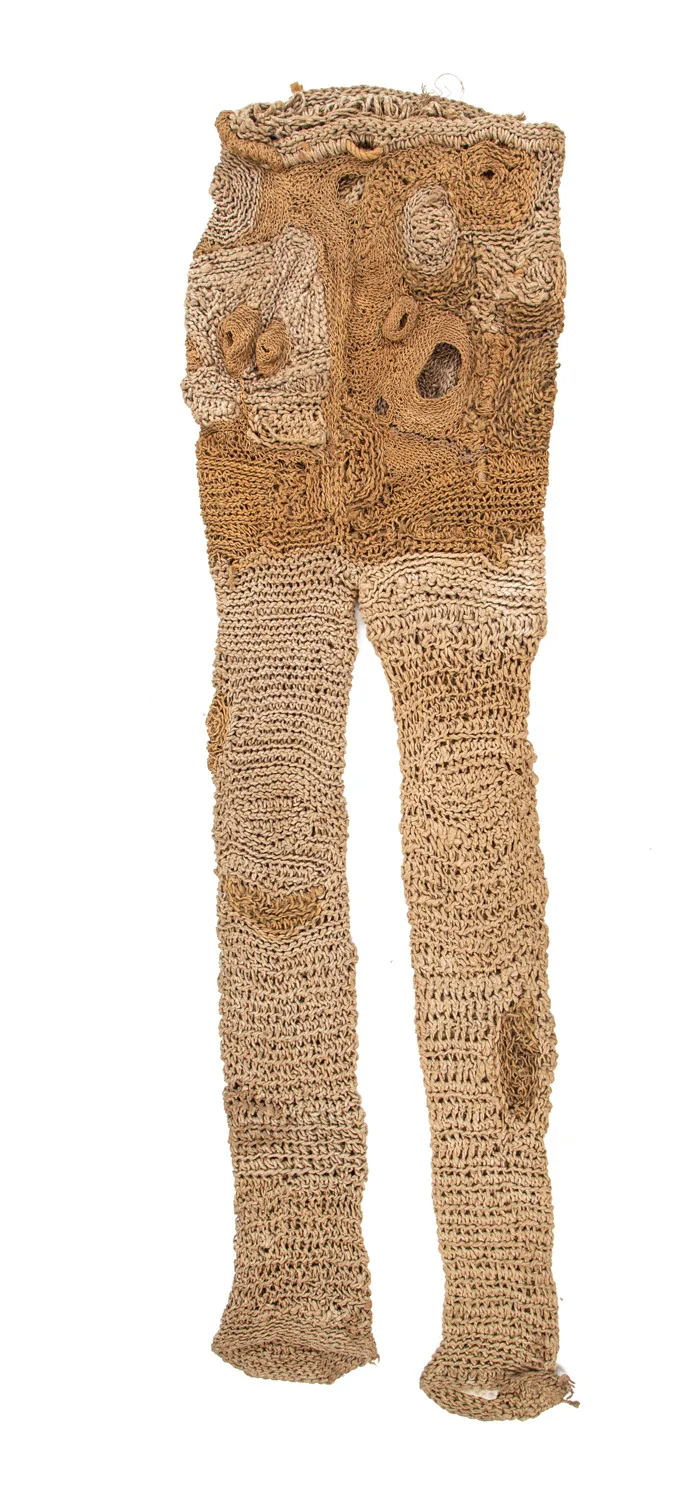
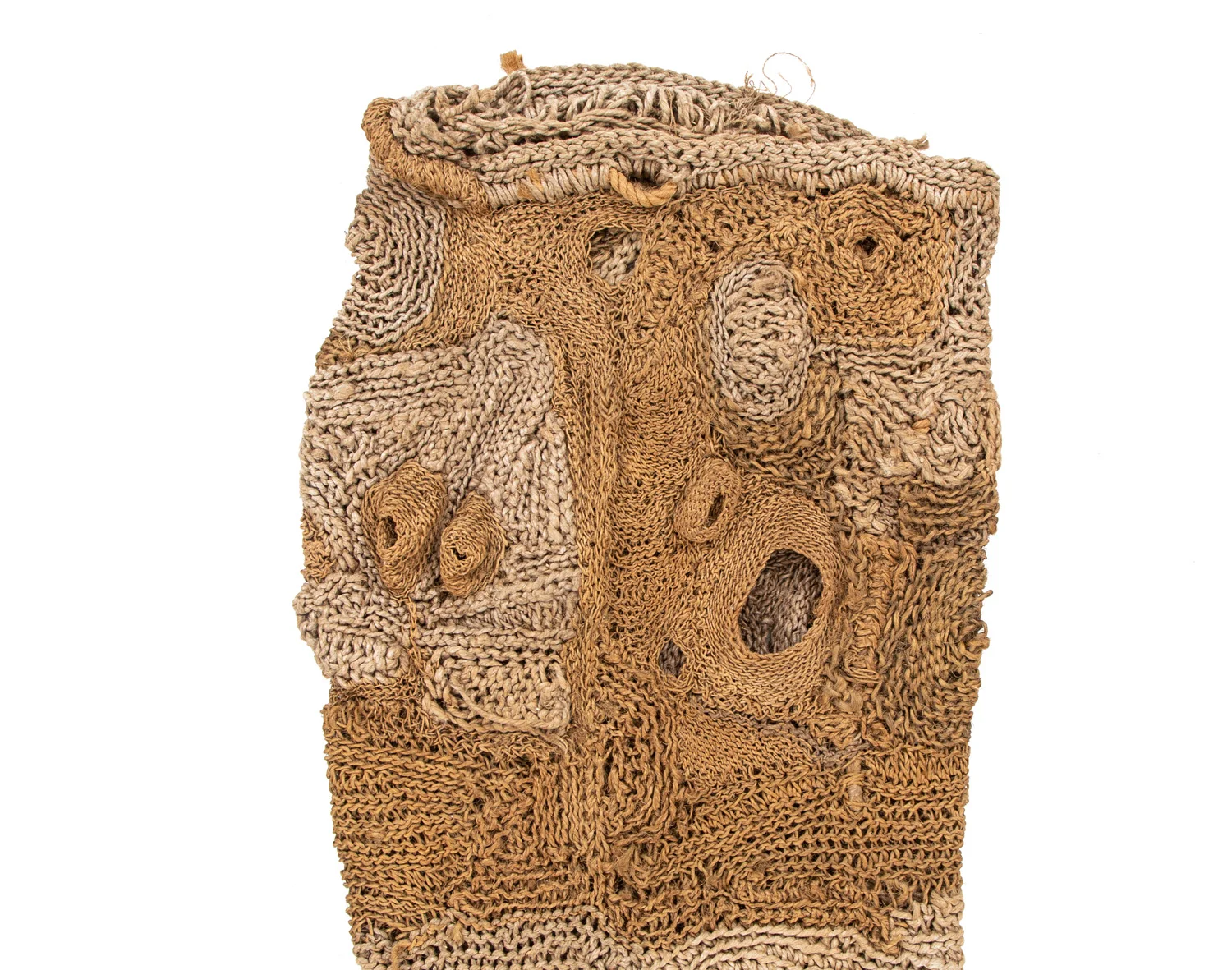
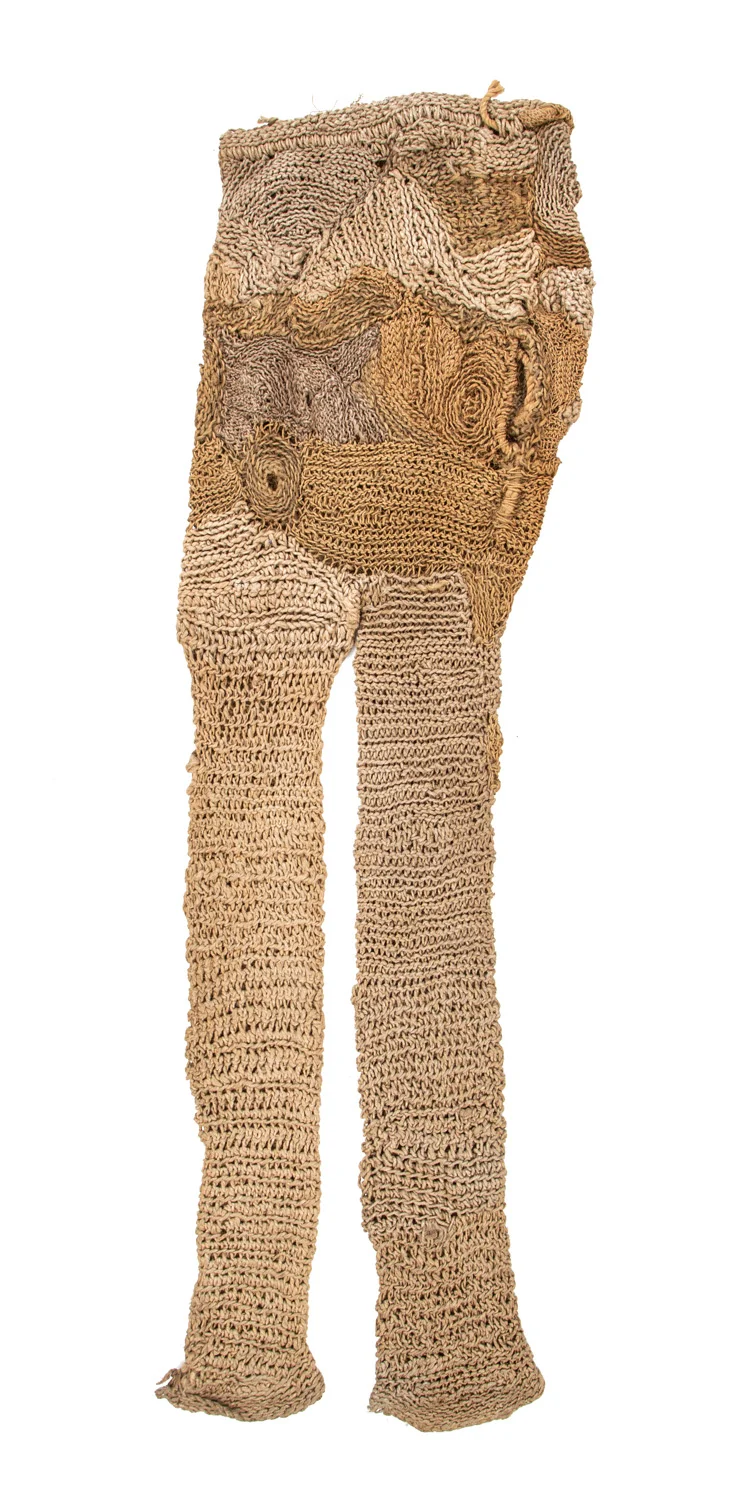
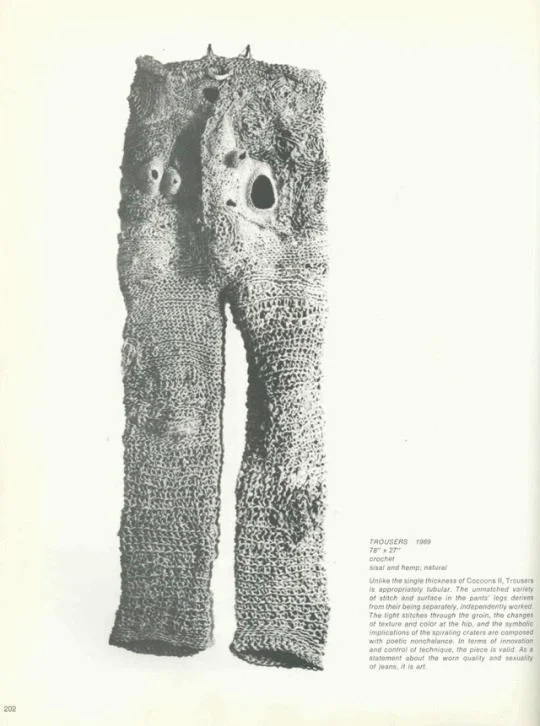
The form "Trousers" from 1969, presented at our exhibition, is an example of a work made with a crochet hook. This monumental piece is one of the most representative works of Ewa Jaroszyńska-Pachucka's art. It comes from the "Clothing" series, which features other works referring to garment elements. However, the creator associated these items with artificial skin, depriving them of their utilitarian aspect and giving them bodily character.
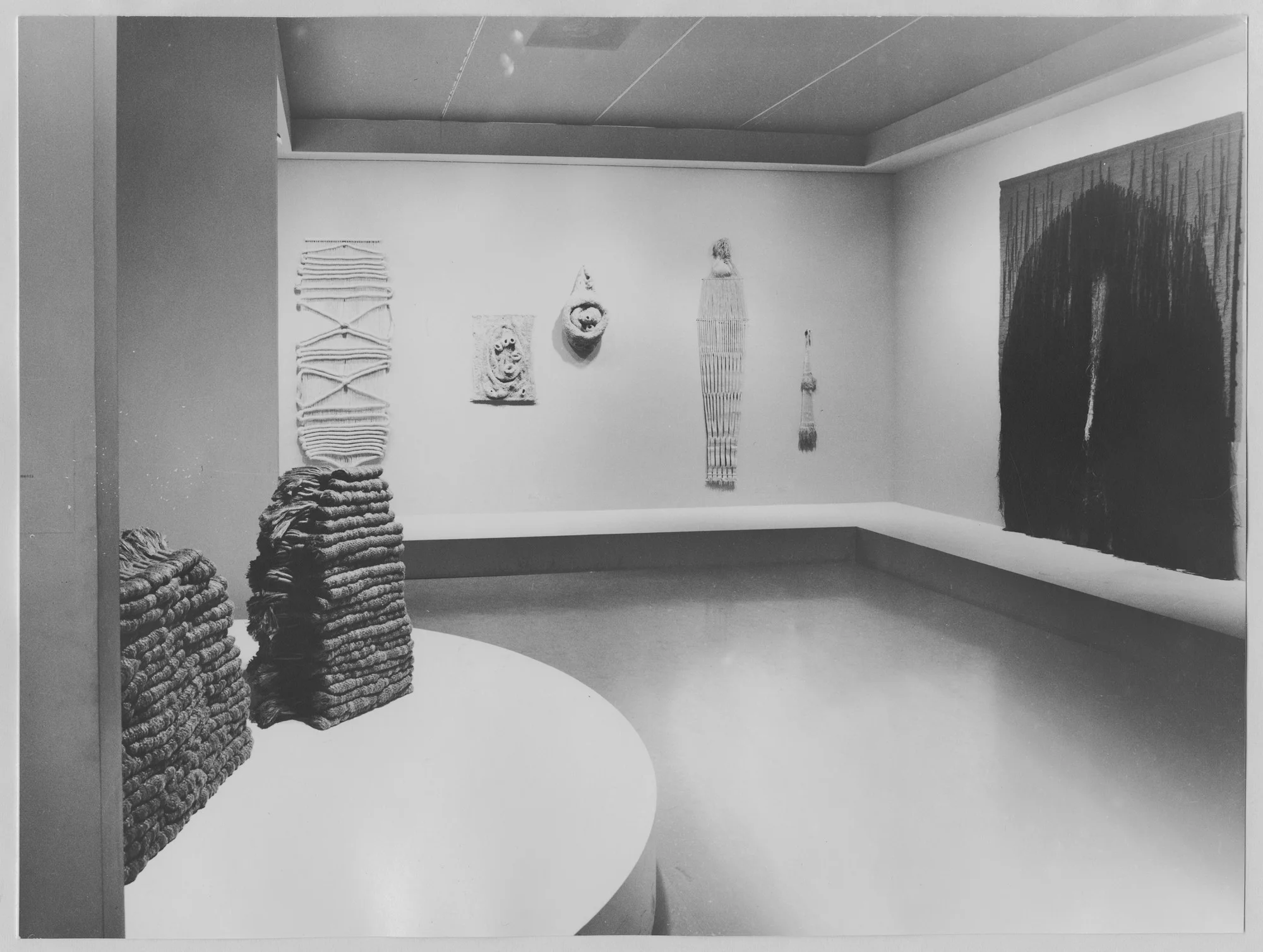
The artist's career took real momentum in 1969 with a spectacular exhibition "Wall Hangings" in New York's MoMA, curated by Mildred Constantine and Jack Lenor Larsen. The exhibition included the works of the most important contemporary artists dealing with textile art, with particular emphasis on the artists from the Eastern Bloc. Jolanta Owidzka, who visited Jaroszyńska's studio, introduced the artist to the curator. Thanks to this encounter, as many as two works from the "Cocoons" series were presented at the aforementioned exhibition. The display also featured works by Magdalena Abakanowicz, Zofia Butrymowicz, Barbara Falkowska, Jolanta Owidzka, and Wojciech Sadley, thus giving recognition to the Polish school of artistic textile in the international area.
The story of the artist's life is also very interesting. At the beginning of 1970, she and her husband moved to Denmark, where the artist had two solo exhibitions: at the Ved Äaen gallery in Aarhus and at the Omme Gallery in Silkeborg in 1971. In March, Jaroszyńska-Pachucka emigrated to Australia, where she quickly became one of the most sought-after artists. A spectacular project titled "Arcadia: Landscape and Bodies", included in the collection of the Art Gallery of New South Wales in Sydney, may testify to this phenomenon. This monumental, multiform work made with a crochet hook was created over the period of five years. It was displayed for the first time at the artist's solo exhibition at Rudy Komon Gallery in Sydney in 1977. The installation featured five naked life-size women, accompanied by a pig, a dog and architectural elements – stairs and stone arches. As the artist herself said, "I like the idea of peace in the landscape, when people live in harmony with nature, without conflicts. And all shapes complement one another, just like trees complement stones." In 1974, the artist represented Australia at the Third Triennial of Contemporary Art in New Delhi, India and received a grant from the Visual Arts Board, which allowed her to participate in the exhibition in February 1975. In 2000, she returned to Europe and settled in France in the city of Mazamet. There, she resumed creating her visual works, e.g. the series "Clothes", "Masks", "Stones and Debris", or "Landscapes", which were marked by her interest in sculpture accompanied by the references to textile art.
Jaroszyńska's works can be found in numerous international collections, e.g. National Gallery of Australia in Canberra, New South Wales Art Gallery in Sydney, National Gallery of Victoria in Melbourne, Tasmanian Museum and Art Gallery in Hobart, Museum of Modern Art in New York, National Museum in Stockholm, National Museum in Warsaw, and Central Museum of Textiles in Łódź.