
Erna Rosenstein, Un-seeing
Wiktor Komorowski
Erna Rosenstein's painting titled "Un-seeing" is the essence of the artist's style. This piece exceptionally clearly reveals her thoroughly developed and universally recognizable creative idiom.
Although many, e.g. Bożena Kowalska, Janusz Wojciechowski, or Anda Rottenberg, would place Rosenstein's painting within the surrealistic tradition, the artist herself was not comfortable with this label. The most emphatic manifestation of her distinctive artistic activity is her unique technique of filling the painting surface, which is noticeable in the work presented at the auction. "Un-seeing" is tightly packed with shapes that prove her fascination with the organic world. Horror vacui is a frequently used artistic device in Rosenstein's work and aims to create a lyrical aura that reflects what is unconscious and what needs to eventually find an outlet. On the one hand, this method reveals influences characteristic of surrealist creators, particularly those who successfully dealt with automatic drawing. On the other hand, her works are often devoid of any figurative elements and therefore may be associated more closely with abstraction. Thus, Rosenstein's paintings refer to a more visual-centric reception of the work, remaining semantically open to viewers' interpretations. This open semantic form allowed Erna Rosenstein to free herself from oppressive canons and social codes.
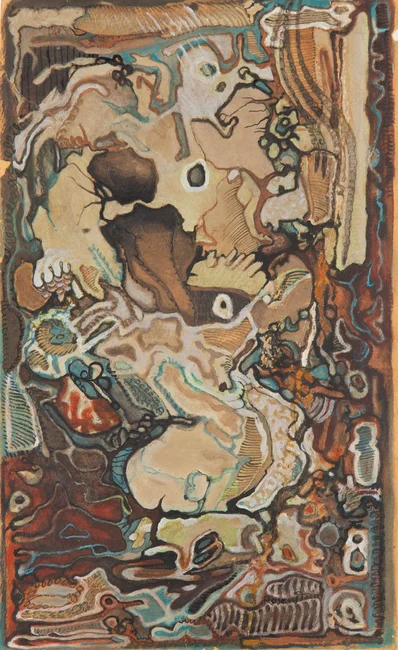
Therefore, it may be assumed that since the begging of 1960s Rosenstein's paintings attempt to escape the confines of classification, as well as confines of the art dominated by men by the use of metaphor. Looking at her art and at the same time approaching the issue of confines more literally, one can also get the impression that her abstract compositions are trying to leave the canvas or their wooden frame. In the 1960s, Erna Rosenstein directed her research towards exploring the possibilities of creating meanings, which comes together with using abstract forms. Aleksander Wojciechowski wrote that the art of Erna Rosenstein, despite being created in the post-war period which focused on the need to develop a new language for speaking about art and taking up historiosophical considerations, never embraced moralizing issues and was born mainly from the dramatic nature of forms, fantasticalness, and fantasy (Aleksander Wojciechowski, Polskie malarstwo współczesne, Warszawa 1977, p. 9). Her attention focused on microbiological shapes. The canvases and wooden frames began to be covered with a thick-lined swarm of organic forms. This is the reason why "Un-seeing" leans more towards abstract painting or Strzemiński's theory of seeing than to surreal compositions, although some notice the elements of surrealistic automatic drawing, characteristic of such artists as André Masson, in the swirl of colorful lines, associated with the world of biology.