
Embossed Romances by Alicja Halicka
Alicja Halicka is remembered as a versatile artist and one of the first women to work in the Cubist style. She was also known privately as the wife of Ludwik Markus (Louis Marcoussis), a leading figure in the Parisian avant-garde. Her talent was overshadowed by her possessive husband, who claimed that one Cubist in the family was enough. After a brief period of experimentation with this avant-garde movement between 1914 and 1918, which remained unknown to the world due to Marcoussis's efforts, Halicka gained fame as a sensitive colorist, book illustrator, author of etchings and color lithographs, and creator of highly original works made from fabric scraps, known as "Embossed Romances."
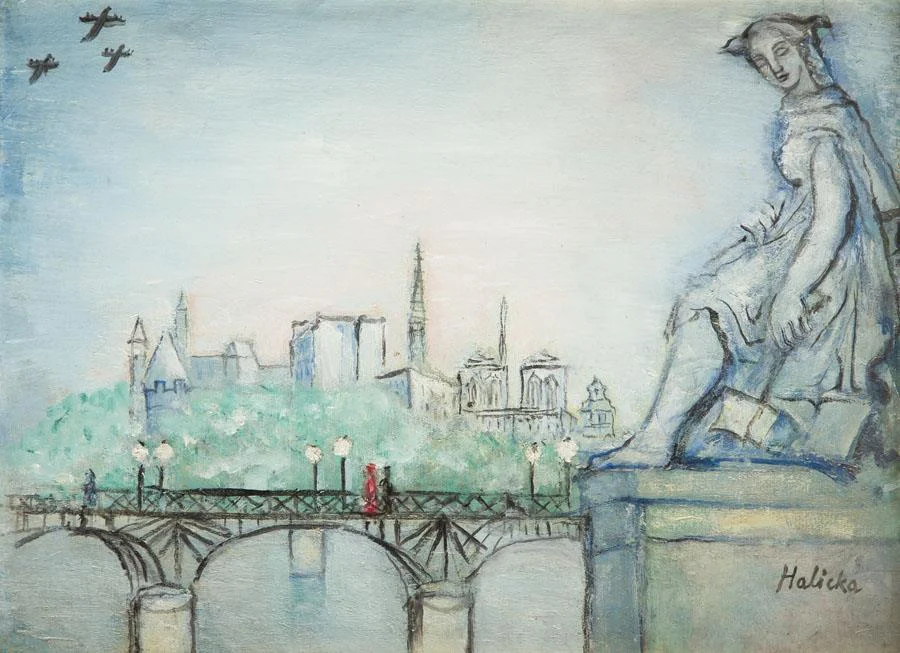
Born with the surname Rosenblatt in a wealthy Krakow family in 1894, Halicka wrote in her diary about her earliest signs of artistic talent at the age of seven, inspired by a visit to the circus, which prompted her to start drawing. Later, at a time when official academies did not yet admit women, she studied for a while at the Women's School of Fine Arts in Krakow, run by Maria Niedzielska. The faculty included renowned professors like Leon Wyczółkowski, Wojciech Weiss, and Józef Pankiewicz. She then continued her studies in Munich at Simon Hollósy's school, which was more progressive than the conservative academy, and in Paris at the Académie Ranson, where she attended the studios of Nabis painters Maurice Denis and Paul Sérusier. Studying abroad allowed the young girl, daughter of a rather authoritative and convention-bound, busy doctor, to taste freedom and independence.
In the spring of 1912, Alicja Rosenblatt arrived in Paris, the city of her dreams. In the capital of art, everything fascinated her, from the sunlight and elegant ladies strolling down the Champs-Élysées to the smell of fried food and gasoline. From the beginning, she lived under the surname "Halicka" of unknown origin, signing her works accordindgly. Even after marrying the prominent Cubist Ludwik Markus, she continued to sign her paintings with the invented surname. Her marriage to him had a significant influence on the direction of the young artist's work. Markus, who had been living on Montmartre since 1903, knew the entire circle of young avant-garde painters, critics, and poets, who met and held heated debates in local cafes, including Café de l'Hermitage and Café Cyrano. Among their acquaintances were Pablo Picasso, Georges Braque, Fernand Léger, Gino Severini, and Serge Férat, while Max Jacob, Guillaume Apollinaire, and Juan Gris were friends of the couple.
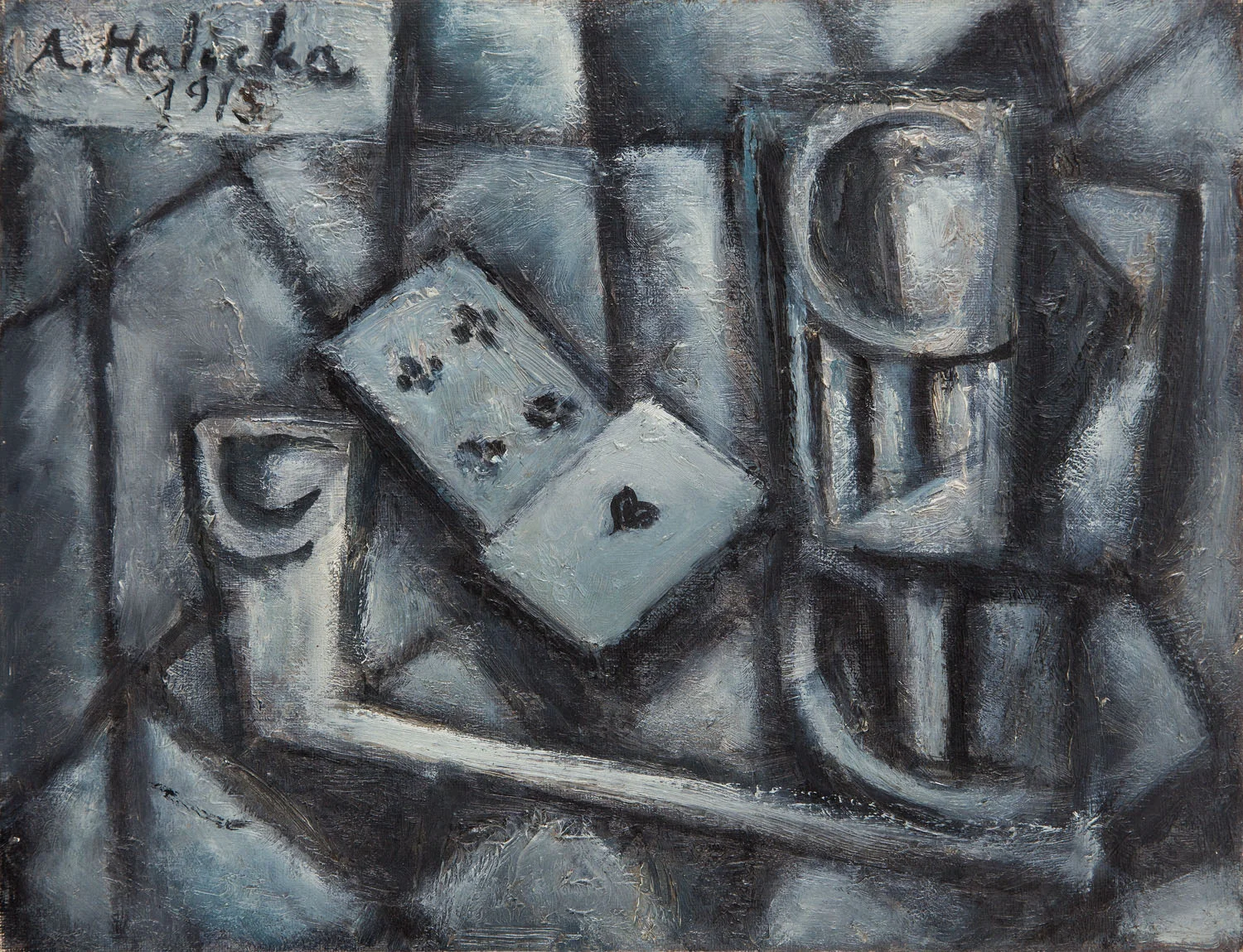
Given her avant-garde circles, it is no surprise that Alicja Halicka herself attempted to create in the Cubist style. If it had not been for her husband's service in the Foreign Legion during World War I, the young artist, just twenty years old, might never have dared to implement the new painting principles she overheard in the heated discussions between Marcoussis and Juan Gris in the Montmartre cafes. In 1914, she went to a farm in Normandy, where she could paint for pleasure whatever she wanted. In the still lifes she created there, she tested all the possibilities that Cubism offered. Upon her husband's return from the war, she distanced herself from Cubist painting, and the works she brought back to Paris were reportedly destroyed by him. Fortunately, several dozen canvases, gouaches, and drawings from that period, left by the artist in the attic, were found almost sixty years later by the heirs of her friends and sent to her, revealing an unknown side of her work to the wider public.
In the second half of the 1920s, Alicja Halicka drew critical attention with an unusual series of picture-collages, some of which were three-dimensional, composed of various fabric scraps, patterned papers, buttons, beads, feathers, or wires, presenting small genre scenes. She first exhibited them at the Galerie d'Art de la Grande Maison du Blanc in late 1925. In the introduction to the exhibition catalog, Princess Murat described them as "Romances Captionnées." In Polish literature, the term "embossed romances" was adopted, which does not fully capture the diversity of techniques in these works. Captionné in French also means "quilted" or "doubled." Fabric as an artistic medium had been close to Alicja Halicka since the 1920s. Difficult financial circumstances forced her to work in applied arts to support the household budget. Initially, she designed fabrics and wallpapers for Paul Dumas, then created patterns for the patterned silk producer Bianchini, and also worked for the Rodier company.
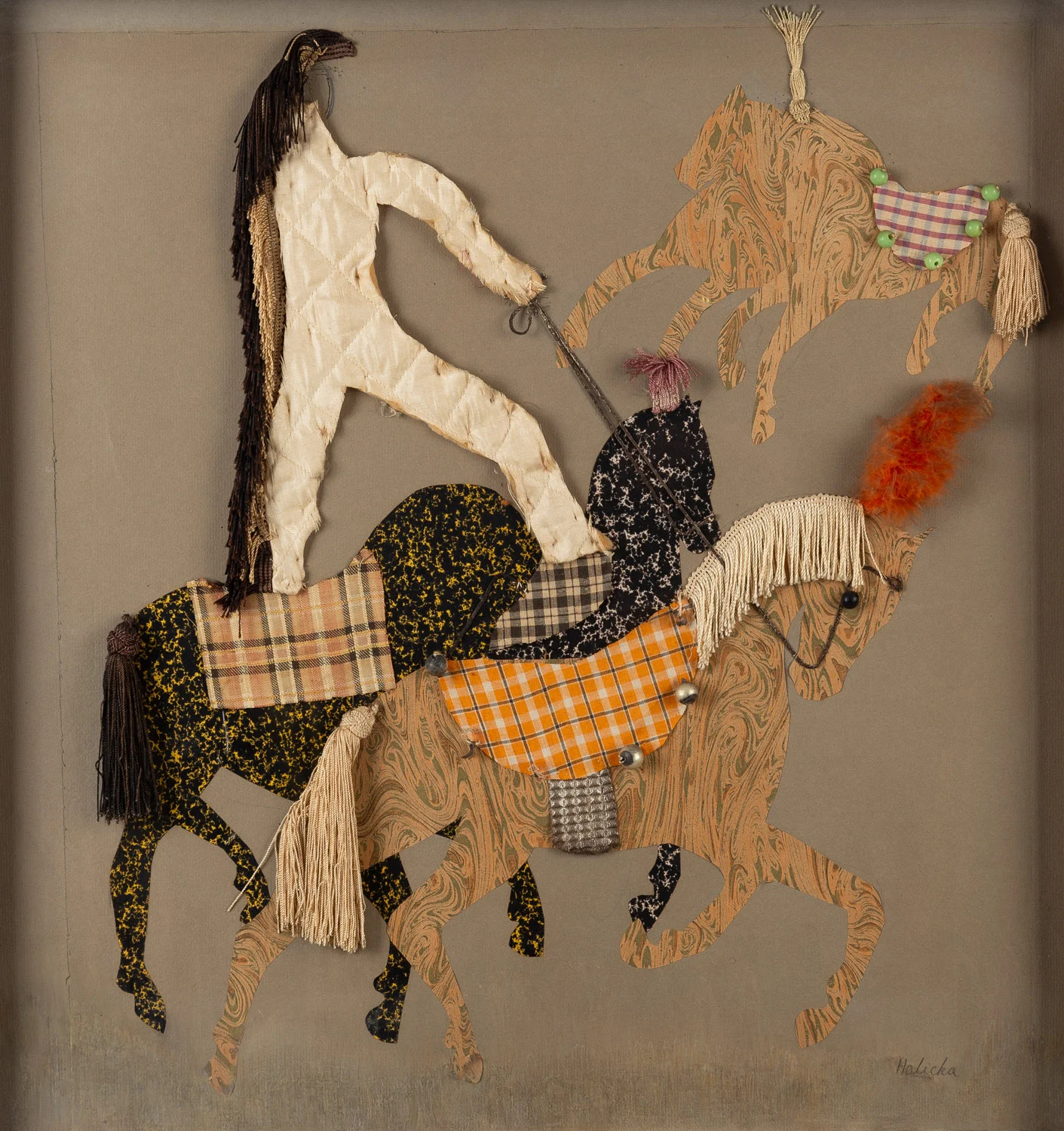
The next exhibition of "Embossed Romances" at the Galerie Georges Petit in 1930 brought even greater success and publicity in the press. Critic Tériade wrote about them: “These ‘Romances' are not, as one might suppose, simple women's crafts. The poetic values that arise from numerous technical ideas involving the amusing combination of materials, colors, and refined details can be placed in a place of honor among the currently fashionable ‘collages'" (quoted in: Mistrzowie École de Paris, text: Krzysztof Zagrodzki, Artur Winiarski, Warsaw 2011, p. 29). Her fabric collages were subsequently exhibited multiple times in London and New York until the late 1930s. They became so popular in the Parisian haute couture circles that they influenced shop window decorations. The scale of the influence of "Embossed Romances" is also evidenced by Suzanne Roland-Manuel's attempt to copy Halicka's ideas while collaborating with Cocteau on New York window displays.