
Edward Dwurnik's Painting Journeys
"When I was young, I drew a lot outdoors. I have depicted so many corners of Poland that if I had to list all the names of cities and towns, it would turn into an index of places in a road atlas. 'Hitch-hiking Journeys' is the most popular series of my work. It all started from my fascination with Nikifor […] I wanted to paint architecture and landscapes as he did, I borrowed his take on perspective and different tricks. I used to travel around Poland with a drawing block. I made a journey à la Nikifor from my hometown of Międzylesie near Warsaw to Międzylesie in Lower Silesia. My father would send me PLN 500 via poste restante, that's what we agreed on. I used to go to the post office and collect my money, that's what we agreed. Of course, I had it a lot easier than Nikifor did, because I lived comfortably in a hotel, whereas he slept anywhere and, instead of taking the bus or the train, he sometimes went by foot. He painted along the way, of course. Me too, it was like a habit, I went on a bender. I would come to town, get off the bus, and immediately sit on the pavement and start drawing."
- Edward Dwurnik. Od początku, exhibition catalog, Małgorzata Czyńska, Wojciech Tuleya [ed.], Warsaw 2016, unnumbered pages
"Hitch-hiking Journeys" is one of Edward Dwurnik's most well-known series and also the one he produced the longest. The main inspirations for the work were the exhibition of Nikifor Krynicki's paintings, which the artist saw in 1965, and the meeting with the master, which took place two years later at the Warsaw Academy. An initial fascination of the young artist turned into a lifelong project. Nikifor was his most important master. Actually, the only one. Dwurnik consciously drew a lot of inspiration from the natural and architectural landscapes made by the artist from Krynica, becoming one of the most important and recognizable creators of contemporary art. He adopted his master's blunt realism and grotesqueness. Dwurnik admired his imagination and never agreed to describe Nikifor's art as "naïve." He had discovered his greatness before anyone else did.
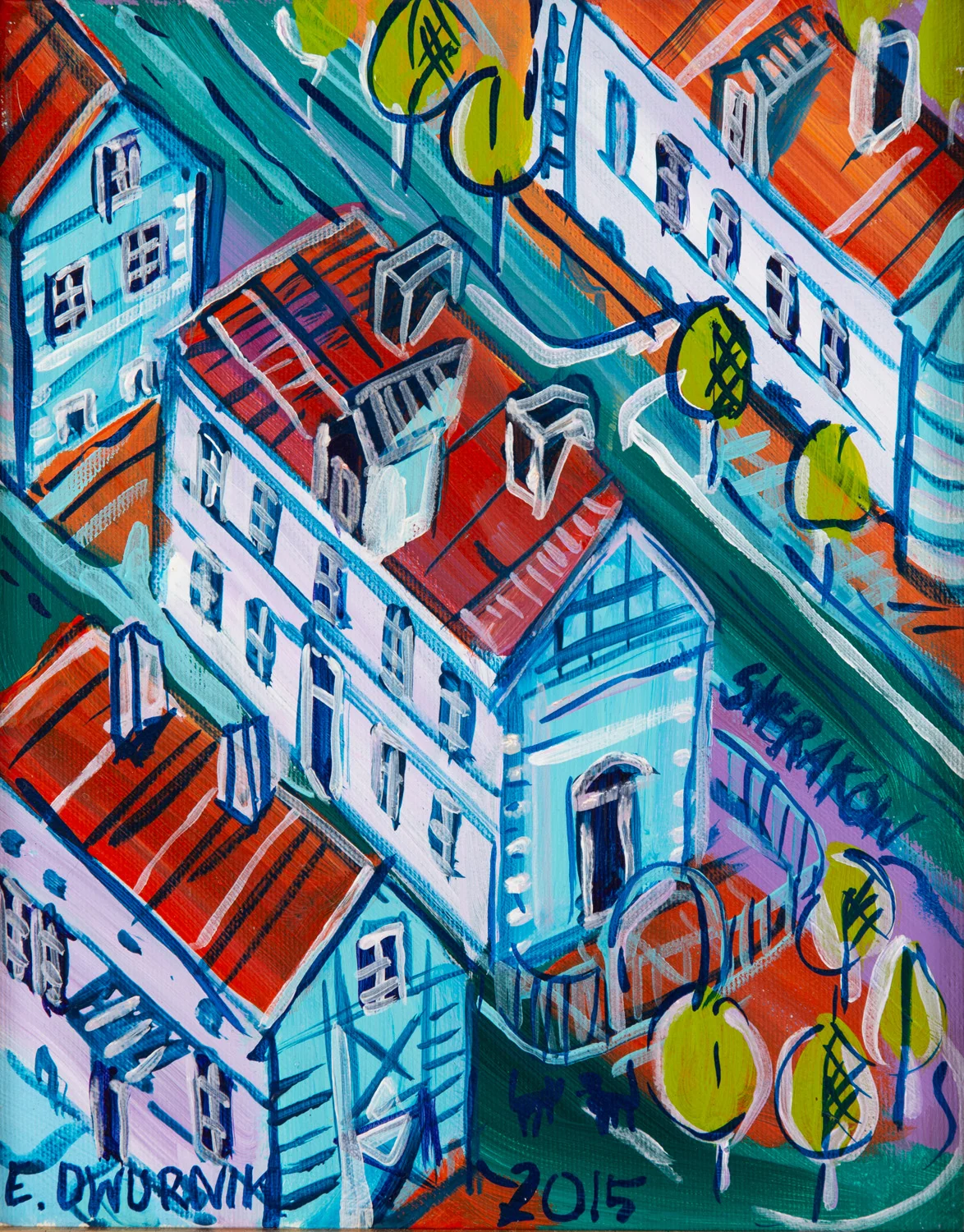
Dwurnik recalled Nikifor's art:
"This is a very simple and naïve painting, some say primitive or tawdry, but that's not true. Nikifor was an excellent colorist. I lived in Józefów for several years, surrounded by wooden houses with wooden verandas in the Świdermajer style, and it all stayed in my subconsciousness so that when I came across Nikifor's watercolors, memories and the environment in which I grew up somehow accentuated the meaning of these watercolors, and they gained even greater importance to me, strongly influencing my psyche. I felt as if I had found something I could call completely mine. That's why I decided to draw and paint like him. A little bit of defiance, a little bit for fun. I strongly identified with him, styled and posed as him."
- Małgorzata Czyńska, Moje królestwo. Interview with Edward Dwurnik, Wołowiec 2016, p. 103.
Edward Dwurnik set out into the world following the example of Nikifor and skilfully documented the places he visited. He began his journey with a trip to Lower Silesia in 1996. The resulting "Hitch-hiking Journeys" series is a record of his countless trips made to all corners of Poland and abroad. In Dwurnik's atlas, we will certainly find the largest metropolises, such as New York and London, but also Polish towns, to which he paid equal attention and – as it seems – was fond of. Dwurnik's vedutas are partly fantastic landscapes with a casual take on perspective and recalibrated elements that the author would like us to pay attention to. They can be approached as tales in which many stories happen simultaneously – heroes visible in towns often appear several times in different places. The paintings also feature characters signed by names known to Dwurnik from everyday life and people known from history, politics, and literature. The architecture itself also plays a significant role in the works from the series. Although the artist had a casual take on this aspect, it was representative of the given area.
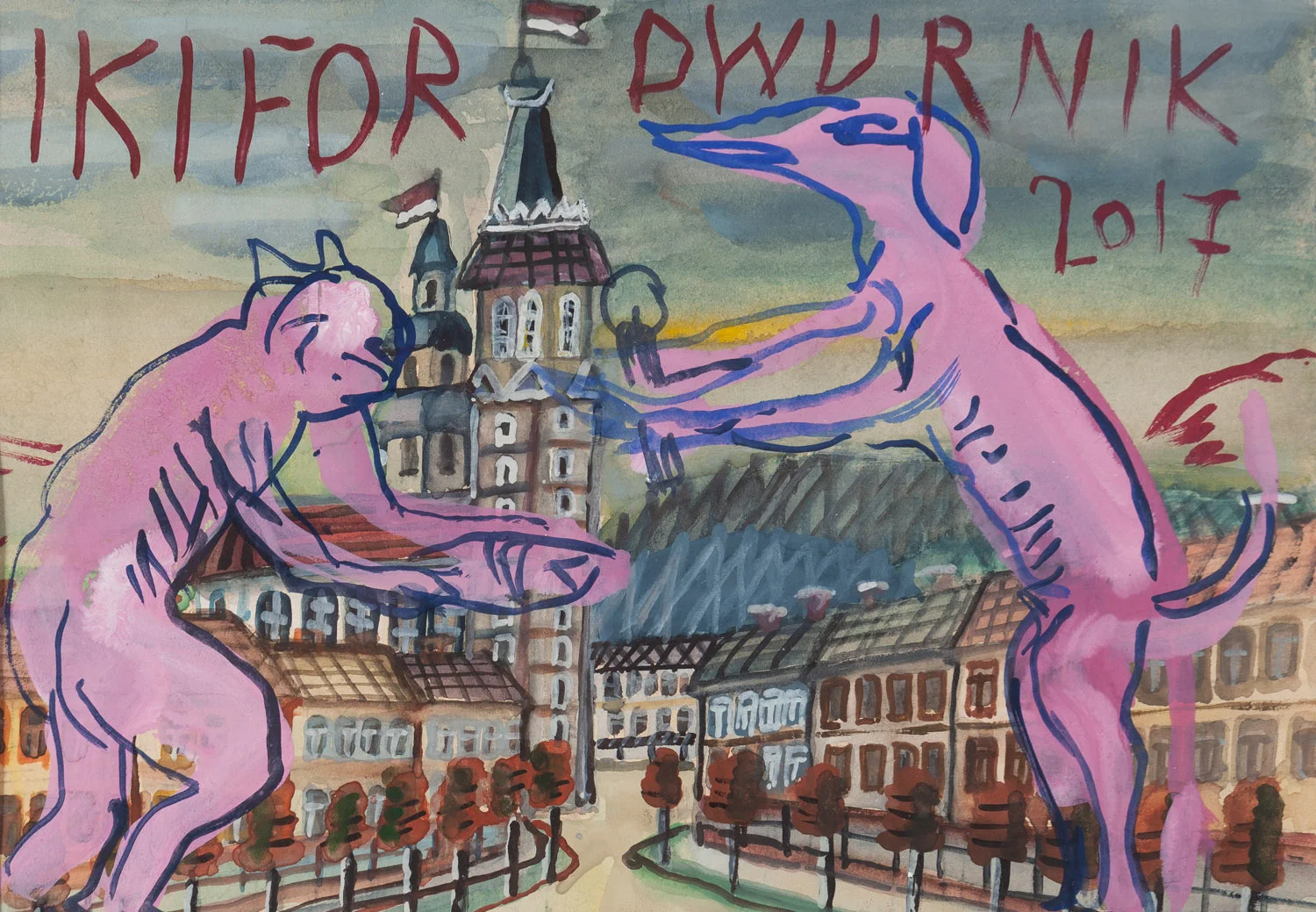
Over the years, the series became an integral part of Edward Dwurnik's extremely rich work, which would be later complemented with subsequent pieces throughout the artist's life. Traveling often constituted the main theme in his art. The paintings from the series present cityscapes from a bird's-eye view. The landscapes are devoid of the horizon line and are full of architecture and people. They do not constitute a faithful representation of urban layouts or topography of given places. The artist chose characteristic spots, changing their proportions, as well as the distances between them. He would make the urban landscape more or less dense, creating works that were a synthesis of magic and reality. However, the schematic representations of city views leave no doubt as to what place they are. The paintings combine the features of documentary and symbolic painting. Aesthetic compositions proposed by the artist and their picturesqueness encourage the viewers to visit a given place.
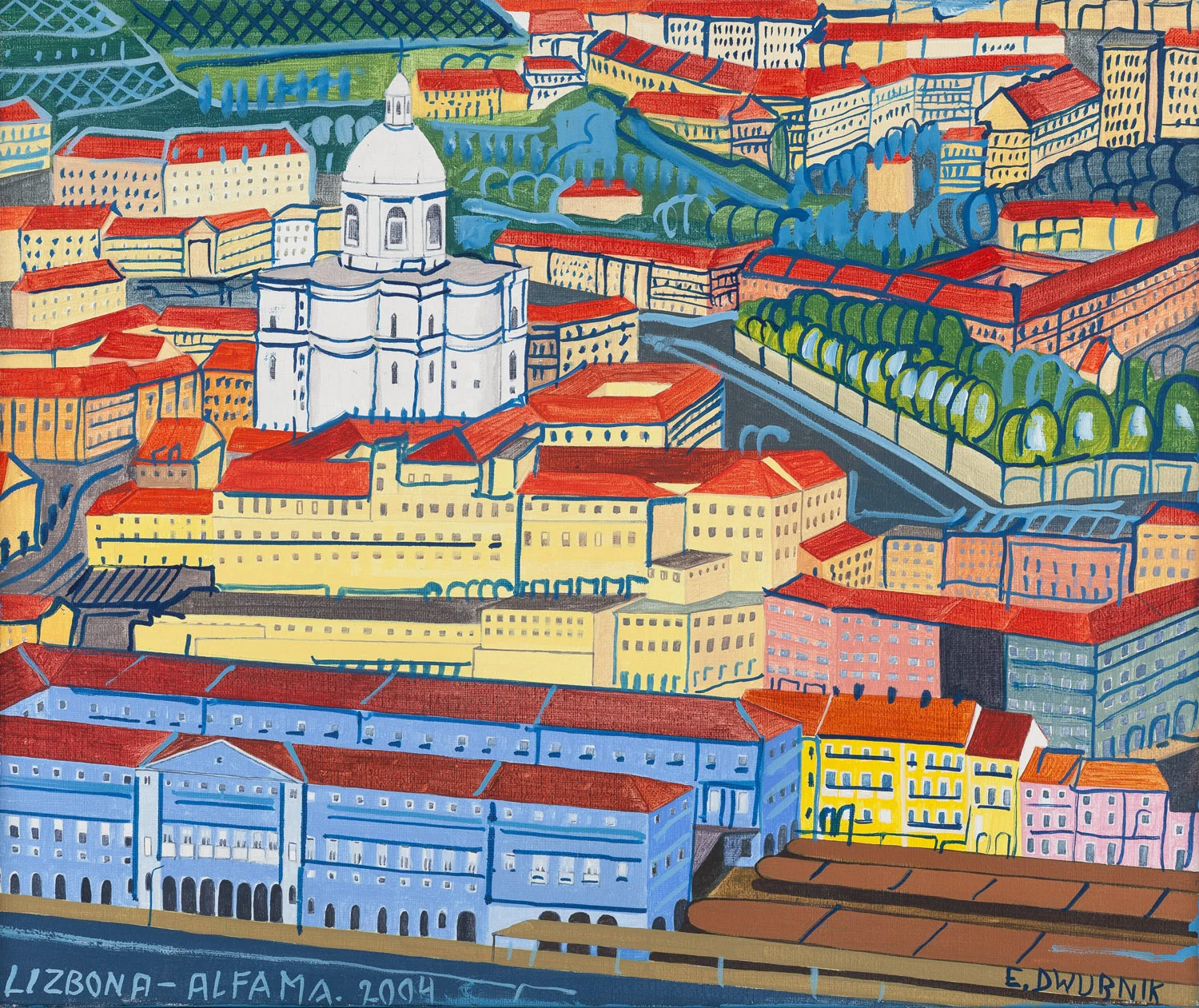
At the current online auction, devoted exclusively to the work of Edward Dwurnik, there are several examples of paintings created as part of this famous series. The painting titled "Lisbon – Alfama" from 2004 is particularly worthy attention as it stands out from other representations of Polish cities and towns. The long stripes of pastel buildings with red roofs surround the old Church of Santa Engrácia, which is now known as the National Pantheon and serves as a memorial to the meritorious Portuguese citizens. It is one of the most important buildings in Portugal, located in the Alfama district of Lisbon. Igreja de Santa Engráa was in construction for almost three centuries. It began in 1681 and lasted until the 20th century. The church was erected on the plan of the Greek cross and crowned with a dome. The building stands out from the background of Alfama and is visible from many spots in Lisbon. No wonder it caught the gaze of the artist who depicted it in his composition.