
Artur Szolc: a multi-talented artist
"The first painting with the 'five' at the front required a different approach from me to the best of my abilities, one that was innovative and perhaps somewhat reflective. After half a century of experience, from the youngest years to today, I believe that neither age nor generational differences pose an obstacle to constructive conversation, which simultaneously leads to the development of the world while preserving, maintaining, and nurturing traditions. So, thanks to the knowledge and experience of our ancestors, it also improves the world. Of course, the best is to find a balance between tradition and modernity. This work is full of symbolism but also open to personal interpretation (…). Moreover, this is also my first painting that can be hung upside down and change its meaning, and consequently, it can be interpreted differently..."
- Artur Szolc
Artur Szolc is an artist of many talents. From early childhood, when he couldn't leave home, he spent his time drawing, and when the weather was good, he engaged in various sports. In the mid-1980s, he started listening to rock and metal. What intrigued him was not only the sound of the music but also the entire stylistic aspect associated with these music genres, such as the dark album covers. It was a true breeze of the West, freedom, which intensified his fascination. Music inspired him to take action, to create new things. During those times, he had three main passions: listening to music, sports activities, and drawing. Art was what allowed him to find peace and look within himself. He started by creating art for his friends. Initially, he painted metal-themed shirts for his friends and landscapes from postcards and outdoor scenes. Soon, a new passion emerged, one that dominated his life. When Szolc went to high school, he began playing the drums in the band Annalist. Life writes interesting scripts, and through music, Szolc met many people who convinced him to start painting and drawing again. He did so, but after a while, painting on canvas and drawing on paper bored him; he wanted to try something new. In 1999, he bought his first tattoo machine and started developing in that direction as well. His career took off, especially in the music field. More albums and bands emerged. His music career demanded his dedication, which left him with less time for painting and drawing. Tattooing also took up a significant portion of his time, and it continues to do so. Szolc is a fulfilled and happy artist, and it's surprising that such a busy person finds the time to paint artworks for our auctions. Fortunately, practically every fantasy art auction features a new and intriguing painting by Szolc. As he claims, his secret is that, regardless of what he does, he does it with enthusiasm because he does what he loves, and he hopes that this passion shows. Painting, music, and tattooing continue to intertwine and complement each other in his life. The artist believes that this is just the beginning, and there are many more wonderful moments ahead related to tattooing, painting, and playing music. Szolc is open to new experiences and connections. He sets a goal to spend time among people frequently because, in his opinion, human connections form the true foundation of his creativity.
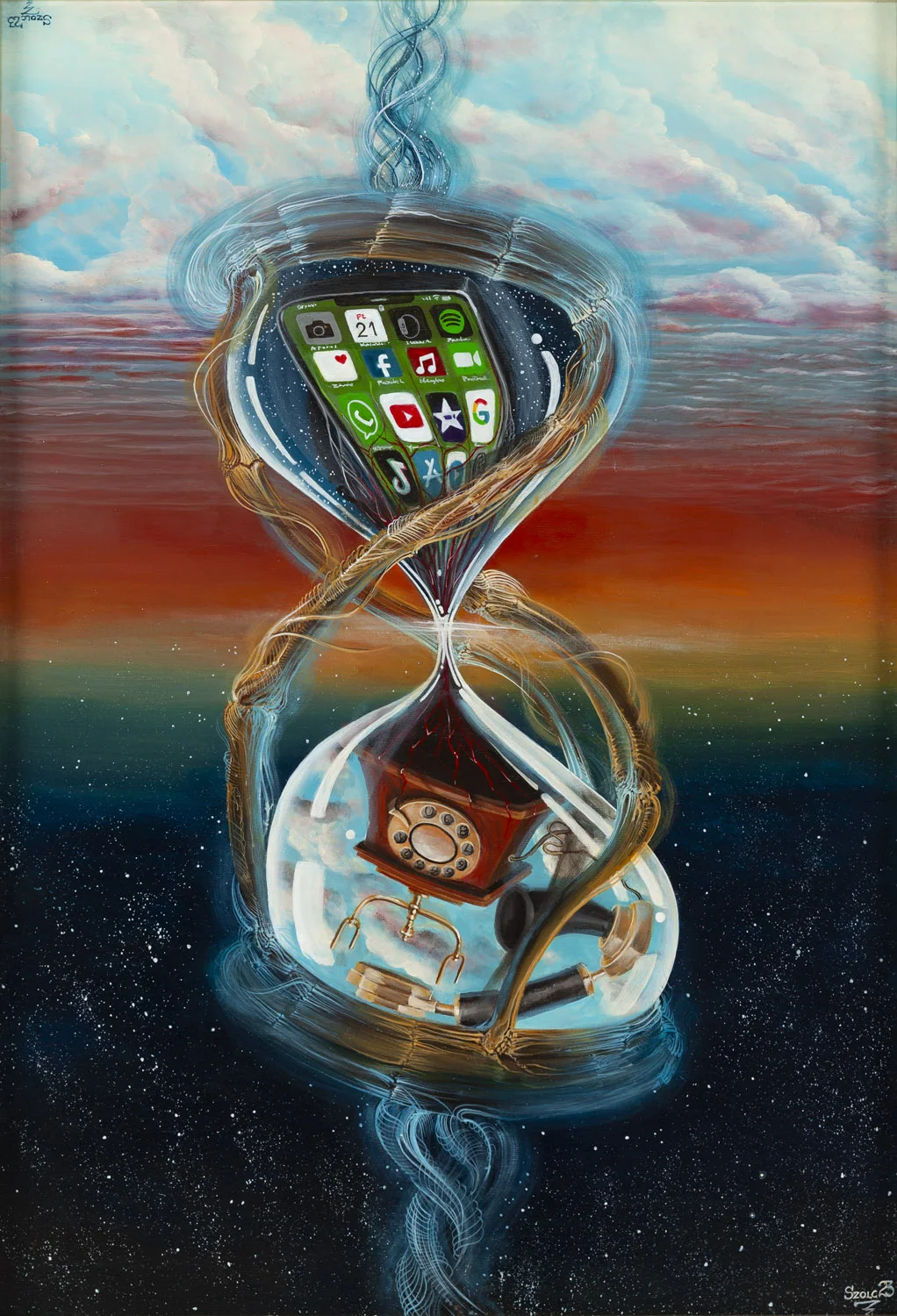
This philosophy of life is also reflected in his latest painting, "The Talk." It visualizes the flow of information between generations. It is a unique work in Szolc's oeuvre. Firstly, it is the first painting created by the master after turning 50, and secondly, it is an artwork that can be hung in any orientation. It is constructed like a playing card and can be rotated. Interestingly, depending on the arrangement, the painting changes its meaning. The work depicts an hourglass (a symbol of passing time) against the backdrop of the Cosmos meeting Earth. In one part of the hourglass is an old-fashioned telephone, while the other part features a state-of-the-art smartphone. Without a doubt, these phones can be seen as symbols of interpersonal communication.
To understand this better, it's essential to clarify what the word "telephone" means. It comes from Greek and is a combination of the words tēle (far) and phōnē (voice). It is an international term, and in languages like Polish, English, French, and many others, it sounds very similar (telephone, telephone, téléphone, etc.). Alexander Bell, often credited with the invention of the telephone (although it's not entirely certain), officially registered it in 1876. However, it was a very simple design and quite different from what we call a telephone today. Bell's first telephone could be assembled even today. It doesn't require special knowledge or tools. A few wires, some vinegar, screws, and a speaker are enough. As you can imagine, the device worked but wasn't long-distance or reliable – absolute silence was required for the recipient to hear the sound. This necessitated improvements. Over the years, renowned scientists (like Thomas Edison) refined the design by adding various elements. Finally, in 1973, a breakthrough occurred. The world's first mobile, wireless cell phone was created. It was presented in New York by John Mitchell and Martin Cooper, engineers from Motorola. The DynaTAC Model 8000x – the name of this innovative phone – weighed about 1.1 kg and cost $3,995. Its battery lasted for half an hour of conversation and 8 hours of standby. Due to its price and size, it wasn't widely used. Humanity had to wait for further innovations. One of the milestone years was 2007 when the first iPhone was introduced. This was the work of the visionary Steve Jobs. On January 9, 2007, he uttered the words: "Today, Apple is going to reinvent the phone." And indeed, he did.
Our smartphones have successfully replaced traditional phones, radios, cameras, maps, and other devices. Unfortunately, with so many new features and apps, we sometimes forget why all these were created in the first place. In essence, the most crucial function of a phone is human contact. This is what Artur Szolc's painting reminds us of. We shouldn't just get lost in what's new. We should also appreciate past inventions and draw knowledge from previous generations.