
Art in the eternal city
"Rome was therefore a place belonging to the past, which was often an escape - for many exiles of subsequent revolutions it was very literal from the present day: the ferment of politics, noise, ugliness and rush of the nascent industrial civilization or even an escape from life, but it was always an escape" towards art " .
"Rome was a place belonging to the past, which was often an escape - for many exiles of successive revolutions it was very literal from the present day: the ferment of politics, noise, ugliness and rush of the nascent industrial civilization, or even an escape from life, but it was always an escape" to art " Artists were especially attracted to it, as evidenced by numerous lists of studios active on the Tiber, from the first nineteenth-century inventory of Giuseppe Antonio Guattani in 1808, through the lists of Giuseppe Tambroni, Enrico Keller, Giuseppe Brancador, Francesco Saveria Bonfigli, and reports successively published in the Roman press. over the years, more and more information about painting and sculpting studies have come and their owners came to Rome from the farthest corners of the world: from Moscow to New York, from Stockholm to the ends of South America. They carried out orders for aristocracy and bourgeoisie, public institutions; in turn, he willingly describes numerous artistic Roman and international press "(M. Nitka, The works of Polish painters in papal Rome in the 19th century, Warszawa-Toruń 2014, p. 11).
Wilhelm Kotarbiński arrived in Rome in 1872 after completing his education in the Warsaw Drawing Class, under the supervision of Rafał Hadziewicz. In order to go to Italy, the young artist took out a loan from his uncle and applied for a scholarship to the Society for the Encouragement of Fine Arts in Warsaw. However, the accumulated funds were still very low and Kotarbiński faced poverty in Rome. In the Eternal City, the artist was admitted to the Academy of Saint Luke. He became involved with the milieu of Polish and Russian emigration. Initially, the Polish artist used the atelier on Via Margutta. After graduation, Kotarbiński rented his own studio in Via di San Basilio on the Quirinale. "During his 16 years in the Eternal City, Kotarbiński gained recognition from collectors and art lovers, despite the fact that his beginnings were very difficult, mainly in material terms. Paweł Swiedomscy. Educated in Düsseldorf and Munich, the Swiedomski family supported Kotarbiński financially, carrying out many interesting artistic projects with him in later years "(Goch (2015: 37–42)
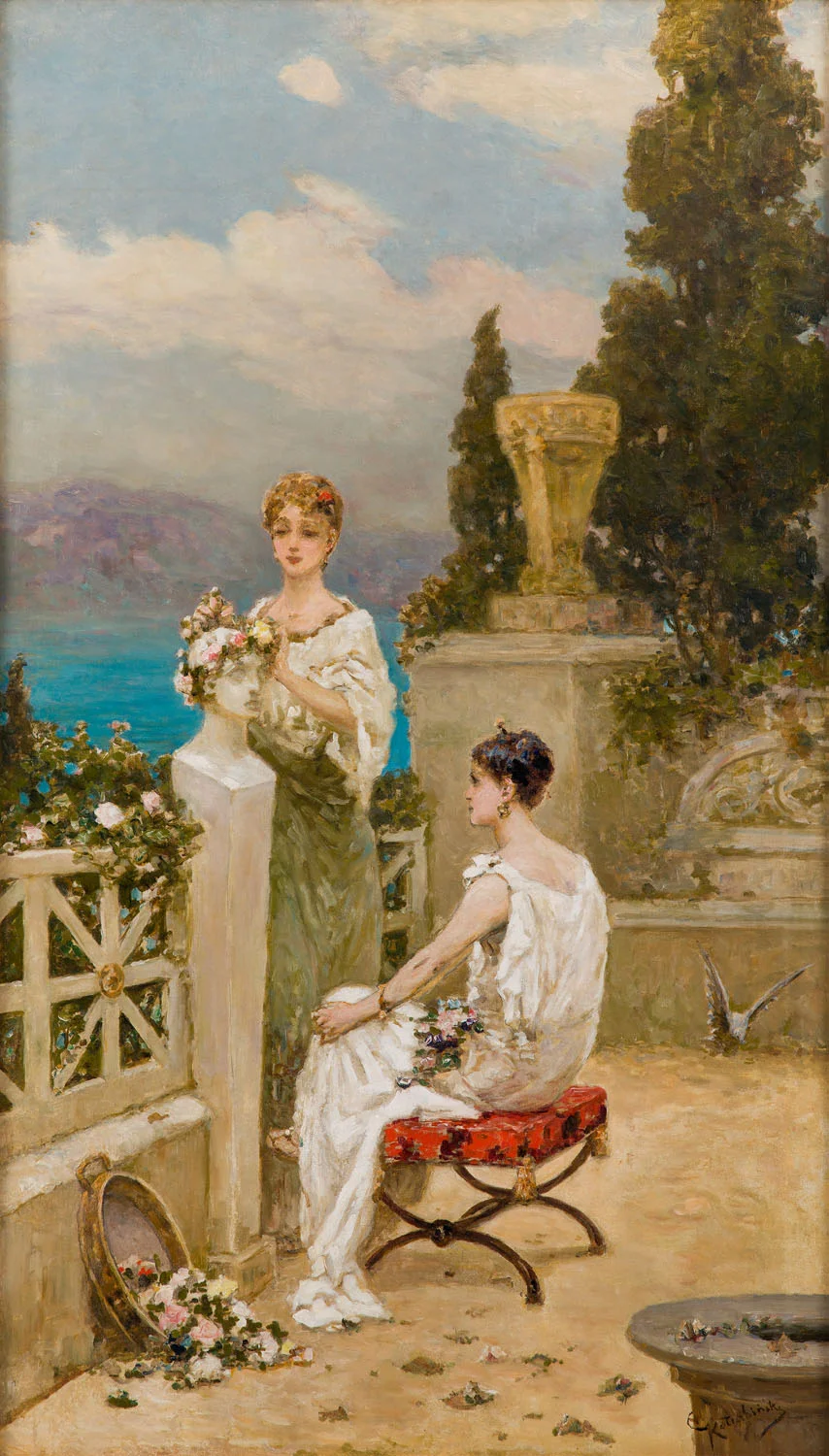
The presented painting is an excellent example of the mainstream work of Kotarbiński. Kotarbiński's art was highly decorative, perfectly matching the tastes of the Russian bourgeoisie. The artist at the turn of the 1870s and 1880s developed his own individual style. While working in Rome, he primarily created genre scenes, often - following Siemiradzki's - using biblical and antique costumes, or referring to Italian culture. His paintings show the knowledge of the rules governing academic art and his extraordinary compositional ability. The works are characterized by the virtuosity of the finish and the rich and very subtle palette of colors. Thus, Wilhelm Kotarbiński used the idea of his epoch, which, wishing to restore the spirit of the antiquity, promoted the value of contact with nature and the essence of aesthetics in everyday rituals.
The popularity of the theme of the ancient idyll in the academic painting of the nineteenth century is explained by the theory of interpreting antiquity as the golden age of civilization. The longing for a harmonious epoch, expressed in idyllic genre scenes from the life of the ancients, was an attempt to restore the Apollonian ideal of beauty and human harmony with the world of nature. The people of the nineteenth century were convinced that the world of antiquity was heading towards carnal, external, pagan beauty, and the paintings depicting scenes, most often genre, from the Greco-Roman times should, in a way, directly transfer this element to the present day. Ancient "idylls" are therefore cheerful genre scenes maintained in a carefree atmosphere, presenting characters engaged in rather trivial activities. Naturalistically depicted characters most often indulge in trivial activities, and the scenes mostly take place on the shaded terraces of patrician palaces or surrounded by Mediterranean cliffs and hills. It seems that the painter deliberately deprived the characters of the psychological aspect, the emotional element, thus preventing the brutality of the real world from penetrating into Arcadian scenes. Saturated with light, consciously conventionalised compositions, through their plasticity, affirm the simplicity of life and the beauty of nature.
During the peak of Wilhelm Kotarbiński's artistic activity, St. Petersburg critics and audience split into supporters of Kotarbiński and Siemiradzki's painting; the latter was an equally important and outstanding representative of academic painting in the "ancient idyll" trend, working on similar themes and painting themes. In 1880, the artist found himself in the orbit of the eminent Russian art critic and historian, Vladimir Stasov, who was a strict judge for both Henryk Siemiradzki and Wilhelm Kotarbiński, being faithful to the realistic genre.
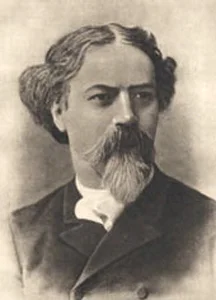
Kotarbiński, after a several-year stay in Rome, stayed in Kiev, which means that in Russian literature he is sometimes depicted as a Russian or Ukrainian painter. Kotarbiński, however, always signed his works using the Latin alphabet. Although this procedure gave him clients in Western Europe, it also caused trouble in tsarist Russia. The clash that took place between Kotarbiński and Pavel Tretyakov, the founder of Moscow's most important contemporary art museum, is especially known. Tretyakov, having purchased Kotarbiński's painting, asked him to change the signature to the Cyrillic alphabet. Kotarbiński replied by letter: "I always sign like this and for the sake of money I will not modify my signature. You are buying a painting, not my signature".
He lived in Kiev until the end of his life. He survived the difficult years of the Russian Revolution of 1905, World War I and the October Revolution, which resulted in the creation of the Ukrainian Soviet Socialist Republic in 1919 (until 1934 with its capital in Kharkiv). Probably after the end of hostilities in 1918, Wilhelm Kotarbiński intended to return to Warsaw and his already independent homeland - he started by packing and shipping most of his canvases, but they never reached Poland; the artist himself did not come back. He died forgotten and poor in 1921 in Kiev.