
Art for toothache
In 1984, Andy Warhol created a series of four screen prints dedicated to the martyr and patron saint of dentists, Saint Apollonia. Each print in the series depicts a portrait of the saint martyr tortured by an Alexandrian mob in Egypt during the 2nd century.
The story of Saint Apollonia's death can be found in a letter by Saint Dionysius the Great, which describes the massacre of Christians in Alexandria that took place on the day the millennium of Rome was celebrated. During this time, Christians in the city were attacked by followers of other religions. One of the victims of this massacre was Apollonia, who died for her faith. Historical sources indicate that at the time of her death, she was an elderly woman, although Renaissance iconography often depicts her as much younger than she actually was at the time of her death. It is believed that Saint Apollonia was tortured by having her teeth pulled out, which is why Warhol portrayed her holding her attribute, a pair of pliers, in this complete set of prints. In iconography, Saint Apollonia is also depicted with a crown, book, palm of martyrdom, or with the pyre on which she was burned. She is traditionally considered the patron saint of dentists, and her images can be found in many dental offices and on university campuses training dentists.
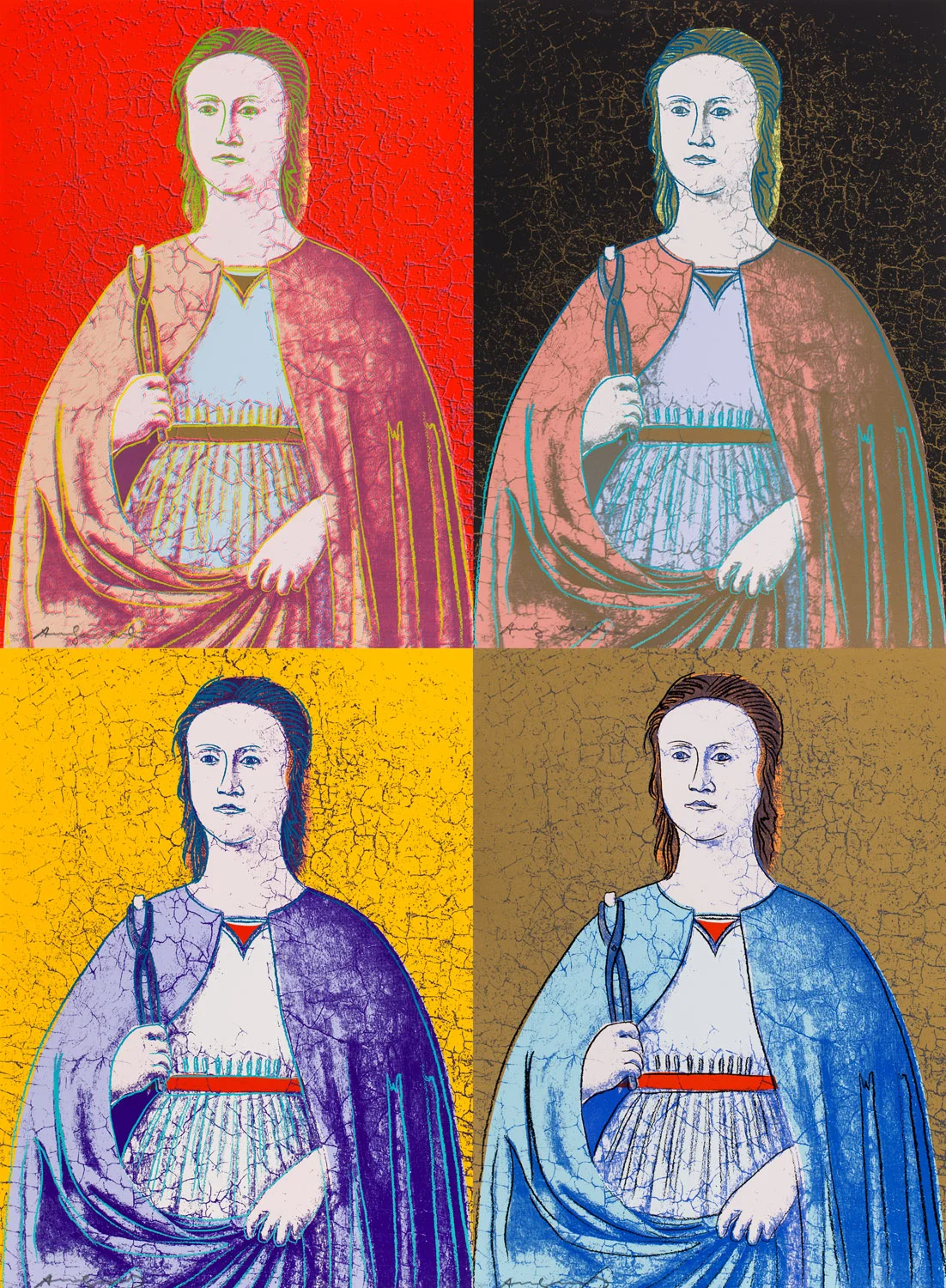
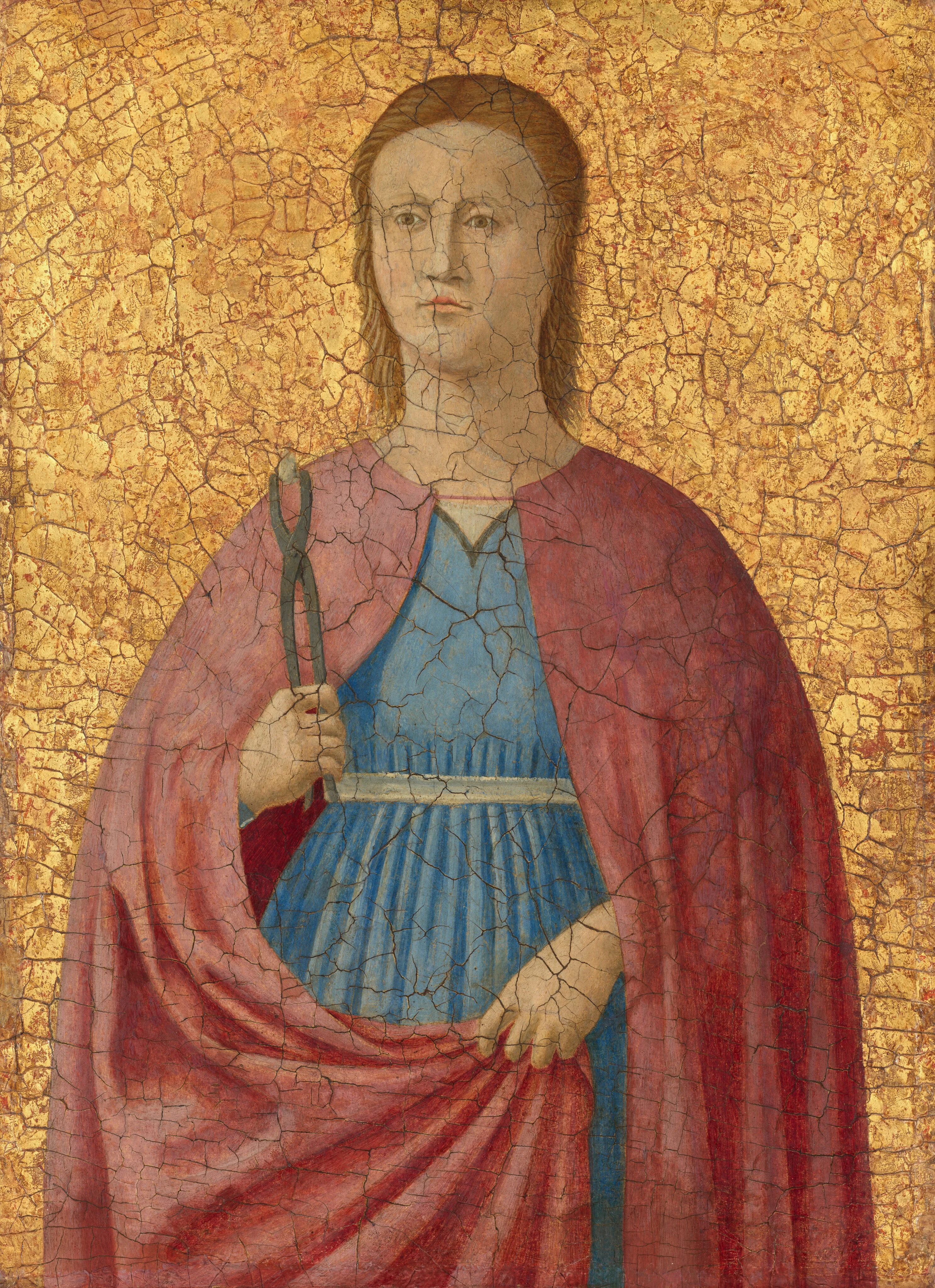
The prints in this portfolio are directly inspired by the portrait of Apollonia created by Italian painter Piero della Francesca between 1455 and 1460. The original tempera painting attributed to Francesca is housed in the National Gallery of Art in Washington, D.C. This artwork depicts Apollonia with a stern expression on a gold background. Over time, the drying paint left characteristic craquelures. The small cracks on the surface of the painting formed a dense network over the image of the patron saint of dentists, creating a kind of raster. Warhol was deeply impressed by the distortions left by time on the painting, so much so that he decided to replicate them using the screen-printing technique. While the artist often distorted, reworked, and interpreted his images, in the case of Apollonia, he aimed to faithfully reproduce the three-dimensional cracks on the surface of the painting. Warhol's screen prints from this cycle also feature characteristic shifts and a certain roughness at the edges, which is intended to convey the depth of the paint cracks on Piero della Francesca's painting. Reproducing such cracks in screen printing requires exceptional technical skill from the printer, who must very precisely align the successive screens. Warhol also refrained from cropping the image, maintaining the original proportions of the original. Noteworthy are the color combinations proposed by Warhol. Besides the work on a gold background, he suggested black, red, and old gold. In each version of this cycle, Warhol presents the saint against a vivid background, perfectly capturing the spirit of pop art. Warhol also used bright outlines, which emphasize the saint's facial features and highlight the texture of her clothing and the cracked background. Despite Warhol's use of bold colors for the background, the palette he employed to depict the saint is much more subdued, which contrasts with other prints from this period, especially the Renaissance screen-print series, in which the artist used popular motifs from 15th-century Italian painting, creating semi-print collages. In the case of Saint Apollonia, however, the artist chose to faithfully render the image of the martyr, also striving to preserve the original colors.
In popular culture, the artist is primarily seen as the father of pop art, a dandy, provocateur, and profit-driven egocentric. Few people, however, realize that Andy Warhol was a highly religious person who tried to keep his rich spiritual life hidden until the end. Warhol died in February 1987 from a heart attack and was buried next to his parents in the Byzantine Cemetery of St. John the Baptist in Bethel Park, Pittsburgh. His funeral, as per the artist's wishes, was modest, but the farewell ceremony held on April 1, 1987, in New York attracted crowds. It was at this time that Warhol's religiosity was publicly revealed for the first time. John Richardson, a friend of Warhol, in his eulogy at St. Patrick's Cathedral in Manhattan, mentioned that the king of pop art prayed almost daily at his parish of St. Vincent Ferrer on Lexington Avenue, kneeling in the church porch. Warhol was also very active in supporting New York's homeless. Warhol's apartment was filled with religious-themed paintings, mostly by Pre-Raphaelites, and the religious themes were frequently discussed by the artist with his friends. It is often believed that Warhol's screen prints using religious motifs were primarily created for purely aesthetic reasons. Although the artist never directly addressed issues of faith, in the context of his biography, many scholars believe that they should also be interpreted on this more personal level.