
Andy Warhol's Fruits
Warhol, the son of Slovak immigrants, was born in Pittsburgh, Pennsylvania. He became the founder and leading representative of Pop Art in the United States. The basis of his success was his analysis of the patterns that governed American society. Although his art may seem primarily an unrefined manifesto of capitalism, it conceals a long-term observation of the developing American culture. Warhol highlighted cultural clichés that defined American culture of that time, along with the development of films, advertisements, and celebrities. He often remarked, "I think everybody had an impact on me. But that's good. That's what pop is."
The genius of Andy Warhol was shaped in his childhood and by a very close relationship with his mother. She introduced him to the world of art, and they spent every free moment cutting pictures from colorful magazines and creating various collages. Soon, his talent was noticed by editors of New York magazines, with whom Warhol had contact shortly after completing his design studies at Carnegie Mellon University in Pittsburgh. He received subsequent commissions from music labels and theaters. He spent his free time experimenting with various printmaking techniques, with screen-printing gaining particular recognition.
Warhol's portfolio titled "Space Fruits Still Lifes" dates back to 1979. It belongs to the less common still lifes by Warhol, alongside sets of works like "Skulls" and "Flowers," serving as an example of Warhol's work with this classic painting theme. The portfolio consists of six representations of fruits placed against strongly color-saturated backgrounds.
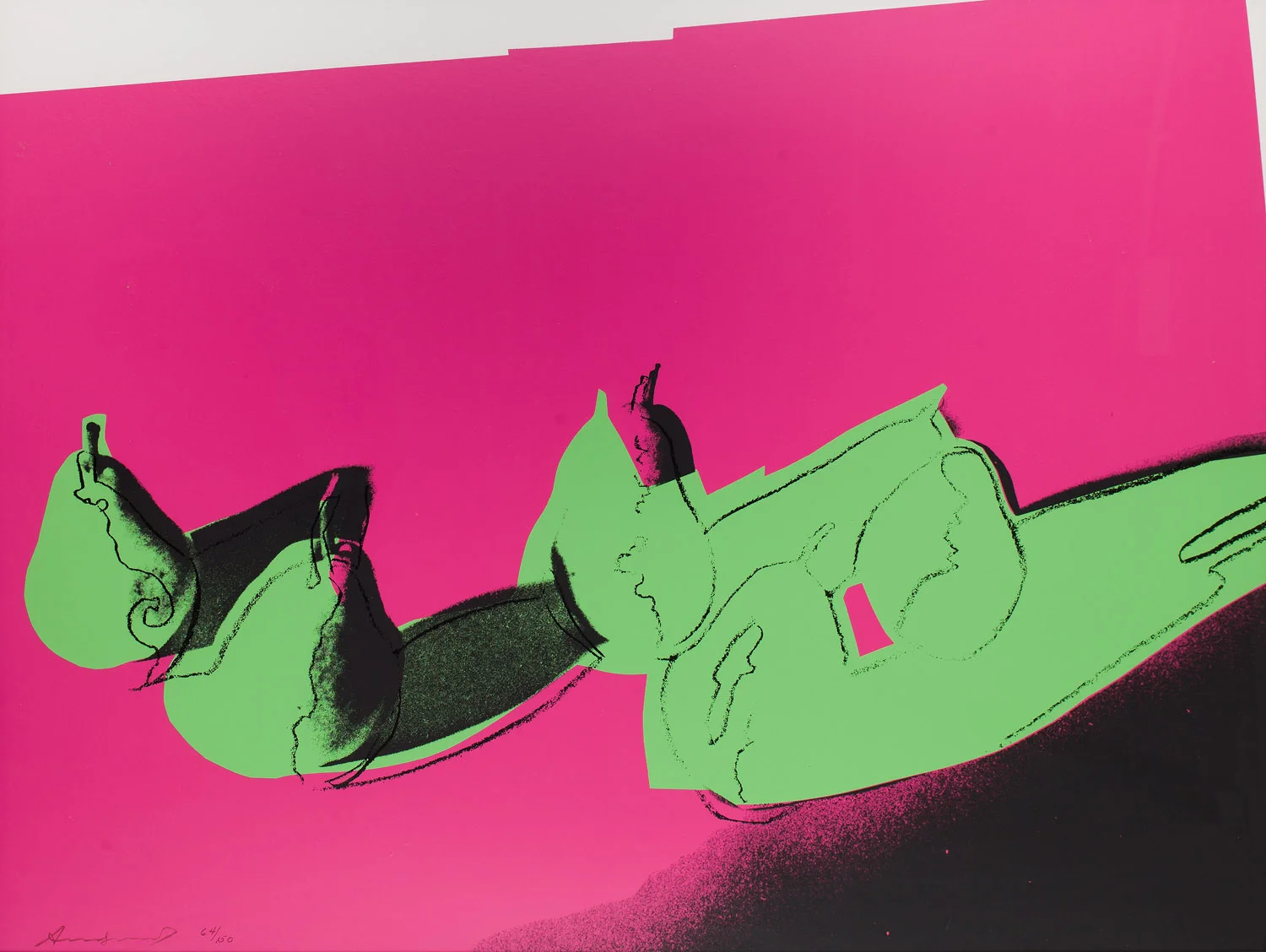
Warhol initially placed his fruit paintings on a white background and used focused light directed at objects from various angles to intensify and play with shadow, composition, and color intensity. This arrangement was later photographed and used as a reference point for creating silkscreens. There are certain similarities between still lifes and other Warhol series depicting portraits or consumer products. Warhol's compositions are arranged in a somewhat staged manner, and Warhol himself creates scenes on which he places his actors. This choreography of the presentation on the canvas is intended to evoke a specific reception from the viewer. Hanging objects in space is also his trademark, and a common feature of his prints is the difficulty of determining the size of the displayed representations. Warhol's fruits seem much larger than they were actually presented on paper. In this respect, the title "Space Fruits" alludes to this suspension in space. The Cold War space race, which is also an inherent element of American culture in the second half of the 20th century and a significant inspiration in Warhol's work, is often invoked here. Indeed, the artist's fruits resemble meteors, planets, or moons scattered in a colorful, abstract cosmic space. Interestingly, despite the use of silkscreen technique, the overall depiction may suggest the use of collage, further emphasized by irregular lines drawn by hand and rendered in the silkscreen technique. This technique combines three artistic realities. Warhol first uses photography as a base for creating silkscreen prints. Silkscreen prints, in turn, carries the reflected hand-drawn trace of the artist in the form of printed irregular lines surrounding the fruits.
Space Fruits were printed on Strathmore Bristol paper. Each reproduction from the portfolio was signed and numbered from a limited edition of one hundred and fifty copies, plus one printer's proof, and an additional 30 numbered with Roman numerals printed on Lenox Museum cardboard. These are some of the less common prints on the market by the master of Pop Art.