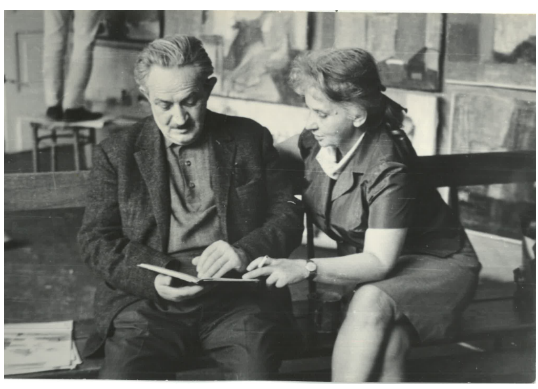
Andrzej Jurkiewicz: A Versatile Artist
What connects the works of Tadeusz Makowski, Zygmunt Waliszewski, and Japanese calligraphy? The figure of Andrzej Jurkiewicz-a versatile artist, educator, author of the "Handbook of Methods of Artistic Printmaking," and winner of Polish Olympic competitions in the field of printmaking. While the prints depicting various Olympic disciplines brought Jurkiewicz the most fame, his creative output was much broader, engaging in dialogue with various phenomena in Polish art, far beyond the narrow specialization of printmaking. The artist primarily referred to himself as a painter.
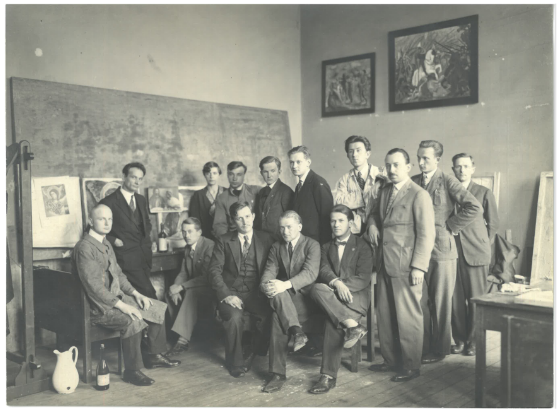
The belief that all forms of artistic expression stem from painting, which lies at their core, was the credo of Jurkiewicz's work. Although he taught printmaking techniques at the Krakow Academy of Fine Arts, he opposed separating printmaking studios from painting studios within the academy's structure. He saw printmaking as a complement to artistic education, not as an exclusive specialization. As a printmaking artist, he saw himself as a continuation of the 19th-century tradition of the peintre-graveur, originating from Józef Pankiewicz. According to this tradition, printmaking moved away from its utilitarian function as illustration and reproduction to become an autonomous work of art. In their prints, artists aimed to convey, similar to painting, light and shadow modeling and spatial relationships within compositions, giving them a "painterly" quality. This stance was in opposition to the influential community of Warsaw woodcut artists, organized in the "Ryt" Association, who emphasized the close connection of printmaking with book art, posters, and typography. A similar approach was taken in the studio of Władysław Skoczylas at the School of Fine Arts in Warsaw, where the craft and utilitarian character of printmaking were emphasized.
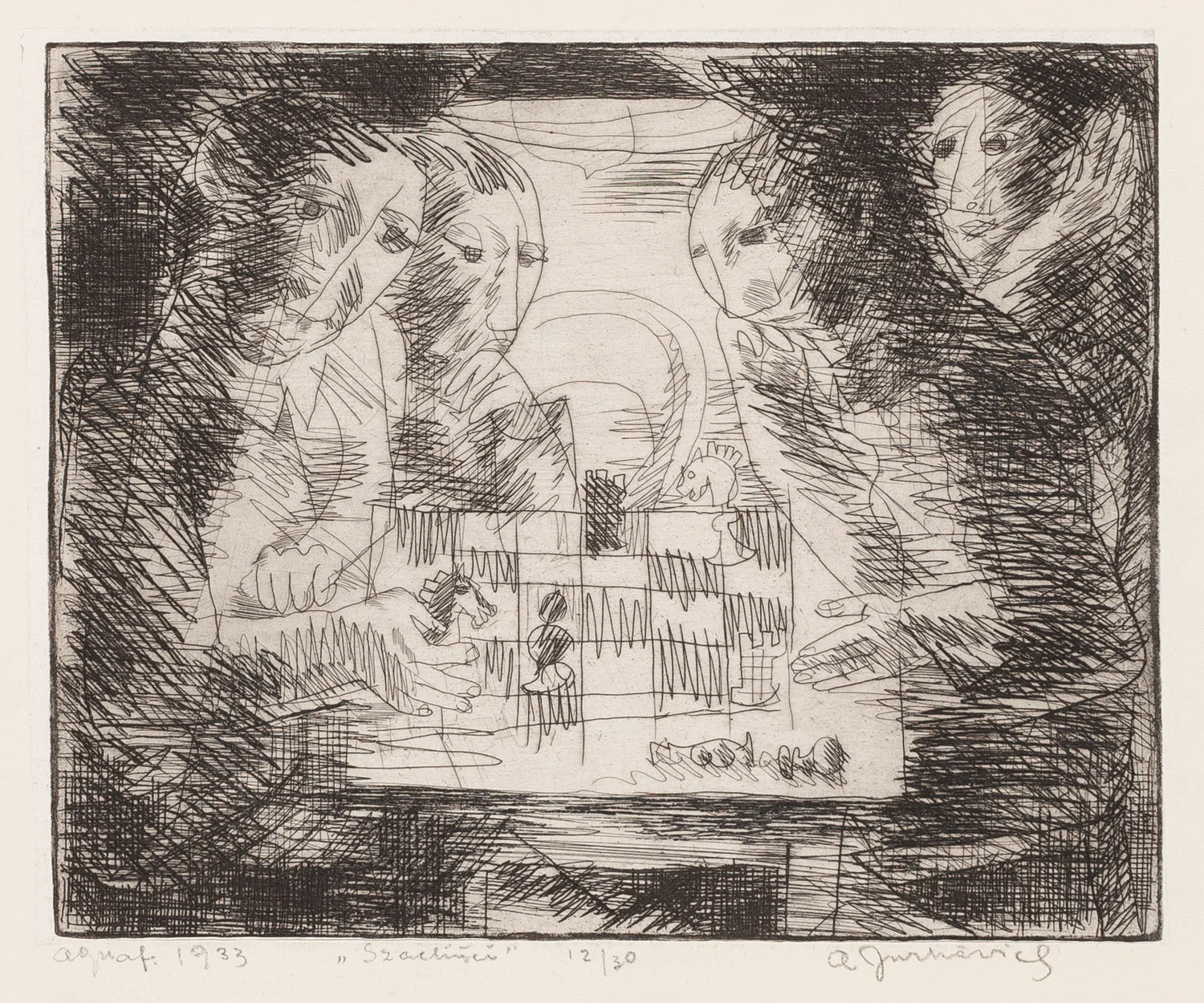
Andrzej Jurkiewicz's early works, until around 1937, were primarily dedicated to printmaking. This period culminated in his first and only solo exhibition during his lifetime at the Czesław Garliński Salon in October 1937, where critics praised his etchings with a distinct, individual expression depicting genre scenes, often with an ironic or grotesque undertone. Jurkiewicz was hailed as a chronicler of urban and street scenes. He depicted jovial men stumbling out of bars, a dubious character with a cigarette earning his living by shining shoes, chess players focused on their game in a dimly lit room illuminated only by a bulb over the chessboard, or cheerful carolers with a Nativity scene. The slightly geometrized silhouettes and faces of his characters echo the work of Tadeusz Makowski. These works feature a characteristic nervous, dense line with which the artist indicated light and shadow modeling. His etchings are distinguished by the freshness and lightness of the line, the character of a work created alla prima.
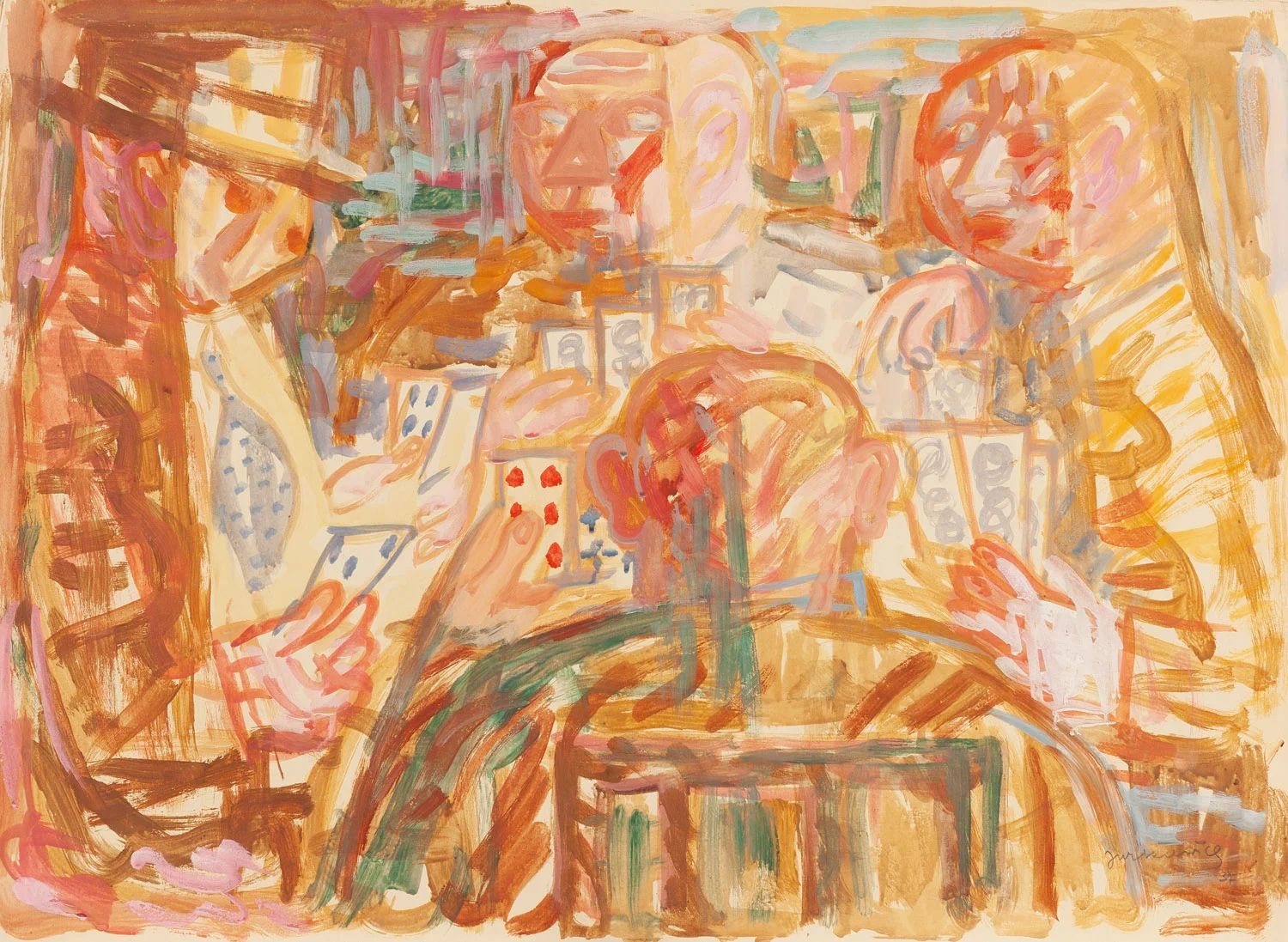
In the latter half of the 1930s, until around 1948, the artist experimented in his works with the methods of the "Kapists," who were returning from Paris to Poland, spreading the concept of "pure painting." The works of Zygmunt Waliszewski had a particularly strong influence on him. The evolution of Jurkiewicz's work towards colorism was not surprising, as this style became "mandatory" in Polish art, taking root in the academies that trained subsequent generations of colorists. However, Jurkiewicz not only applied the principles of this style to create oil paintings and gouaches but also used its rules in printmaking, striving to convey the aspect of "painterliness" in black-and-white prints. This was an innovative approach that found virtually no imitators. Jurkiewicz remained the only one of the younger generation continuing the tradition of painting-printmaking artists.
By the late 1940s, Jurkiewicz began to break away from the principles of the "Kapists." He abandoned the effects of painterly texture, introduced grays and sharp color dissonances into his paintings, and synthesized forms by applying flat areas of local color with clearly emphasized contours. The artist was increasingly interested in issues of drawing and form composition rather than color itself. At the same time, he created entire series of drawings, gradually eliminating unnecessary elements and refining the stroke, achieving a clear, economical composition that maintained a defined linear form. Despite its synthesis, it retained a clear connection to the original concept. Between 1948-1955, drawing, which had previously played a subordinate and supporting role to printmaking arts and painting, became Jurkiewicz's dominant form of artistic expression. In pen and ink drawings, he returned to earlier genre themes and also drew interiors with still lifes, nudes, and landscapes from outdoor sessions in Głębokie. His drawings were created as if he was writing, not drawing, with a single, confidently drawn contour characterized by distinctive breaks and fluctuations, forming his unique handwriting.
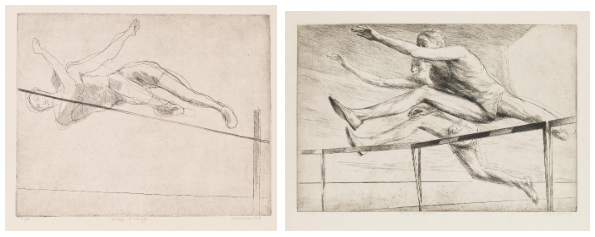
Approaching the Polish Olympic art competition in the field of printmaking in 1948, Jurkiewicz faced the challenge of transposing movement into the inherently static medium of visual arts. This issue had already been troubling him in his pre-war works, where he depicted the lively, changing, and dynamic reality of the city streets. In his competition works, he captured figures from different perspectives: slightly from below, above, diagonally, in unusual foreshortening, using the American shot, and also framing in a reportage style, occasionally cropping parts of the Olympians' legs or arms. Furthermore, to convey movement, he multiplied the contours of figures and skillfully manipulated light. In his 1930s etchings, he had already mastered the technique of subtly diffusing light evenly across the entire composition, without departing from the linear specificity of etching, enhanced by appropriate tonal gradation in the prints.
Jurkiewicz's series of Olympic prints, including "High Jump," was appreciated by the jury, which awarded him one of the three first prizes in printmaking. This series was later frequently exhibited in representative exhibitions of Polish prints abroad and mentioned in general studies on Polish printmaking. The artist's success was repeated in the next competition before the Helsinki Olympics in 1952, where he again won first prize. The second series of works was characterized by a more detailed treatment of the Olympians' faces, a higher degree of background refinement, and stronger light-shadow contrasts. Additionally, it won third prize at the Polish National Printmaking Exhibition in 1952/53.
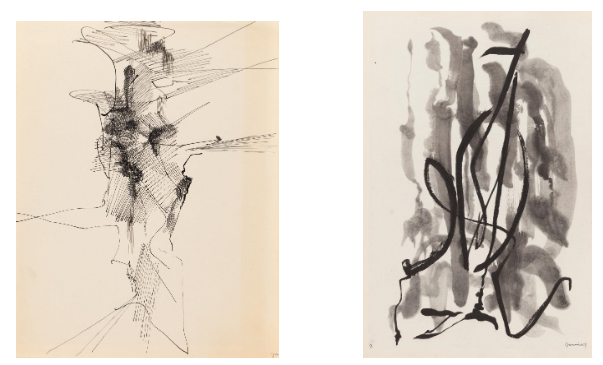
Since the 1950s, printmaking occupied less space in Jurkiewicz's work in favor of painting and drawing. The artist aimed to formulate pure abstraction, derived from the very process of creation and cleansed of any extraneous meanings. This path led him through a long journey, beginning with allusive abstraction, in which motifs can be interpreted based on familiarity with his earlier works. The second stage was a series of works where he experimented with issues of movement, space, and light, while in the final stage, even these concepts were eliminated.
Towards the end of his life, the artist began creating another intriguing series of works reminiscent of abstract Japanese calligraphy. This was ink painting on Japanese paper mounted on cardboard or canvas backing. However, the inspiration from Far Eastern art was quite loose and limited only to technique. These works had nothing to do with ideograms, signs, or traces of gestures; instead, Jurkiewicz returned to the problem of movement and its associated spatial problem. He contrasted a diffuse, lighter stain with a sharp, darker line, creating around and between them a painterly illusion of space, and arranged lines to create directional tensions suggesting the movement of forms, as well as the displacement of surroundings and background.