
A Panorama that never came to be
Michał Gorstkin Wywiórski was born in 1861 in Warsaw to a Polish-Russian family. His father was a Russian officer, Piotr Gorstkin. Before embarking on his painting career, he studied chemistry at the Polytechnic in Riga from 1881-82, where he participated in the activities of the Polish patriotic fraternity association Arkonia. An illness that interrupted his studies and forced him to return to his homeland led to a career change for Gorstkin, who started studying at the Munich Academy in 1883 under the tutelage of Karl Raupp and Nikolaus Gysis. Simultaneously, he studied painting in the private studios of Józef Brandt and Alfred Wierusz-Kowalski.
Gorstkin Wywiórski was one of the most important Polish representatives of the Munich School, a group of artists focused on realism close to academicism. His wide-ranging artistic interests, from favorite maritime themes to landscape painting, for which he received a second-class medal at the Munich Glaspalast for his painting "From the Lithuanian Forest" in 1894, to works with oriental themes, make him an extremely versatile artist. Gorstkin Wywiórski drew inspiration from numerous travels during which he studied the subjects of his works. He visited Polesia, Lithuania, the German island of Sylt, Italy, Spain, and the coasts of the Baltic and North Seas. One of his most important journeys was to Egypt in 1900-1901 with his friend Wojciech Kossak. This trip resulted in sketches with oriental themes, which became the basis for creating the monumental panorama "Battle of the Pyramids," for which Gorstkin Wywiórski painted the landscape sections.
The artist collaborated with Wojciech Kossak earlier on another significant project – the Panorama of Somosierra. This work was intended to be a sort of response to the Lviv Panorama of Racławice, an equally grand example of historical painting. The topic of the famous battle from the Napoleonic Wars, which featured Polish troops, was a natural choice-it allowed for the ostentatious presentation of a universal historical theme, which in reality was a patriotic manifestation, co-financed by wealthy Polish capitalists including Edward Herbst, Edward Krasiński, Ludwik Żarnowski, and Edward Reicher. An important argument was also the strong grounding of this battle motif in the tradition of Polish painting (most notably depicted by Piotr Michałowski in his famous 1837 work). Wojciech Kossak was the first to tackle the theme, using a wide range of historical sources and studies. He also traveled with Gorstkin to Spain to conduct field research in the area where the battle took place. Four monumental sketches by Kossak and Wywiórski were created, but the project was halted by Russian censorship. Thus, the Panorama of Somosierra was replaced by the Egyptian-themed escapade of Napoleon, which had a more universal character and less patriotic expression.
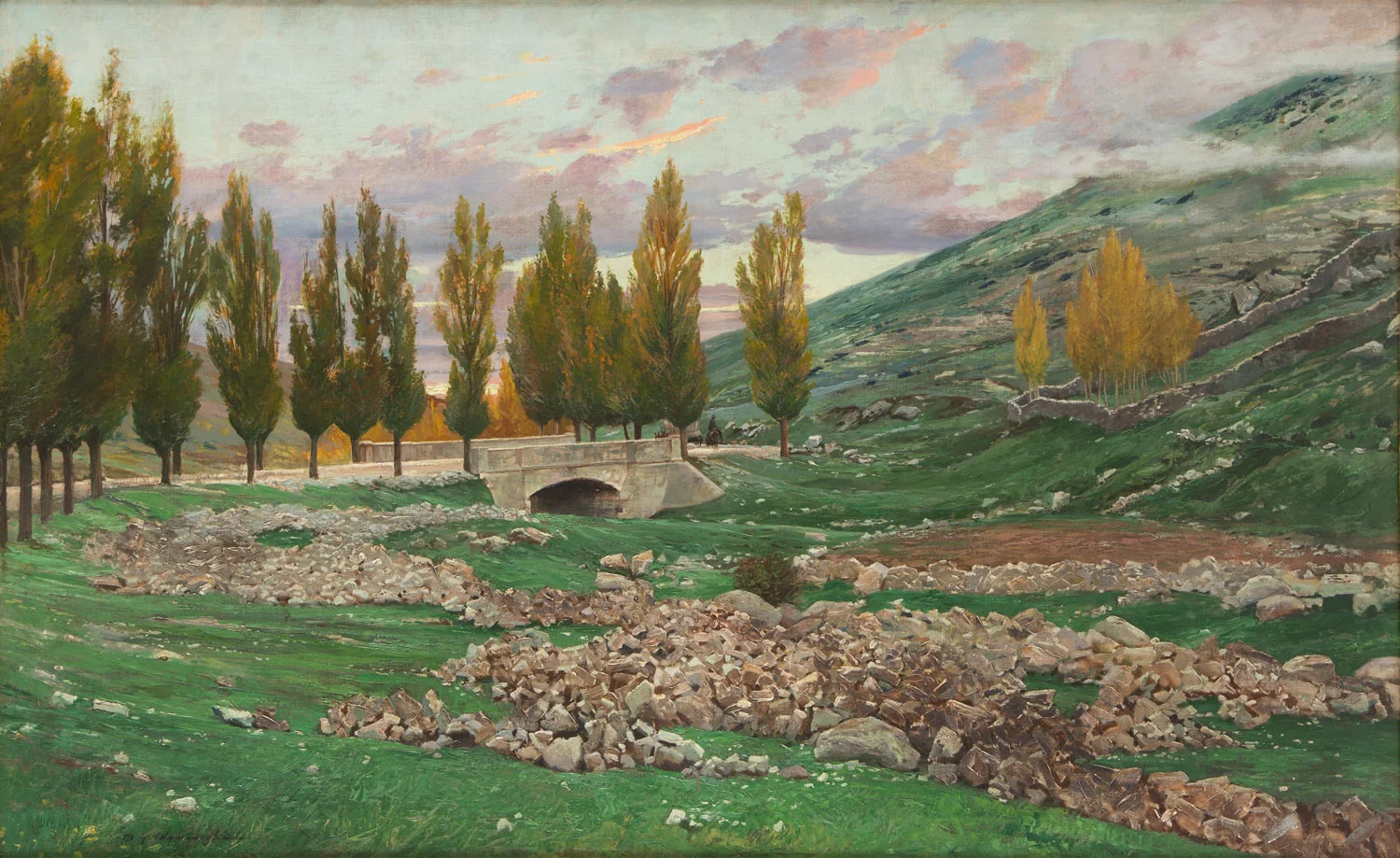
The work presented in the catalog most likely originates from this period. It shows a similarity to one of the four studies titled "Vivent les braves de braves," also known as "The Road from Burgos (North)" from 1900 (Museum of the Przemyśl Land in Przemyśl). The similar layout of the tree-lined avenue, the presence of a bridge, and the prominently accentuated mountain on the right side of the composition suggest a study for a landscape onto which Wojciech Kossak intended to paint battle scenes. Both works share the presence of rocky terrain and expanses of bare land visible in both Gorstkin's work and Kossak's piece. Thus, this work can be seen as part of the preparations for the panorama, with sketches shown at the 1901 exhibition of the Society for the Encouragement of Fine Arts.
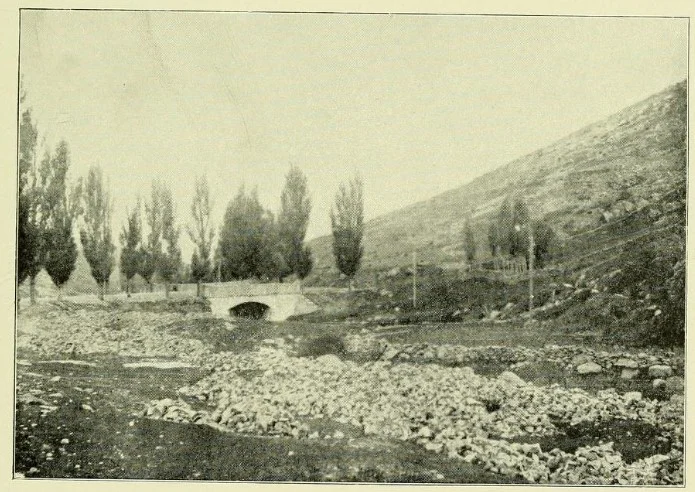
The characteristic palette, full of grays broken with violets, oranges, and greens, indicates the typical Munich manner of using muted colors to create a composition rich in tonal nuances. Despite its sketchiness, the work is a good illustration of Gorstkin's landscape style, detailed realism already showing the influences of impressionism. Compositionally, it matches the archival photograph taken during the artists' trip to Spain in 1899, later published in Kossak's "Memoirs."